
The Refusenik
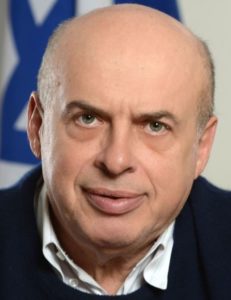 Anatoly Borisovich Sharansky (b. 1948) was born in Donetsk, Ukraine. He was a child chess prodigy, and won his city’s chess championship as a teenager. He went on to study math in Moscow and later worked in a secret Soviet research lab. In 1973, Sharansky applied for an exit visa to Israel and was refused. Henceforth, he became a vocal activist on behalf of Soviet Jewry, and became the world’s most famous refusenik. He soon expanded his scope to work for all human rights, and was the spokesperson for the Moscow Helsinki Group, today Russia’s primary human rights organization. In 1977, Sharansky was arrested on trumped-up charges of treason and espionage, and sentenced to 13 years of hard labour. He was tortured, and kept in solitary confinement for long periods of time. (He would later remark that one of the things that helped him through it was playing chess in his mind.) After ceaseless activism from his wife, mother, and countless international supporters, Sharansky was finally released in 1986. Shortly after, he received a Congressional Gold Medal from the US government. He moved to Israel and started going by his Hebrew name, Natan. A couple of years later, he published a bestselling memoir, Fear No Evil. (This book was passed on by Helen Suzman to Nelson Mandela, then still in prison, and inspired his ongoing struggle.) In 1995, Sharansky co-founded the Yisrael BaAliyah political party to advocate on behalf of hundreds of thousands of new Soviet Jewish immigrants to Israel. They won seven seats in their first election. Sharansky served as Minister of Industry and Trade, then Minister of Internal Affairs, and even Israel’s Deputy Prime Minister. In 2003, as chairman of his party, he merged it with Likud, and became Minister of Jerusalem Affairs. In 2005, Sharansky resigned in protest of Israel’s withdrawal from Gaza. He is a staunch supporter of Israeli settlements, and co-founded One Jerusalem, an organization that works to keep the Jewish capital from being divided ever again. President Bush awarded him the Medal of Freedom in 2006, and he won the Israel Prize in 2018. Last year, he won the prestigious Genesis Prize, and donated all $1 million of it for coronavirus relief. Currently, Sharansky heads the Institute for the Study of Global Antisemitism and Policy, and continues to serve on the board of the Jewish Agency.
Sharansky: The Dangerous Rise of the Un-Jews
Understanding the Arab-Israeli Conflict in 5 Easy Points
Words of the Week
Jews came here 3,000 years ago and this is the cradle of Jewish civilization. Jews are the only people in history who kept their loyalty to their identity and their land throughout the 2,000 years of exile, and no doubt that they have the right to have their place among nations—not only historically but also geographically. As to the Palestinians, who are the descendants of those Arabs who migrated in the last 200 years, they have the right, if they want, to have their own state… but not at the expense of the state of Israel.
– Natan Sharansky
 Yitzhak Yezernitsky (1915-2012) was born in what is now Belarus and spent his youth in Poland. As a young man, he joined Betar, the Zionist organization founded by
  Charles Ellis Schumer (b. 1950) was born in Brooklyn to a Jewish family with Russian, Ukrainian, and Polish ancestry. He scored a perfect 1600 on his SAT and went to Harvard, where he first studied chemistry before switching to law. He passed the bar in 1975, but went right into politics, having once been inspired when volunteering on a presidential campaign. Schumer was elected to the New York State Assembly straight out of law school. After three terms, he won a seat on the US House of Representatives. He served on the House for nine terms until 1998, when he ran for a Senate seat instead and won again. He has since been re-elected to the Senate three times, with consistently high approval ratings. In 2016, he was voted head of the Senate Democrats, making him the minority leader. Earlier this year, when the Democrats took control of the Senate, he became the majority leader. In both cases, Schumer became the first Jew (and first New Yorker) to hold the Senate leader title. Impressively, Schumer visits every single one of New York’s 62 counties every year to meet with his constituents. He has been praised for helping average New Yorkers deal with even minor issues that are not the role of a senator to address. Over the years, Schumer has worked hard to keep jobs and factories in America, and has been fiercely critical of China. In 2017, he tried unsuccessfully to get Trump to impose a ban on Chinese buyouts of American companies. (This week, he finally pushed through a massive $250 billion