Category Archives: Writers & Thinkers

Jews in the Wonderful World of Literature, Thought, and Scholarship

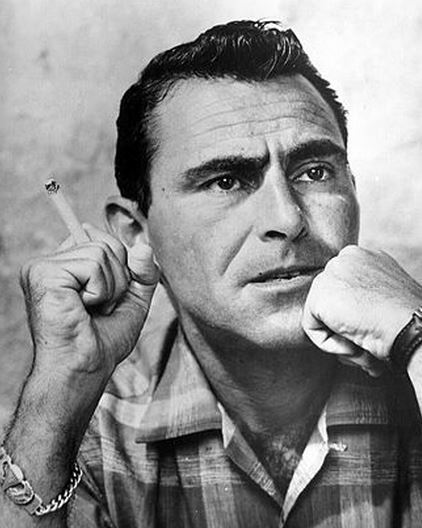
Jew of the Week: Rod Serling

The Twilight Zone

Rod Serling

Rod Serling

Rodman Edward Serling (1924-1975) was born in Syracuse, New York. From a very young age he was drawn to performing, spending hours each day acting in his basement. Initially a class clown, and thought to be a “lost cause” by his teachers, Serling was soon a key member of his high school debate team, a public speaker, journalist, athlete, and social activist. The day after graduating high school, he enlisted in the army and fought in World War II as a paratrooper, earning a Purple Heart and a Bronze Star, among other medals. After the war, he studied physical education, then switched to theatre, broadcasting, and literature. It was in his college days that he began writing, directing, and acting in radio programs. He struggled to break through in the radio industry for several years after, meanwhile earning money on the side by participating in dangerous flight experiments for the Air Force (and nearly getting himself killed on multiple occasions). He then tried his luck at television, and after many years of writing scripts, Serling finally got a break. His 72nd script, Patterns, earned many accolades and was described by some at the time as the best program in the short history of television. After this success, he had little worry finding jobs. However, corporate sponsors and politicians always meddled with his scripts. Fed up with this, Serling created his own show: The Twilight Zone. The series became an instant hit, and in 2013 was ranked as the third best TV show of all time. Serling went on to write and produce a number of other television, film, and radio programs. He also wrote many short stories and poems, and published 11 books. On top of this, Serling taught film and media at colleges across the US. Throughout his life, his primary goal was to spread awareness of human equality, world peace, and social justice. This was the underlying theme of all of his work, and Serling himself often stated that “the ultimate obscenity is not caring.” Sadly, Serling died at the young age of 50 from a string of heart attacks. He is credited with helping to establish television as a serious medium, and his episode of Patterns was the first TV rerun in history. He was ranked first among the “25 Greatest Sci-Fi Legends” by TV Guide. Serling won 8 Emmys, 3 Hugo Awards, and a Golden Globe, among others, and has been inducted into both the Television Hall of Fame and the Science Fiction Hall of Fame.

Words of the Week

As long as they talk about you, you’re not really dead, as long as they speak your name, you continue. A legend doesn’t die, just because the man dies.
– From an episode of The Twilight Zone (written by George Clayton Johnson)

Jew of the Week: Saadia Gaon

Depiction of the Sura Academy

Depiction of the Sura Academy

Sa’adiah ben Yosef (c. 882-942) was born in Fayum, Egypt. His family moved to Israel while he was still very young, and he began his Torah studies at the famous academy of Tiberias. By the time he was 20, he completed his first work, Agron, possibly the first official Hebrew dictionary. Sa’adiah went on to write over two dozen significant texts in both Hebrew and Arabic, including Emunot v’Deot, thought to be the first Jewish work that blended Jewish teachings with science and Greek philosophy. He also translated the entire Torah into Arabic, and wrote a deep commentary on top of it, together with many other books of the Bible. At the time, the vast majority of Jews in the world lived in Arabic lands, so this translation served a monumental role in helping spread Jewish learning. Sa’adiah also authored a number of legal treatises, and translated the mystical Sefer Yetzirah into Arabic, adding his own commentaries that weaved together both esoteric and scientific explanations. Sa’adiah is credited with being a key force in Judeo-Arabic culture, and inspiring a “renaissance” in Jewish-Arabic literature. Meanwhile, he played an instrumental role in defending traditional Judaism in the face of the rising Karaite sect, a cause he fought for until his last days (at times risking his life). For his great wisdom and tireless work on behalf of the Jewish community, Sa’adiah was appointed “Gaon” in 928. The title Gaon (literally “genius”) was given to the head of the Sura Academy, then the leading body of Jewish scholarship in the world. Sa’adiah Gaon died in Baghdad at the age of 60, having inspired a new generation of Torah scholars. Two hundred years later, the great Maimonides wrote: “Were it not for Rav Sa’adiah Gaon, the Torah would have almost disappeared from the Jewish people, for it was he who shed light on that which was obscure, strengthened that which had been weakened, and spread the Torah far and wide, by word of mouth and in writing.”

Words of the Week

The birds and many of the land animals forbidden [to eat] by the Torah are predators, while the permitted animals are not. We are commanded not to eat those animals possessive of a cruel nature, so that we should not absorb these qualities into ourselves.
– Nachmanides (the Ramban)

Jew of the Week: Jonathan Sacks

The Rabbi Baron

Rabbi Lord Jonathan Sacks

Rabbi Lord Jonathan Sacks

Jonathan Henry Sacks (b. 1948) was born in London, England, and studied at some of London’s finest schools, earning a Ph.D in philosophy in 1981. In the same year, he received his orthodox rabbinic ordination from Jew’s College, the world’s oldest rabbinic seminary. He went on to become principal of that seminary, while also serving as a community rabbi. In 1991 he was appointed as the British Commonwealth’s Chief Rabbi. He remained in this role for 22 years until retiring last September. Over the years, he taught as a visiting professor at several universities. He also authored 25 books, among them award-winning bestsellers. He was a popular guest on BBC Radio and TV programs, and wrote a regular column for The Times. Sacks holds 16 honourary degrees, together with a number of international awards for his work in promoting social justice and religious liberty, scholarly achievement, leadership, and inspiring Jewish life around the world. In 2009, he was introduced to England’s House of Lords, and was granted the title “Baron”. He was invited to the wedding of Prince William and Kate as the representative of the Jewish community. The Prince of Wales described Sacks as a “light unto this nation… whose guidance on any given issue has never failed to be of practical value and deeply grounded in the kind of wisdom that is increasingly hard to come by.” Former British Prime Minister Gordon Brown described him as “…the greatest scholar I know, the greatest philosopher, the greatest writer I know, one of the greatest thinkers in the world…” Sacks continues to teach as a professor at New York University, Yeshiva University, and King’s College London. He is also a vegetarian.

Update: Sadly, Rabbi Jonathan Sacks passed away on November 7, 2020.

Words of the Week

“A good leader creates followers; a great leader creates leaders.”

“To defend a country you need an army, but to defend a civilization you need education.”

“Technology gives us power, but it does not and cannot tell us how to use that power. Thanks to technology, we can instantly communicate across the world, but it still doesn’t help us know what to say.”

– Rabbi Lord Jonathan Sacks