“The Jewish Avenger”
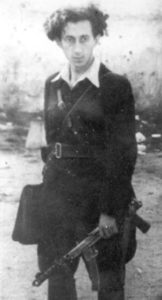 Abel “Abba” Kovner (1918-1987) was born in what is today Belarus and grew up in Vilnius (then part of Poland). As a young man, he was a member of HaShomer HaTzair, the Zionist youth movement. When the Nazis invaded Vilnius in 1941, Kovner escaped to a convent, but soon returned to the Vilna Ghetto to organize a Jewish resistance. At the start of 1942, Kovner secretly published a manifesto inside the Ghetto to inspire the Jews to fight back, writing that it was better to die than “go like lambs to the slaughter”. Along with several other young men, Kovner formed the United Partisan Organization, possibly the first armed underground Jewish group in Nazi Europe. Before they could launch their first large-scale attack, the Vilna Ghetto was liquidated in 1943, forcing the group to flee to the surrounding forests. From there, they launched a guerrilla warfare campaign against the Nazis. The small group began calling themselves “the Avengers” (HaNokmim) and were successful enough to draw the attention of the Red Army. They would go on to coordinate with the Soviets to crush the Nazis in Eastern Europe. Once the fate of the Nazis was sealed towards the end of 1944, Kovner was among the founders of a new group, called Bricha (“Escape”), which worked to get Jewish refugees out of Europe and to the Holy Land. Over the next couple of years, they would successfully move 250,000 Holocaust survivors to Israel. Having seen first-hand the horrific devastation inflicted by the Nazis, Kovner yearned for revenge. He started yet another group, called Nakam (“Vengeance”), seeking to punish Germany for the Holocaust. “Plan B” was to poison the water supply in Allied prisoner-of-war camps where Nazi SS soldiers were kept. The far more controversial and shocking “Plan A” was to poison the water supplies of several major German cities in order to kill 6 million Germans, one for each Jew lost in the Holocaust. Thankfully, Plan A was soon abandoned, though Kovner was still arrested by the British and held in a Cairo prison for several months. He did aim to accomplish Plan B, and Nakam members infiltrated a POW camp bakery in April 1946, coating the loaves of bread with arsenic. Over two thousands German soldiers fell ill, though no deaths were reported. In December 1947, Kovner joined the Haganah and fought in Israel’s Independence War as a captain of the Givati Brigade. Following this, he lived out the remainder of his life in a kibbutz, working tirelessly to strengthen the nascent state. He also helped to design several Holocaust museums, and testified at the Eichmann trial. More famously, Kovner wrote a series of poetry books (in Hebrew and Yiddish) describing the struggles he faced during the Holocaust and in Israel’s early years. This made him one of the country’s most celebrated poets and writers. For this, he won the Israeli Prize for Literature in 1970. A heavy smoker, Kovner succumbed to tracheal cancer before his 70th birthday.
Words of the Week
It is perfectly clear that the Arab nations do not want to solve the Arab refugee problem. They want to keep it as an open sore, as an affront against the United Nations, and as a weapon against Israel… Arab leaders don’t give a damn whether the refugees live or die.
— Sir Alexander Galloway, former head of UNRWA
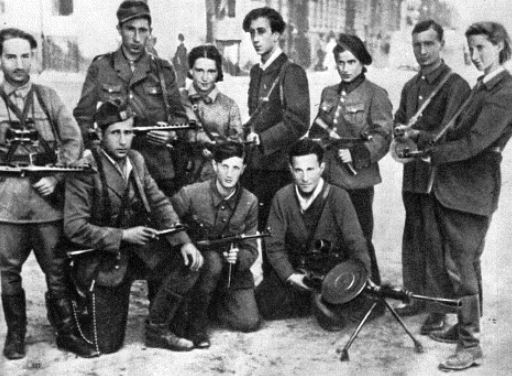
Abba Kovner (Centre) and his Avengers.
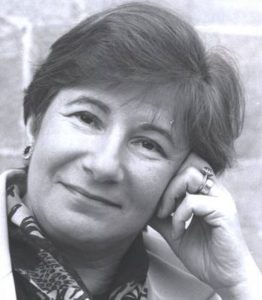 Ruth Lynn Fraenkel (b. 1943) was born in London to Jewish-Polish refugees who fled the Nazis. She studied law at Oxford University’s prestigious St. Anne’s College, and there met her future husband John Deech. After getting her MA, she briefly taught law at Windsor University in Canada, then returned to St. Anne’s and taught there for two decades before being elected its principal in 1991. As a specialist in family law and bioethics, she also headed Oxford’s Health Authority, and eventually became the governor of the UK Department of Health’s Human Fertilisation and Embryology Authority (HFEA). The HFEA regulates fertility treatments, in-vitro fertilization, and embryological research across the UK. As its governor, Deech made some difficult and controversial decisions, including one case where a woman was forbidden from having a baby with her dead husband’s frozen sperm. She also fought against the decision to allow birth certificates not to name a father, stating “I regret the downgrading of the father as a person of importance – the legislative dismissal of the contribution of half the population to the upbringing of the next generation” and that “Tolerance of both types of parenting has to be ensured.” In 2002, Deech was knighted as a Dame Commander of the Order of the British Empire. That same year she was appointed governor of the BBC. Following this role, she was made a life peer of the House of Lords, and given the title Baroness Deech of Cumnor. At the same time, she served as the chairman of the Bar Standards Board, which regulates lawyers across England and Wales, and sat on the Jewish Leadership Council. Deech remains one of the world’s most renowned academics and ethicists. Oxford University recently named one of its buildings after her, and she was once ranked on “The God List” of the fifty most influential “people of faith” in Britain. She also regularly stands up for the Jewish community, and for Israel – at
  Dennis Mark Prager (b. 1948) was born in New York City to an Orthodox Jewish family. He attended religious schools, and during his time at the Yeshiva of Flatbush met the future renowned rabbi Joseph Telushkin. Prager majored in history and Middle Eastern studies at Brooklyn College before spending several years at Columbia University studying both the Middle East and Russia, followed by a stint at the University of Leeds learning Arabic and comparative religions. In the mid-70s, Prager teamed up with Rabbi Telushkin to co-author The Nine Questions People Ask About Judaism. The bestselling book was a huge success and shot Prager into the spotlight. Shortly after, he was hired to be the director of the Brandeis-Bardin Institute of the American Jewish University. (He would later teach Hebrew Bible at the University between 1992 and 2006.) In 1982, he met an executive of Los Angeles’ KABC Radio who was struck by Prager’s impressive knowledge, and instantly hired him to host a Sunday radio show called Religion on the Line. It was so popular that Prager was soon doing radio shows every day except Friday and Saturday (because of Shabbat). Meanwhile, he co-authored another bestseller with Rabbi Telushkin, Why the Jews? The Reason for Antisemitism. By 1999, Prager’s radio show was nationally syndicated, as was his newspaper column. He was called “One of America’s five best speakers”, as well as “one of the three most interesting minds in American Jewish Life”, and was described by the LA Times as “An amazingly gifted man and moralist”. All in all, Prager has published seven books (including The Ten Commandments: Still the Best Moral Code) and produced five films (including Israel in a Time of Terror, and the forthcoming No Safe Spaces about the extremes of political correctness). He continues to host one of America’s most popular radio shows, and is among the most sought-after political commentators in the world. Today, Prager is perhaps most famous for his Prager University, which he co-founded in 2009 in response to the growing trend of squashing conservative voices in the media and on campus. PragerU’s concise and informative five-minute videos have become hugely popular. To date, they have garnered over 1 billion views, with hundreds of millions of followers across social media sites. The videos have been so successful that PragerU has been called “the right-wing YouTube empire that’s quietly turning millenials into conservatives.” Perhaps because of this, Google recently started blocking some of PragerU’s videos, perplexingly citing them as “inappropriate”. Regardless of whether one agrees with Prager’s views or not, the blatant suppression of free speech sets a dangerous precedent. For this reason, Prager has launched a lawsuit against Google and YouTube, together with a campaign to draw support for the preservation of free speech (see their video,