The Philanthropist Behind PJ Library

Harold Grinspoon (Credit: Robert Charles Photography)
Harold Grinspoon (b. 1929) was born and raised in Newton, Massachusetts to a family of Jewish-Russian immigrants. He had a difficult childhood, struggling with dyslexia and rampant anti-Semitism, poverty, and losing his father at 19. While a student at Marlboro College, he had his first business idea: Putting together some meagre savings, he bought an old laundry machine and put it in the college dorm, charging 25 cents per load. Meanwhile, he worked on an ice cream truck and soon left school to manage a whole fleet of them. After serving in the Navy, Grinspoon bought his first property in 1959. He renovated it and rented out one of the units, and from there steadily built his real estate development business. He founded Aspen Square Management, now one of America’s top-50 private developers, with 15,000 apartments across 16 states. When diagnosed with cancer at age 59, Grinspoon realized he wanted to do something more meaningful with his life. He was particularly troubled by Jewish assimilation and intermarriage. Together with his wife, he founded the Harold Grinspoon Foundation to fund a variety of Jewish causes, and has since donated over $200 million. At one Passover seder, Grinspoon saw how excited his grandkids were to read Jewish books, and came up with the idea of sending a free Jewish book once a month to every Jewish home. Thus, in 2005 he launched PJ Library. Today, PJ Library operates around the world, delivering nearly 1 million free books each month to kids in some 30 countries. PJ Library also delivers popular Arabic-language books to Arab Israeli children. (It’s the largest Arabic book program in the world!) Meanwhile, PJ Library runs weekend and after-school programs, along with over 3000 events a year. The Harold Grinspoon Foundation funds other Jewish programs, too, including Jewish camps and day schools. In 2015, Grinspoon signed The Giving Pledge to donate more than half of his wealth. Grinspoon and his PJ Library have won a number of prestigious awards, including one from the Library of Congress. Grinspoon has been called “the most important Jewish philanthropist you’ve never heard of”. He is also an avid artist and sculptor, and is still very active at 92 years old. Sign up to PJ Library here!
Words of the Week
We are indignant when we are fooled by others but live comfortably with our unconscious desire for self-deceit.
– Rabbi Abraham Joshua Heschel
 Don Manuel Pimental (d. 1615) was born to a family of Sephardic Jews who had been forced to convert to Christianity in the decades prior. Pimental became a wealthy merchant, trading with the Muslims under the name Isaac ibn Jakar. He soon converted back to Judaism, and did a lot of work on behalf of the many struggling Jewish communities at the time. Despite the ban on Jews living in France, he settled there anyway and became best friends with King Henry IV. The two played cards together regularly, and it is reported that after one 1608 game in the palace, King Henry said: “I am the king of France, but you are the king of gamblers!” Many didn’t like the fact that the king was so close to a Jew, but Henry defended his friend with the following words: “Those who honestly follow their conscience are of my religion, and mine is that of all brave and good men.” A couple of years later, a Catholic fanatic assassinated King Henry IV for being too friendly with Protestants and Jews. Pimental had to flee, and spent three years in Venice. He then joined his friend Samuel Pallache, the famed “
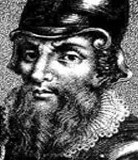 Fernão de Loronha (c. 1470-1540) was born in Lisbon, Portugal to a Sephardic Jewish family that had been forcibly converted to Christianity by the Inquisition. Like many such families, they continued to practice Judaism in secret. Loronha became a wealthy merchant, and also worked for the German Augsburg banking family. He was knighted by King Manuel I of Portugal (and for this reason, was often associated with the Noronha nobility, being incorrectly referred to as “Fernando de Noronha”.) In 1501, he financed a Portuguese expedition to explore the newly-discovered lands of South America, then called Vera Cruz. Scholars believe his primary motivation was finding a new home for persecuted Jews, where they could finally live free of the Inquisition. Some say Loronha captained the expedition himself, and we know for sure that on board was Amerigo Vespucci (after whom “America” is named). At the time, Europeans imported expensive red dyes made from brazilwood from India. Loronha came back to Portugal in 1502 describing the abundant brazilwood in the new lands and the opportunity for great riches. King Manuel gave him an exclusive ten-year charter for all the commercial rights to brazilwood in Vera Cruz. In exchange, Loronha had to send at least six ships per year on behalf of Portugal, build a fort for the Portuguese military, explore new coasts, and pay the crown 4000 ducats per year. His first six-ship fleet set forth the following year, establishing the first brazilwood factories in the New World. Soon, vast amounts of the precious dye were being imported to Europe, making it the continent’s second most valuable commodity (after gold). The fleet also discovered a new group of islands, which Vespucci named São Lourenço, or São João. Shortly after, a grateful King Manuel gave the islands as a gift to Loronha and his descendants, and made him the first official donatario (“administrator”) in South America. Today, the idyllic islands are still referred to as “Fernando de Noronha” in his honour. Unlike many other colonists, Loronha did not employ slaves, and obtained all the brazilwood through trade with local natives. Most interestingly, it was Loronha who was responsible for renaming the new land to “Brazil” instead of its original name, Vera Cruz. Still a Jew at heart (and soul), Loronha did not want to use the Christian term Vera Cruz (meaning “True Cross”), so he would always refer to it in all of his business dealings as “Brazil” instead. The new name stuck. Similarly, he renamed his main ship from São Cristóvão (“Saint Christopher”) to A Judia (“The Jewess”). In 1506, his crew on that ship discovered a set of islands in Mozambique, named Bassas da Judia. Today, the name has been corrupted to “Bassas da India”.