
Category Archives: Business & Finance

Jews in the World of Business and Finance

Jews of the Week: Dov Moran, Dan Harkabi, and the USB Key

Dov Moran

The Universal Serial Bus (USB) key was invented in Israel by a tech company called M-Systems. The company was founded in 1989 by Dov MoranĀ (b. 1955), a graduate of Haifa’s Technion Institute. Their first major project was creating an easy to use digital storage device that could hold a great deal of information in a small space. In 1995, M-Systems released DiskOnChip, the first ever flash drive. Building on this success, M-Systems patented the DiskOnKey in April 1999. The technology was quickly licensed by IBM and debuted in the US in late 2000, known as the USB Key. With 8 Mb of storage, it held over 5 times more data, wrote 10 times faster, and was far more durable (and smaller) than the standard floppy disk. The USB rapidly rose to popularity, and is now the most ubiquitous personal digital storage device.
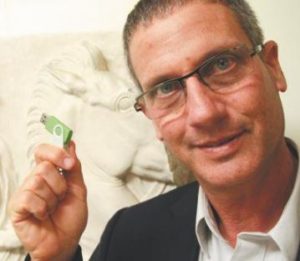
Dan Harkabi

The project to develop the USB was led by Dan Harkabi, along with Amir Ban, Oron Ogdan, and company founder Dov Moran. In 2006, M-Systems was acquired by competitor SanDisk for $1.6 billion. Moran went on to start a company called Modu, which was acquired by Google in 2011. He now chairs two more Israeli tech companies, and recently launched a new start-up called Comigo, which is building systems to intertwine handheld devices with televisions. Meanwhile, Dan Harkabi – who served in the Israeli Air Force for over 20 years – is CEO of Picosmos, where he continues to work on flash drive technology.

Words of the Week

The tongue is secured behind the teeth and behind the lips, yet there is no end to the damage it causes. Imagine if it were outside!
Yalkut Shimoni

Jews of the Week: Ralph Lauren and Michael Kors

Michael Kors and Ralph Lauren

Listed by Forbes among the richest people in the world, Ralph Lauren (b. 1939) was born Ralph Lifshitz to Polish-Belorussian immigrants in the Bronx. He began selling ties to his classmates at the Marsha Stern Talmudical Academy. Lauren then studied at Baruch College, followed by several years in the US Army, after which he became a tie salesman. For a long time he would struggle to make a living, until he was finally able to open his own tie store in 1967, called Polo. As his success grew, Lauren released several men’s clothing lines. Today, Polo Ralph Lauren is a multi-billion dollar company. Interestingly, Lauren owns a rare car collection with over 70 unique vehicles – one of the greatest collections in the world. He is also a knight of the French legion.

A fellow New Yorker, Karl Anderson (b. 1959) was born to a Swedish father and Jewish mother. He changed his name to Michael Kors at age 5 when his mother remarried. Influenced by his mother’s modelling career, Kors began designing clothes as a teen and selling them out of his parents’ basement. He was discovered soon after while studying at New York’s Fashion Institute of Technology. After working for French fashion giant Celine for many years, Kors left to focus on his own label, which has quickly grown to huge popularity globally. Aside from the fashion world, Kors received the Oliver R. Grace Award for Distinguished Service in Advancing Cancer Research.

Words of the Week

You create your own universe as you go along.
– Winston Churchill

Jews of the Week: The Warner Brothers

Few people know that the Warner Brothers that brought you hundreds of great films (such as The Dark Knight and The Matrix trilogies) and amazing television programs (Bugs Bunny and the Looney Tunes) were Jewish immigrants from Poland. Their names were Hirsch Moshe, Avraham, Shmuel and Yakov. Struggling to make a living, the family moved to the U.S., then to Canada, then back to the U.S., at which point the father of the brothers adopted the name Warner, changing it from Wonsal. The brothers worked in various odd jobs – bowling alleys, bicycle shops, meat salesmen – until they finally pooled their earnings and invested in a film projector. They would travel across small mining towns and put on film screenings. Once they saved enough money, they opened a proper theatre in Pennsylvania. It was such a success that they could soon afford to open more than a dozen other theatres.

During World War I, the brothers began experimenting with making their own films. In 1918, they officially opened Warner Brothers Studio in Hollywood, with their first popular film My Four Years in Germany. However, WB only made it big with their famous dog Rin Tin Tin, a German shepherd rescued by an American soldier. The dog became such a celebrity that WB signed Rin Tin Tin to star in films for $1000 per week – a great deal of money at the time. WB’s fame continued to rise, and by 1924 they were already the most successful independent studio in Hollywood. WB became a pioneer in motion pictures, and was the first studio to produce a “talking picture”, sparking the “talkie” revolution and changing the course of film. They would do this again in the 1930s, ushering in the “realistic” film period, as well as popularizing children’s cartoons. The success of Warner Brothers would continue to grow over the decades and their reach was extended to music (Warner Brothers Records), television (the WB Network) and even comic books (DC Entertainment). Thanks to the success of the Harry Potter films, WB became the first studio to gross over $2 billion domestically in just one year. They continue to produce hits and elevate film-making to new heights.

Words of the Week

“Who the heck wants to hear actors talk?”
Hirsch “Harry” Warner, when first hearing of the talking picture.