The Unbelievable True Story of the Real Founders of Zionism
Yehuda Aryeh Leon Bibas (1789-1852) was born in Gibralter to a long line of Sephardi rabbis. After his father’s untimely death, the young Bibas moved to Livorno to be raised by his grandfather. There, he studied both at the yeshiva and the university, becoming a rabbi and physician. He returned to Gibralter to head its yeshiva, attracting many students from across Europe and North Africa. In 1831, he was appointed chief rabbi of Corfu (a Greek island that had a large population in those days). Over the next decade, he understood the terrible predicament that Jews were in, and resolved that restoring an independent Jewish state in the Holy Land was the only solution. In 1839, he embarked on an international tour to encourage Jews all over the world to make aliyah. Some credit him with being the first prominent figure to do so in modern times. He was supported by the great Moses Montefiore, a wealthy Sephardic Jew who financed the first printing press and textile factory in the land of Israel, refurbished many of its Jewish holy sites, and established several Jewish agricultural colonies.
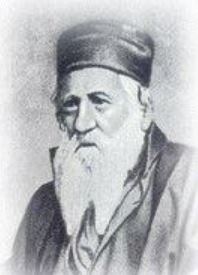
Rabbi Alkali
It was during Rabbi Bibas’ global tour that he met Rabbi Yehuda Alkali (1798-1878). Rabbi Alkali was born in Sarajevo and studied in Jerusalem under the tutelage of the holy city’s greatest Kabbalists. He went on to become the chief rabbi of Semlin, Serbia. Partly inspired by Serbia’s own nationalist movement, and further spurred by an 1840 blood libel against the Jews of Damascus, Rabbi Alkali was convinced that Jews must have a state of their own after meeting Rabbi Bibas. Rabbi Alkali established the Society of the Settlement of Eretz Yisrael and began a campaign to encourage Jews to settle in their ancestral home. Based on a famous prophecy in the Zohar, Rabbi Alkali proclaimed that the year 1840 would be the start of the process of Redemption, and that it would take one hundred years to accomplish. In an incredible prediction, he said that if Jews failed to take advantage of this spiritually-auspicious century, then by 1940 the Redemption would begin anyway, but in a much more difficult way, and only through “an outpouring of wrath will our dispersed be gathered”. History has eerily confirmed his prophecy. More amazing still, Rabbi Alkali published a book in 1857 titled Goral L’Adonai (“Lot for the Lord”) which clearly outlined the steps to re-establish a Jewish state in Israel. He presented one of the first copies of the book to his dear friend, and a member of his Semlin synagogue, named Simon Loeb Herzl. This happened to be the grandfather of Theodor Herzl, who would inherit the book. Scholars agree that Rabbi Alkali and his 1857 treatise played a major role in influencing Theodor Herzl, and thus the whole Zionist movement. In fact, it was Rabbi Alkali who first proposed restoring Hebrew as the primary spoken language of the Jews, who argued that the Holy Land should be legally purchased piece by piece, and that Jews must re-learn to become agriculturalists for the whole endeavour to work. (All three of these things would soon materialize.) Both Rabbi Bibas and Rabbi Alkali practiced what they preached and made aliyah to Israel. Rabbi Bibas first joined his disciples in Yaffo, then moved to Hebron and opened a library. He passed away shortly after, and is buried in Hebron’s Jewish Cemetery. Rabbi Alkali, meanwhile, founded a settlement near Jerusalem and lived there for the remainder of his life. He is buried in Jerusalem’s Mount of Olives Cemetery.
Did You Know These Famous People are Sephardic Jews?
Words of the Week
It was a city of wonders. Everything was written in Hebrew. People were speaking Hebrew. I thought, This is redemption. This is the city of the Messiah.
– Amnon Shamosh, Syrian-Israeli novelist, on first arriving to Tel-Aviv in 1937
 Edith Stern (b. 1952) was born in Brooklyn to impoverished Holocaust survivors who had married in the Warsaw Ghetto. Her father, Aaron Stern, had been a professor of languages (he was fluent in seven). When his daughter was born, he called a press conference – to which two reporters showed up – and declared: “I shall make her into the perfect human being.” Thus began what journalists at the time called “the Edith Project”. Stern immediately immersed his daughter in learning. He exposed her only to classical music, talked to her all the time, and taught her with flash cards. Suffering from jaw cancer and unable to work, Stern spent all of his time with Edith. By the age of 5, Edith had read through the entire Encyclopedia Britannica. Although her father did not believe in IQ tests, she nonetheless scored a 205 that same year. Edith enrolled in college at 12, earned her BS in mathematics by 15, and her Master’s at 18. By this point, she was already teaching at Michigan State University. She went on to defend her Ph.D and joined IBM’s R&D division. Today, Stern holds over 100 patents for technological innovations used in telephones, digital media, video conferencing, self-driving cars, and the internet. Stern is still a “distinguished engineer” at IBM, where she is a VP, and recently won the Kate Gleason Award for lifetime achievement in technology. Although her mother once disagreed with her father about his methods, she later concluded that it had made her a “very mature, compassionate, kind, intelligent and wise young woman.” Her father maintained that being a genius has little to do with genetics, and everything to do with how a child is raised and educated. He wrote in his 1971 The Making of a Genius: “I can foster the same meteoric IQ in the children of the Tasaday tribe, a Stone Age people living in the Philippines.”
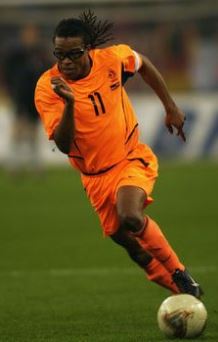 Edgar Steven Davids (b. 1973) was born in Suriname to an African-Surinamese father and a Dutch-Jewish mother. The family moved to the Netherlands when Davids was still a child, and the boy grew up immersed in soccer. By age 12, he signed on with Amsterdam Ajax, a team known for its “Jewish” character. (This is probably due to the team’s origins in pre-war Amsterdam, which had a huge Jewish population and was then nicknamed “Jerusalem of the West”. Today, Amsterdam is still known by the locals as “Mokum” from the Yiddish-Hebrew word meaning “place”). Davids soon led Ajex to three national championships. He also led the team to the finals in several UEFA tournaments. It was while playing for Ajax that he earned his nickname, “the Pitbull”. Davids moved to Italy in 1996 and played for AC Milan and Juventus. His greatest success was in Turin, where he led the team to multiple championships, and was described as a “one-man engine-room”. During this time, he underwent surgery on his right eye (for glaucoma from a previous injury), and henceforth wore his trademark protective glasses. In 2004, he joined Barcelona and immediately changed the team’s fortunes. The struggling club suddenly went on a hot streak, winning all but two games in the rest of the season, and going on to dominate the European football scene for a decade. Davids timely presence has been credited with this huge shift in the club’s history. Davids also played for the Dutch national team in multiple FIFA and Euro Cups, twice being named to the all-star “Team of the Tournament”. In 2002, he was chosen to be one of the stars in a Nike commercial for that year’s FIFA World Cup. The premise of the ad was a “secret tournament” for the world’s “24 elite players”. The