Tag Archives: Yiddish

Jew of the Week: Leonard Nimoy

The World’s Most Popular Alien

Nimoy Demonstrating the Kohanic Blessing Sign/Vulcan Salute

Nimoy Demonstrating the Kohanic Blessing Sign/Vulcan Salute

Leonard Simon Nimoy (1931-2015) was born in Boston to Orthodox Jewish-Ukrainian immigrants. He began performing in the Yiddish theatre when he was eight years old, and was encouraged to pursue a career in acting by his grandfather, against his parents’ wishes. He got his first role at 17, acting in a play about a Jewish family’s struggles during the Great Depression. Following this, he studied at Boston College, and made a living by selling vacuums, working in an ice cream shop, and at the National Yiddish Book Center. He then served for a year and a half in the US Army Reserve and earned the rank of sergeant. Nimoy continued to pursue his passion, though with very little success. He played tiny roles in over fifty movies, and had to deliver newspapers and drive a taxi at the same time just to get by. Finally, Nimoy got his big break when he was cast as Spock in Star Trek, which premiered in 1966. Spock quickly became one of “the most popular alien characters ever portrayed on television”. He played the TV role until 1969, for which he received three Emmy nominations. Nimoy improvised the famous Vulcan salute from his experiences at the synagogue as a child, where he watched the Kohanim bless the congregation. Nimoy adopted the Kohanic hand gesture, and adapted the Hebrew wording of the blessing to the Vulcan “live long and prosper”. He also invented the famous “nerve pinch” (to make a person unconscious), which has been both spoofed and adopted countless times in literature, television, and film. Nimoy played Spock again in eight Star Trek movies, including the most recent in 2013, and he directed two of them himself. Aside from this, Nimoy played in the original Mission: Impossible TV series (from which the Tom Cruise films were adapted), as well as many other movies and TV roles, together with a number of highly acclaimed stage performances (including Tevye in Fiddler on the Roof). Nimoy was also a photographer, producer, pilot, poet, writer (publishing two autobiographies), and musician, releasing five albums! All in all, Nimoy starred in 53 films, appeared in over 45 TV shows, 5 video games, and 3 music videos. Throughout his life, he was very active in the Jewish community, voicing a documentary about Hasidic Jews, leading a project to record Yiddish children’s stories, and preserving the Yiddish language, as well as dedicating much of his time to Holocaust remembrance. Nimoy passed away last week, aged 83. His former co-star George Takei said of him: “The word extraordinary is often overused, but I think it’s really appropriate for Leonard. He was an extraordinarily talented man, but he was also a very decent human being.”

Purim Begins Tonight!

Words of the Week

“Logic is the beginning of wisdom, not the end.”
“When you let me take, I’m grateful. When you let me give, I’m blessed.”
“The miracle is this: the more we share, the more we have.”
– Leonard Nimoy
Jew of the Week: Elie Wiesel

Messenger to Mankind

Elie Wiesel

Elie Wiesel

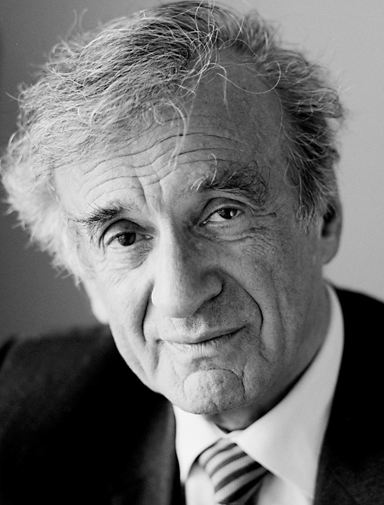
Eliezer Wiesel (b. 1928) was born in Romania in a home that regularly spoke Hungarian, German, Romanian, and Yiddish. During the Holocaust he suffered in multiple labour and concentration camps, including Buchenwald and Auschwitz, and lost both parents and a younger sister. After the war, he resettled in Paris, studied at the Sarbonne, and worked as a journalist. In 1949, Wiesel became the Paris correspondent (later the international correspondent) for Yediot Ahronot. Though originally not wanting to write at all about the horrors of the Holocaust, he was convinced by a friend and published Night in 1958 – a shortened French version of his 900-page memoir in Yiddish. Though it took a while to hit the mainstream, the book now sells hundreds of thousands of copies every year and has been translated into 30 languages. Wiesel has subsequently authored many more publications, and has become an internationally-renowned speaker. In 1986, he won the Nobel Peace Prize for his efforts against racism, violence, and genocide, and was called a “messenger to mankind”. He has also won the Presidential Medal of Freedom, the Congressional Gold Medal, and was knighted, among many other awards. He has even been nominated as President of Israel, but did not wish to take up the post. Wiesel has taught at Boston and Columbia Universities, the City University of New York, and served as a visiting scholar at Yale. He has spent a great deal of his life as a political activist for international causes. He stood strongly against apartheid South Africa and raised support for intervention during the Bosnian genocide, and more recently in Darfur. He has assisted the plight of Kurds, Native Americans, Argentinian Desaparecidos, as well as Soviet and Ethiopian Jewry. Wiesel remains a vocal supporter of Israel, and Jerusalem as its undivided capital. For the past 58 years, he has lived in the US and to this day has authored 57 books.

UPDATE: Sadly, Elie Wiesel passed away on July 2, 2016.

Words of the Week

For me, the Jew that I am, Jerusalem is above politics. It is mentioned more than six hundred times in Scripture – and not a single time in the Koran.
– Elie Wiesel

Jew of the Week: Franz Kafka

Franz Kafka

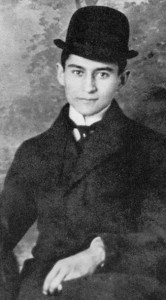
Franz Kafka (1883-1924) was born near Prague to Yiddish-speaking parents, the grandson of a shochet (kosher meat slaughterer). His Jewish education culminated with his bar mitzvah, after which he went to the prestigious Altstädter Deutsches Gymnasium. He enrolled to study chemistry in university, but quickly switched to law. After graduating, he worked for various insurance companies – a job that he despised, but which allowed him to make a living. The little time that he had off work he would spend writing. Kafka composed dozens of stories, novels (most of them unfinished), essays, letters and diaries. Ninety percent of these he burned. In his will, he instructed his friend Max Brod to destroy the remainder of his writings. Brod ignored the request, and published them instead. Thus, Kafka was virtually unknown in his own lifetime, but became hugely famous after his death. It is believed that there are still thousands of unpublished Kafka works. He is considered by many to be the greatest writer of the 20th century, and some of his writings have been ranked among the most influential of that century. He has inspired the adjective “kafkaesque”, and has an asteroid named after him. Besides writing, Kafka was an avid swimmer, hiker, and rower, studied alternative medicine, and was a vegetarian. After once seeing a Yiddish play, he immersed himself in Jewish study. In addition to Yiddish, Kafka spoke German, Czech, French, and studied both Hebrew and classical Greek. Towards the end of his life he intended to immigrate to Israel. This wish did not come to be, as Kafka succumbed to tuberculosis at a young age. His three sisters perished in the Holocaust. For what would be his 130th birthday today, he is honoured with a Google Doodle.


Words of the Week

Anyone who keeps the ability to see beauty never grows old.
– Franz Kafka