
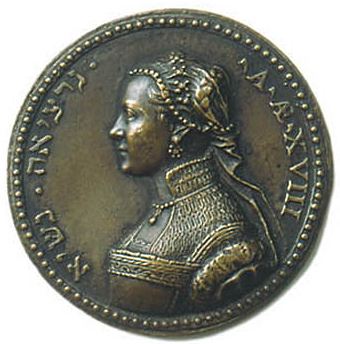
Commemorative Medal of Dona Gracia Mendes
Hanna ‘Gracia’ Nasi (1510-1569) was born in Lisbon, Portugal to a family of conversos – aka Marranos, Jews who were forcibly converted to Christianity – and named Beatriz de Luna Miquez. She married Francisco Mendes Benveniste, a wealthy spice trader and banker. When she was only 28, Gracia’s husband passed away, leaving the business to her and his brother. Gracia thus joined her brother-in-law in Antwerp (then part of the Spanish Netherlands). From there, she organized an escape network for Jews to flee Spain and Portugal from the Inquisition, smuggling them in spice ships, providing them with money and documents to make their way to the Ottoman Empire where Jews were still welcome. This saved the lives of countless Jews, who nicknamed her ‘Our Angel’. Shortly after, her brother-in-law died as well, leaving Gracia alone at the helm of the massive Mendes financial empire, dealing with the likes of European kings, the Sultan of Turkey, and several Popes. At the time, she was possibly the most powerful woman in the world. After a series of political intrigues, which included an unjust imprisonment and several attempts to seize her wealth, Gracia settled in Istanbul, where she was now free to return to her religion. She built and financed dozens of synagogues and yeshivas across the Ottoman Empire. In 1558, the Sultan granted her a lease for the desolate town of Tiberias in Israel. Gracia began rebuilding the town, allowing Jewish refugees to settle there, with the vision of reestablishing a Jewish homeland in Israel. Many historians consider this the earliest modern Zionist attempt. Today, Donna Gracia has become a feminist icon, and is celebrated as a hero around the world. Both Philadelphia and New York City host a ‘Dona Gracia Day’, and the Turkish government has sponsored exhibits in her honour. There is a museum exploring her life in Tiberias, and the ‘La Senora’ synagogue of Istanbul, named after her, still stands to this day. Dona Gracia is the aunt of past Jew of the Week Joseph Nasi
Words of the Week
One of the greatest tragedies of intellectual human experience is that we study Bible stories when we are 55 in the same manner as we studied them when we were 5.
– Rabbi Yaakov Kamenetsky
 Chaim Yosef David Azulai (1724-1807) more commonly known as the Chida (derived from his initials), was born in Jerusalem to a family with a long line of rabbis. From childhood he showed amazing proficiency in Jewish study, and learned under the great Torah scholars of the day. His name was soon well-known across the Jewish community of the Holy Land, and before he was 30, the Chida was selected to be the community’s emissary to Europe. He would go on several international trips to raise support and funds for the Jews in Israel (long before the start of the Zionist movement). Two of these trips lasted over 5 years each, and took him across Africa and Europe. Many credit him with sustaining the small Jewish community of Israel, which would have otherwise been extinguished by various Turkish and Arab warlords. During his travels he made sure to visit any ancient libraries he came across, and diligently studied their manuscripts, which earned him fame as a great scholar of all subjects. Meanwhile, he was able to publish roughly 70 different works on Judaism (writing his first book at age 16), ranging from Jewish law and scriptural commentaries to prayer books, mysticism and Kabbalah. His works are also important to secular scholars, as the Chida recorded a detailed diary during his trips around the world, giving historians an eyewitness account of the 18th-century. His incredible travels included a meeting with the Sultan of Turkey and King Louis XVI of France, a stint as Chief Rabbi of Cairo, as well as some dangerous encounters with the Knights of Malta and the Russian Navy. By the end of his life, he was considered a saint by both Jews and non-Jews alike.