
Tag Archives: Sephardic Jews

Jews of the Week: Alfred Nakache & Ben Helfgott

The Holocaust Survivors Who Became Olympians
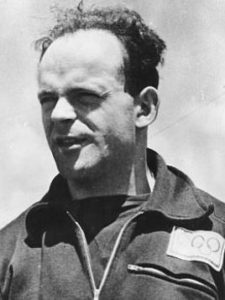
Helfgott at the 1966 Olympics in Melbourne, Australia

Ben Helfgott (b. 1929) was born in Poland and was only a child when the Nazis invaded his country. He was sent with his entire family to Buchenwald concentration camp. Everyone perished except for one sister. After the war, Helfgott was among some 750 Jewish kids under 16 taken to England as refugees. Now safe in England, Helfgott started a Jewish youth club and became a big fan of sports. He was soon introduced to weightlifting and wanted to take it up professionally. Being just 5 foot 4 inches tall, and weighing 154 pounds, Helfgott was told to find another sport. He persisted nonetheless, and at age 26, became England’s champion in the 11-stone division. He went on to win four more English and British Commonwealth weightlifting championships, and represented the UK at the 1956 Olympics in Australia. He returned in the 1960 Olympics in Rome as the coach of the UK weightlifting team. He also participated in the Maccabiah Games, earning weightlifting gold three times. After retiring from sport, Helfgott became a successful businessman. He used his wealth to start The ’45 Aid Society, generously supporting struggling Holocaust survivors. Helfgott was recently knighted by Queen Elizabeth. He is one of just two Holocaust survivors to become an Olympian.
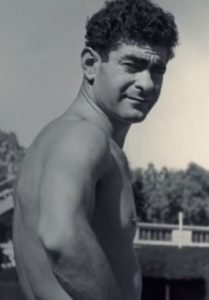
Alfred Nakache

The other is Alfred Nakache (1915-1983), born in French Algeria to a traditional Sephardic family of eleven children. As a child, Nakache had a crippling fear of water. He made the decision to overcome his phobia, and soon immersed himself in swimming and water sports. He went on to become a five-time French swimming champion, and set five European and World Records. After a silver medal at the 1935 Maccabiah Games, Nakache made the French Olympic team and competed in the 1936 Berlin Olympics. When the Nazis invaded France, Nakache escaped to the Free Zone in the south of the country. He wasn’t safe from anti-Semitism, though. Banned from swimming in Toulouse, he moved to Marseilles. Several weeks after setting a new record in the 400 metre butterfly in 1943, he was arrested and deported to Auschwitz. Surviving the camp’s hellish conditions, Nakache returned to swimming, setting a new French record in 1946. He made the French Olympic team again and participated in the 1948 games in London. In 1993, Nakache was inducted into the International Jewish Sports Hall of Fame. He was the subject of the 2001 documentary Alfred Nakache, the Swimmer of Auschwitz. Today, many pools across France are named after him.

What’s the Difference Between Ashkenazim and Sephardim?

Words of the Week

According to the pain is the gain.
– Pirkei Avot 5:21
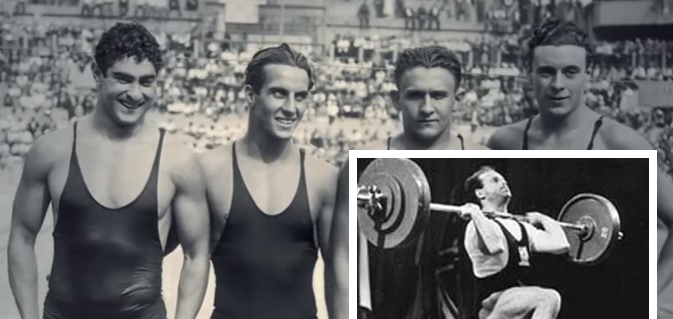
Nakache (far left) with the French relay team at the 1936 Berlin Olympics. Helfgott (inset) at a weightlifting competition.
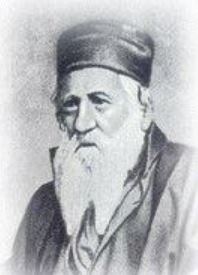
Jews of the Week: Rabbi Yehuda Bibas and Rabbi Yehuda Alkali

The Unbelievable True Story of the Real Founders of Zionism

Yehuda Aryeh Leon Bibas (1789-1852) was born in Gibralter to a long line of Sephardi rabbis. After his father’s untimely death, the young Bibas moved to Livorno to be raised by his grandfather. There, he studied both at the yeshiva and the university, becoming a rabbi and physician. He returned to Gibralter to head its yeshiva, attracting many students from across Europe and North Africa. In 1831, he was appointed chief rabbi of Corfu (a Greek island that had a large population in those days). Over the next decade, he understood the terrible predicament that Jews were in, and resolved that restoring an independent Jewish state in the Holy Land was the only solution. In 1839, he embarked on an international tour to encourage Jews all over the world to make aliyah. Some credit him with being the first prominent figure to do so in modern times. He was supported by the great Moses Montefiore, a wealthy Sephardic Jew who financed the first printing press and textile factory in the land of Israel, refurbished many of its Jewish holy sites, and established several Jewish agricultural colonies.

Rabbi Alkali

It was during Rabbi Bibas’ global tour that he met Rabbi Yehuda Alkali (1798-1878). Rabbi Alkali was born in Sarajevo and studied in Jerusalem under the tutelage of the holy city’s greatest Kabbalists. He went on to become the chief rabbi of Semlin, Serbia. Partly inspired by Serbia’s own nationalist movement, and further spurred by an 1840 blood libel against the Jews of Damascus, Rabbi Alkali was convinced that Jews must have a state of their own after meeting Rabbi Bibas. Rabbi Alkali established the Society of the Settlement of Eretz Yisrael and began a campaign to encourage Jews to settle in their ancestral home. Based on a famous prophecy in the Zohar, Rabbi Alkali proclaimed that the year 1840 would be the start of the process of Redemption, and that it would take one hundred years to accomplish. In an incredible prediction, he said that if Jews failed to take advantage of this spiritually-auspicious century, then by 1940 the Redemption would begin anyway, but in a much more difficult way, and only through “an outpouring of wrath will our dispersed be gathered”. History has eerily confirmed his prophecy. More amazing still, Rabbi Alkali published a book in 1857 titled Goral L’Adonai (“Lot for the Lord”) which clearly outlined the steps to re-establish a Jewish state in Israel. He presented one of the first copies of the book to his dear friend, and a member of his Semlin synagogue, named Simon Loeb Herzl. This happened to be the grandfather of Theodor Herzl, who would inherit the book. Scholars agree that Rabbi Alkali and his 1857 treatise played a major role in influencing Theodor Herzl, and thus the whole Zionist movement. In fact, it was Rabbi Alkali who first proposed restoring Hebrew as the primary spoken language of the Jews, who argued that the Holy Land should be legally purchased piece by piece, and that Jews must re-learn to become agriculturalists for the whole endeavour to work. (All three of these things would soon materialize.) Both Rabbi Bibas and Rabbi Alkali practiced what they preached and made aliyah to Israel. Rabbi Bibas first joined his disciples in Yaffo, then moved to Hebron and opened a library. He passed away shortly after, and is buried in Hebron’s Jewish Cemetery. Rabbi Alkali, meanwhile, founded a settlement near Jerusalem and lived there for the remainder of his life. He is buried in Jerusalem’s Mount of Olives Cemetery.

Did You Know These Famous People are Sephardic Jews?

Words of the Week

It was a city of wonders. Everything was written in Hebrew. People were speaking Hebrew. I thought, This is redemption. This is the city of the Messiah.
– Amnon Shamosh, Syrian-Israeli novelist, on first arriving to Tel-Aviv in 1937

Jews of the Week: Mendes Seixas Family

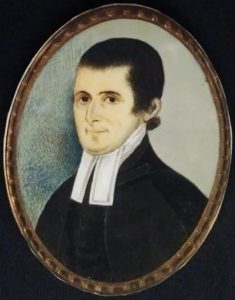
Gershom Mendes Seixas

Antonio Abraham Mendes Seixas (d. 1738) was born in a small village in Portugal to a family of Conversos (or Marranos), Jews who had been forcibly converted to Christianity but continued to practice their ancestral faith in secret. The Seixas family was made up of physicians, lawyers, and merchants, and were among the most successful in Portugal. Despite this, they were still hounded by the Inquisition, and many were imprisoned or put to death. Abraham Mendes Seixas himself barely escaped the Inquisition, and settled in London with his wife and three kids around 1725. There, the family openly returned to Judaism, and Seixas renewed his marriage vows under a proper chupah in a public ceremony. Seixas quickly rebuilt his wealth and became a prominent member of London’s growing Sephardic community. When he passed away in 1738 he left very little for his only son, Isaac Mendes Seixas (b. 1709) apparently believing he was unfit to run the business. Isaac set forth for a new start in America. The son proved a good businessman, and quickly rose to the highest ranks of the merchant class in the New World. He married Rachel Levy, daughter of the great (former Jew of the WeekMoses Levy, and became an important member of Shearith Israel, one of America’s first synagogues.

Isaac’s son, Gershom Mendes Seixas (1745-1816) was the hazzan of that synagogue, and although not ordained for the role, served as its rabbi. Some say he may have been the first rabbi born in America, while others point out he was the first rabbi to give sermons in English. He was also the first Jew to sit on the board of an American university (Columbia). His good friend of twenty years, and fellow on Columbia’s board, was Alexander Hamilton, one of the Founding Fathers of the United States. It is quite likely that Gershom helped Hamilton in drafting and promoting some of the famous Federalist Papers. Meanwhile, Gershom’s older brother Moses Mendes Seixas (1744-1809) moved to Newport and became one of its richest businessmen. He co-founded the Bank of Rhode Island, and served as president of Touro Synagogue, America’s first (and also to whom George Washington wrote one of his most well-known letters). Meanwhile, younger brother Benjamin Mendes Seixas (1748-1817) was one of the founders of the New York Stock Exchange, and youngest brother Abraham Mendes Seixas (1751-1799) was a decorated officer in the Continental Army during the American Revolution. The entire family was known for their tremendous patriotism and philanthropy.

Did You Know These People Are Jewish, Too?

Words of the Week

For happily the Government of the United States gives to bigotry no sanction, to persecution no assistance, requires only that they who live under its protection should demean themselves as good citizens, in giving it on all occasions their effectual support.
– George Washington, in his 1790 letter to the Touro Synagogue and the Jewish community of Newport.