
The Refusenik
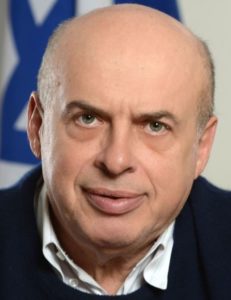 Anatoly Borisovich Sharansky (b. 1948) was born in Donetsk, Ukraine. He was a child chess prodigy, and won his city’s chess championship as a teenager. He went on to study math in Moscow and later worked in a secret Soviet research lab. In 1973, Sharansky applied for an exit visa to Israel and was refused. Henceforth, he became a vocal activist on behalf of Soviet Jewry, and became the world’s most famous refusenik. He soon expanded his scope to work for all human rights, and was the spokesperson for the Moscow Helsinki Group, today Russia’s primary human rights organization. In 1977, Sharansky was arrested on trumped-up charges of treason and espionage, and sentenced to 13 years of hard labour. He was tortured, and kept in solitary confinement for long periods of time. (He would later remark that one of the things that helped him through it was playing chess in his mind.) After ceaseless activism from his wife, mother, and countless international supporters, Sharansky was finally released in 1986. Shortly after, he received a Congressional Gold Medal from the US government. He moved to Israel and started going by his Hebrew name, Natan. A couple of years later, he published a bestselling memoir, Fear No Evil. (This book was passed on by Helen Suzman to Nelson Mandela, then still in prison, and inspired his ongoing struggle.) In 1995, Sharansky co-founded the Yisrael BaAliyah political party to advocate on behalf of hundreds of thousands of new Soviet Jewish immigrants to Israel. They won seven seats in their first election. Sharansky served as Minister of Industry and Trade, then Minister of Internal Affairs, and even Israel’s Deputy Prime Minister. In 2003, as chairman of his party, he merged it with Likud, and became Minister of Jerusalem Affairs. In 2005, Sharansky resigned in protest of Israel’s withdrawal from Gaza. He is a staunch supporter of Israeli settlements, and co-founded One Jerusalem, an organization that works to keep the Jewish capital from being divided ever again. President Bush awarded him the Medal of Freedom in 2006, and he won the Israel Prize in 2018. Last year, he won the prestigious Genesis Prize, and donated all $1 million of it for coronavirus relief. Currently, Sharansky heads the Institute for the Study of Global Antisemitism and Policy, and continues to serve on the board of the Jewish Agency.
Sharansky: The Dangerous Rise of the Un-Jews
Understanding the Arab-Israeli Conflict in 5 Easy Points
Words of the Week
Jews came here 3,000 years ago and this is the cradle of Jewish civilization. Jews are the only people in history who kept their loyalty to their identity and their land throughout the 2,000 years of exile, and no doubt that they have the right to have their place among nations—not only historically but also geographically. As to the Palestinians, who are the descendants of those Arabs who migrated in the last 200 years, they have the right, if they want, to have their own state… but not at the expense of the state of Israel.
– Natan Sharansky
 Eilat Mazar (1956-2021) was born in Israel to a family of archaeologists, and grew up playing and learning on excavation sites. Her grandfather, Benjamin Mazar, was the State of Israel’s first official archaeologist, and was the president of the Hebrew University. Eilat studied archaeology at the same university, and began her field work in 1981. She made a big splash right away by discovering the Royal Quarter of the ancient City of David in Jerusalem, including what is thought to be the royal palace of King David himself. She went on to uncover some of the biggest finds of the last century, including parts of the walls built by King Solomon, the seal of King Hezekiah, and the seal of the Prophet Isaiah. Mazar was driven by her belief that the Tanakh records actual historical events (whereas many of her secular colleagues often viewed the Tanakh as mythology). She would say that “I work with the Bible in one hand and the tools of excavation in the other.” Over the decades, her work played a major role in helping to prove the authenticity of the Bible. Mazar discovered countless treasures from the First and Second Temples in Jerusalem, and was a vocal activist trying to stop Palestinian and Jordanian authorities from
 Meir Har-Zion (1934-2014) was born in the new town of Herzliya in 1934. His mother’s side hailed from Sephardic-Turkish heritage, while his father’s side came from Romania and Russia. He spent his early years on a number of different kibbutzim and moshavim. He loved hiking and exploring the Holy Land, together with his younger sister, and the two youths were once arrested by Syrian authorities when they wandered a little too far. It happened again in 1951, and it took negotiations mediated by the UN to secure their release. Two years later, Har-Zion was a co-founder of Unit 101, Israel’s first special forces commando team. While sometimes brutal, the operations of Unit 101 were essential in securing Israel’s borders and maintaining its defenses in the early years. They also made it clear that the new IDF is a force to be reckoned with, and that Israel would respond forcefully if provoked. In 1954, Har-Zion joined the 890th Paratroopers, led by