Tag Archives: Israelis

Jew of the Week: Avigdor Lieberman

Israel's New Minister of Defence, Avigdor Lieberman (Photo Credit: Yossi Zamir)

Israel’s New Minister of Defence, Avigdor Lieberman (Photo Credit: Yossi Zamir)

Evet Lvovich Lieberman (b. 1958) was born in Moldova to a Russian-Jewish family. He grew up speaking Yiddish and dreamed of being a poet. In 1978, his family made aliyah to Israel, where he went by the name “Avigdor”. After serving in the IDF, Lieberman studied political science at the Hebrew University. During this time, he worked as a bouncer in a club, and went on to become the club’s manager. In the mid-80s, Lieberman co-founded the Zionist Forum for Soviet Jewry, and worked for Israel’s National Worker’s Union. His first real foray into politics was in 1988, when he began collaborating with Benjamin Netanyahu. By 1993, Lieberman was the Director-General of Likud, and in 1996 became the Director-General of Netanyahu’s Prime Ministerial office. However, the following year he had a falling out with Netanyahu over concessions made to the Palestinians. He left Likud, and two years later, founded a new political party, Yisrael Beitenu. That same year, he was elected to the Knesset for the first time. He remained in this position until 2004, when Ariel Sharon kicked him out because of his vocal opposition to the Gaza withdrawal plans. In the next elections, Lieberman returned to the Knesset, his party having won 11 seats. Once again, in 2008, he left his post to protest “land for peace” negotiations, and was re-elected the following year. All in all, Lieberman has been an MK in every Knesset since 1999, and served as Minister of National Infrastructure, Minister of Transportation, Minister of Foreign Affairs, and even as Israel’s Deputy Prime Minister. Most recently, he has been appointed Minister of Defense. His strong support among the million-plus Soviet immigrants in Israel gives him consistently large Knesset seat victories, making him a key part of forming any successful coalition government. For this reason, he has been nicknamed the “kingmaker”. Over the years, Lieberman has worked to improve ties with European and African nations, and campaigned for Israel to join the European Union and NATO. He has always insisted on keeping Jerusalem undivided, on responding harshly to terror attacks, and strengthening Israel’s borders. On being a controversial figure, he has said: “I’ve always been controversial because I offer new ideas. For me to be controversial, I think this is positive.”

Words of the Week

The peace process is based on three false basic assumptions; that Israeli-Palestinian conflict is the main cause of instability in the Middle East, that the conflict is territorial and not ideological, and that the establishment of a Palestinian state based on the 1967 borders will end the conflict.
– Avigdor Lieberman

Jew of the Week: Rabbi Yehuda Glick

Yehuda Glick (Credit: Amitay Salomon)

Yehuda Glick (Credit: Amitay Salomon)

Yehuda Joshua Glick (b. 1965) was born in Brooklyn to an Orthodox Jewish family which made aliyah to Israel when he was nine years old. After completing his rabbinical studies, Glick began working for the Israeli Ministry of Immigrant Absorption. In 2005, after some ten years, he quit the job to protest Israeli withdrawal from Gaza. He then served as executive director of The Temple Institute, an organization working to rebuild the Holy Temple in Jerusalem through peaceful means. Glick is most famous for his activism with regards to permitting Jews to ascend the Temple Mount. This area is the holiest site in the world for the Jewish people, yet entrance to it is severely limited for Jews, and prayer there is currently forbidden to all but Muslims. As chairman of the Temple Mount Heritage Foundation and leader of the HaLiba group, Glick has worked tirelessly to end this racist policy, and to open the Temple Mount for visitation and prayer to people of all faiths. He envisions rebuilding a temple – “a house of prayer for all nations” – next to the Dome of the Rock. For leading prayer groups to the Temple Mount, Glick has been arrested multiple times. In 2013, he went on a hunger strike to protest a ban that forbid him to go to the Temple Mount. After twelve days without food, Glick was permitted to return to the Mount. In 2014, after giving a speech at a Jerusalem conference, an Arab man approached Glick and shot him four times in the chest before driving off on a motorcycle. Glick underwent multiple surgeries, and was unable to communicate or breathe on his own for a couple of weeks. Amazingly, he survived the assassination attempt. Shortly after, he joined the Likud political party, and was placed 33rd on its list. The party won 30 seats, making Glick third in line to become a parliamentarian. Over the past year, three Likud MKs resigned, including Moshe Ya’alon earlier this month. This opened the door for Glick to enter Knesset, which he did two days ago. His calls for peace, prayer, and human rights are truly universal, as he has stood by not only Orthodox Jews, but also Christian groups and Reform Jews (including the Women of the Wall) who aim to pray freely at Jerusalem’s holy sites. He has also spoken frequently about ending the plight of the Palestinians, and bridging gaps between Jews and Muslims. In addition to his own six kids, Glick is the legal guardian of six more children, and two foster children. He has been compared to Gandhi, and described as “earthly, wise, thoughtful, nonviolent, and compassionate.” Last year, he was awarded the Moskowitz Prize for Zionism by the Jewish National Fund.

Words of the Week

If your dreams don’t scare you, they are not big enough.
– Ellen Johnson Sirleaf

Jew of the Week: Meir Dagan

Meir Dagan (Credit: Kobi Gideon/Flash 90)

Meir Dagan (Credit: Kobi Gideon/Flash 90)

Meir Huberman (1945-2016) was born on a train while his parents, Polish-Jewish Holocaust survivors, were fleeing to the Soviet Union. Five years later, they made aliyah to Israel and ultimately settled in Bat Yam, where Meir’s parents opened up a laundromat, and changed the family name to Dagan. Meir went on to study art at Tel Aviv University, and when conscripted to the IDF, joined the elite Paratroopers Brigade (which accepts just 1 in 5 applicants). A year following the completion of his mandatory service, he was called up to serve in the Six-Day War. As an officer, he commanded a paratrooper unit in the Sinai. Following the war, he stayed in the military and was soon tasked with leading a commando unit, Sayeret Rimon, operating undercover in the Palestinian territories. During one daring mission, Dagan tackled and disarmed a terrorist holding a live grenade, a feat that earned him a Medal of Courage. He was called to command a unit once more during the Yom Kippur War, successfully pushing across the Suez Canal. In 1982, the armored unit under his command was among the first to reach Beirut during the Lebanon War. Dagan retired from the military in 1995 with the top rank of Major General. Prime Minister Ariel Sharon appointed him as National Security Adviser, and then Director-General of the Mossad. Unlike former Mossad heads who were weary of doing so, Dagan was praised for his aggressive tactics in assassinating terrorist leaders (most famously Imad Mughniyeh, the terror chief of Hezbollah and Islamic Jihad). Dagan essentially tripled Mossad’s activities, and a Knesset member has said that under his watch, the Mossad “has undergone a revolution in terms of organization, intelligence, and operations”. Dagan continued to head Mossad until the end of 2010, when he crossed paths with Netanyahu over plans to strike Iran, which Dagan opposed, saying “Israel should not hasten to attack Iran, doing so only when the sword is upon its neck.” (Instead, Dagan had sent countless cyberattacks to cripple Iran’s nuclear program, together with car bombs to assassinate its engineers.) After stepping down, Dagan became director of Israel’s Port Authority, as well as chairman of Gulliver Energy, an Israeli mining company. Unfortunately, he was diagnosed with liver cancer. After chemotherapy failed, he received a liver transplant, but this, too, didn’t remove the cancer completely. Sadly, Dagan passed away last week. He was eulogized by President Rivlin as “one of the greatest of the brave, creative and devout warriors that the Jewish people ever had. His devotion to the State of Israel was absolute.”

Words of the Week

The issue of Iran armed with a nuclear capability is not an Israeli problem; it’s an international problem.
– Meir Dagan

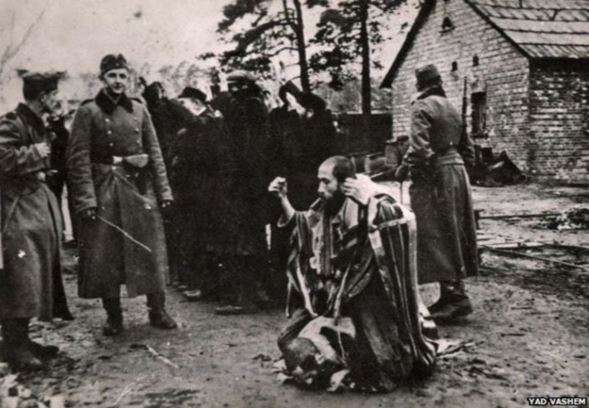
This is a photograph of Meir Dagan’s grandfather right before being murdered by Nazis. The photo hung in Dagan’s office as a constant reminder of his important work.