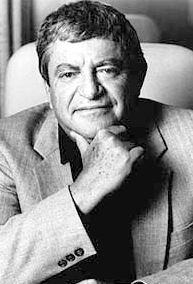
Menachem Golan
Menachem Globus (1929-2014) was born in Tiberias, Israel to Polish-Jewish parents. He served as an air force pilot and bombardier during Israel’s War of Independence (when he changed his last name to Golan). After this, he studied theatre and drama in England, followed by film-making in New York University. Together with his cousin Yoram Globus, Golan began making Israeli movies in the 1960s. They would go on to produce some of Israel’s most famous classics, such as Operation Thunderbolt about the IDF Entebbe raid that saved Israeli hostages in Uganda, and the comedy series Eskimo Limon, which left a permanent mark on Israeli culture. In 1979, Golan purchased the Cannon Group and expanded into Hollywood. Throughout the 1980s he produced some of the biggest action hits of the time, including Sylvester Stallone’s Over the Top, Chuck Norris’ The Delta Force, and Jean-Claude Van Damme’s Bloodsport and Kickboxer. He was also one of the first to see the allure of adapting toys and comic books to film, producing Masters of the Universe, Superman IV, and trying to bring Spider-Man to the big screen (it did only after Sony bought out the film rights). In all, Golan produced over 200 films, and directed 44 of them himself, earning three Academy Award nominations, and the Israel Prize. Sadly, Golan passed away last Friday. Paying tribute to the filmmaker, Chuck Norris said that it was Golan who turned him into a superstar, and Van Damme tweeted: “I love you, and will always do.”
Words of the Week
…splitting Judaism into ‘orthodox, conservative, and reform’ is a purely artificial division, for all Jews share one and the same Torah given by the One and same God. While there are more observant Jews and less observant ones, to tack on a label does not change the reality that we are all one.
– Menachem Mendel Schneerson, the Lubavitcher Rebbe
 Gerhard Scholem (1897-1982) was born to a secular Jewish family in Berlin. At a young age he showed a great interest in religion, but his father was staunchly anti-Orthodox and opposed it. After his mother intervened, Scholem was allowed to study Judaism with an Orthodox rabbi. In university, he studied mathematics, philosophy, and Hebrew, and met other greats like Martin Buber and Hayim Bialik. He later received an additional degree in Semitic languages. During his studies, he discovered Kabbalah and the infinite depths of Jewish mysticism. He ended up writing his doctoral thesis on the oldest known Kabbalistic text, Sefer ha-Bahir. In 1923 Scholem moved to Israel and changed his name to Gershom. He worked as a librarian and spent his time in study. In 1933 he became the first Professor of Mysticism at the Hebrew University of Jerusalem, teaching a unique view of Kabbalah from a scientific and historical perspective. He stayed at this post for over 30 years, while writing over 40 world-famous texts (in addition to over 700 articles) and winning a handful of prestigious awards, including the Israel Prize. He is credited with being a major force in opening the study of Kabbalah to the masses, both Jews and Gentiles. Despite studying Judaism through a scholarly approach, he maintained that Hebrew is a divine language, alone capable of revealing hidden truths.