Tag Archives: Charity

Jews of the Week: Bernie Marcus and Arthur Blank

The Home Depot

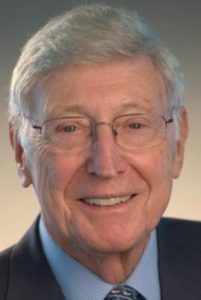
Bernie Marcus

Bernard Marcus (b. 1929) was born in New Jersey to Russian-Jewish immigrants. His dream was to become a doctor, but he could not afford the tuition. Instead, he studied pharmacy at Rutgers University (where he was part of the Jewish AEPi fraternity) and paid his way by building cabinets with his father. While working at a drug store after graduating, Marcus realized that he is far more interested in business than pharmacy. He went on to work in various retail jobs, eventually becoming the CEO of a home improvement store. There he met Arthur Max Blank (b. 1942). Blank had studied business in college, and worked in various accounting jobs until becoming VP of finance at the same home improvement store as Marcus. The two were both fired from the company in 1978. Undeterred, they decided to start their own home improvement store, with a new “warehouse” concept, and a focus on superb customer service and a vision of giving back to the community. The two hired a fellow employee who had been fired, Ron Brill, as well as businessman Pat Farrah, who had once owned a home improvement store. The following year they opened the first Home Depot in Atlanta. Just two years later, they branched out into Florida and went public. Within a decade, Home Depot had become America’s largest home improvement store. Today, it has over 2200 stores across the US, Canada, and Mexico, with some 385,000 employees, and is the world’s largest buyer of construction materials. True to their original vision, The Home Depot Foundation has donated over $200 million in support of various causes, including Habitat for Humanity. They have been lauded for their environmental conservation, avoiding lumber purchases from endangered forests, running the largest light bulb recycling program in the US, and spending $100 million over ten years to build 100,000 green homes and plant 3 million trees. Home Depot also sponsors the US and Canada Olympic Teams.
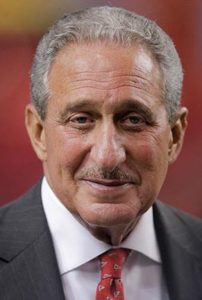
Arthur Blank

Marcus and Blank served as CEO and president of Home Depot for 19 years. Upon retirement, Blank purchased the Atlanta Falcons football team, and recently founded a new Major League Soccer team, Atlanta United FC. He is also a noted philanthropist, donating millions to various causes, including a recent $7 million to Denver’s National Jewish Health Center. Blank has signed The Giving Pledge, committing to donating at least 50% of his wealth to charity. Marcus has signed the Pledge, too, and was one of America’s most charitable donors in 2005. Among his many contributions, he has given $25 million to Autism Speaks, $15 million for a new nanotechnology research centre, and $5 million to co-found the Israel Democracy Institute. He now chairs his Marcus Foundation, which has given countless sums to children’s causes, Jewish communities, medical research, and support for military veterans. When asked why he was so passionate about charity, he said: “It goes back to what I learned as a young Jewish boy growing up in Newark, N.J. with immigrant parents: You have an obligation to give back to society. Thirty years ago, when I had no money, I worked for various charities, gave my heart, soul and time – now I can also give money.”

Words of the Week

We have neither taken other men’s land, nor are we in possession of other men’s property, but of the inheritance of our forefathers; it was wrongfully held by our enemies at one time, but we, grasping our opportunity, hold firmly the inheritance of our forefathers.
– Simon Maccabee (Book of Maccabees I,15:34-35)
Jews of the Week: Evelyn de Rothschild & Jacob Rothschild

In honour of Jew of the Week’s 7th birthday this November, we will feature a month-long series on the most famous (and sometimes infamous) Jewish family of all time: the Rothschilds. This is part five of five. Click here for part one, here for part two, here for part three, and here for part four.

Sir Evelyn de Rothschild (Credit: Raul Vasquez/Bloomberg)

Having explored the lives and achievements of the first generations of Rothschilds, we now turn to the Rothschilds of our days. Although the family has grown very large over the centuries, with the number of members in the thousands, two Rothschilds stand out, and are undoubtedly the most famous in modern times. The elder is Evelyn Robert Adrian de Rothschild (b. 1931), who spent part of his childhood in the United States. There he had his first job: distributing soda and sundaes at a pharmacy. This played a role in making him a “chocoholic”, and led to his eventual founding of an award-winning chocolate shop. Evelyn officially joined the family business at age 26, and successfully widened the family fortune. He was made chairman in 1982. He has also served as chairman of The Economist magazine, De Beers diamonds, and IBM UK. In 1989 he was knighted by Queen Elizabeth II, and remains her personal financial adviser. Like the rest of his family, Sir Evelyn is a noted philanthropist and patron of the arts. He has donated countless sums, and his Eranda Foundation finances social welfare programs, medical research, education, and art. He has chaired a medical school and an arts academy, and is part of a trust fund that provides scholarships for students with disabilities. (His chocolate shop, too, uses only ethically-sourced cocoa beans, and a portion of all sales is donated to Elephant Family, a nature conservation charity.) Sir Evelyn retired from the family business in 2003, after engineering the merger of the London and Paris Rothschild groups into one company.

Jacob Rothschild, 4th Baron Rothschild

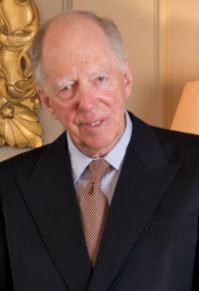
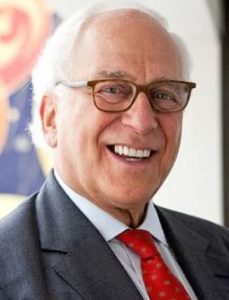
One person who is conspicuously absent from this new Rothschild company is Evelyn’s cousin, Nathaniel Charles Jacob Rothschild (b. 1936), officially the Lord Rothschild. He was the firstborn son of the previous Rothschild baron, thereby inheriting the title. He joined the family business after receiving a Ph.D in history from Oxford University. He expected to eventually take over the family business, but cousin Evelyn was selected instead, leading Jacob to resign in disappointment, and sell his stake in the company. Undeterred, Jacob started his own investment fund and quickly multiplied his fortune (now estimated at $5 billion), proving his doubters wrong. He is a major philanthropist and patron of the arts. One of his pet projects is converting the Waddeston family manor into one of the top museums and art galleries in the world. It attracts half a million visitors a year, and has won a Museum of the Year Award. Jacob has given funds for archaeological research, and large sums to the State of Israel. He chairs Yad HaNadiv, the Israeli arm of The Rothschild Foundation, which invests in Israeli education, environmental restoration, civic projects (including the Knesset, Supreme Court, and National Library buildings), and supports Arab communities. The baron is also president of the Institute for Jewish Policy Research. He has won a long list of awards for his philanthropic work and support for the arts, his wisdom and financial acumen. Click here to see a recent documentary about Jacob Rothschild and his family.

Words of the Week

I did not support you and take you under my wing due to your poverty but due to your passion to work and live in the Holy Land, and to live in accordance with the spirit of the Torah.
– Edmond de Rothschild, to farmers in Israel

Jews of the Week: Lionel and Edmond de Rothschild

In honour of Jew of the Week’s 7th birthday this November, we will feature a month-long series on the most famous (and sometimes infamous) Jewish family of all time: the Rothschilds. This is part four of five. Click here for part one, here for part two, and here for part three.

Lionel de Rothschild

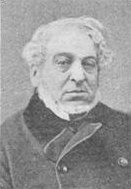
Lionel de Rothschild (1808-1879) was the eldest son of London’s Nathan Rothschild. After studying in university and apprenticing with family members, he entered the family business at age 28. He helped raise funds for Britain for a number of its wars, including the Crimean War, as well as to help victims of the Great Irish Famine. He would organize the largest private relief fund for the famine (which tragically took the lives of over one million people). Lionel pushed for, and secured funding, for Britain’s pivotal purchasing and construction of the Suez Canal. In 1847, he was elected to the British House of Commons. He was required to take a Christian oath and swear on a Bible, which he refused. The Prime Minister passed a “Jewish Disabilities Bill” to remove the necessity to swear a Christian oath. However, the House of Lords rejected it. Lionel resigned. He won the election again in 1850, but was stifled by the House of Lords once more; then again in 1851 and 1852. It was only in 1858 that the Lords relented, and that year Lionel took an oath on a Tanakh, wearing a kippah, and became the first Jew in British Parliament. He was reelected three more times. In 1885, after previously being refused by Queen Victoria, he was finally elevated to the House of Lords, the first Jew in that house as well.

Edmond de Rothschild

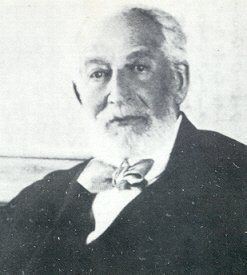
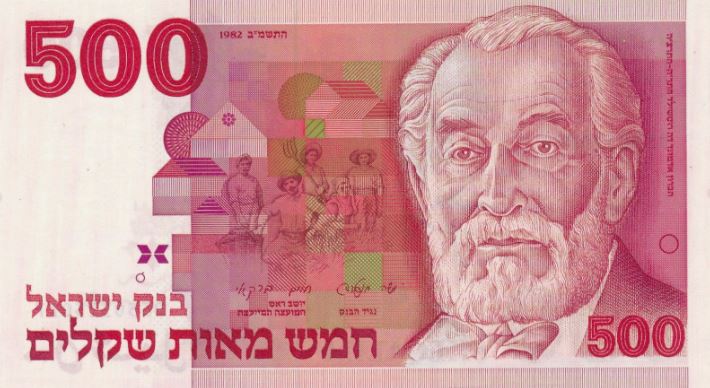
While there were Rothschilds who were vocal anti-Zionists, and some have even refused to visit the State of Israel, one of the greatest Zionists of all time was Edmond de Rothschild (1845-1934). Edmond was the youngest son of Paris’ Jacob de Rothschild. He was a noted patron of arts and sciences, and founded multiple biology, chemistry, and physics institutions. He spent vast sums on art, amassing a collection of over 40,000 valued pieces, most of which would be donated to the Louvre. This continued until he was inspired by the Zionist vision, and stirred to action by horrific pogroms in Russia. Henceforth, he spent whatever money he could to reestablish a Jewish state in the Holy Land. It was Edmond’s funds that created Rishon LeZion, the first modern Jewish settlement in Israel, as well as Metulla, Ekron, Rosh Pina, and Zikhron Ya’akov (named after his father). He later established the Palestine Jewish Colonization Association, through which he acquired 125,000 acres of land in Israel. Edmond spent another $50 million (equal to some $700 million today) to plant farms and wineries, drain swamps, fight malaria, build schools, synagogues, factories and electrical grids, invest in industry and economic development. He supported the Arab populace as well, affirming that putting “an end to the Wandering Jew, could not have as its result, the creation of the Wandering Arab.” Beloved by Jews (and many Muslims, too) he was nicknamed “the Famous Benefactor”. Streets and landmarks across Israel are named after him, including Tel Aviv’s central Rothschild Boulevard, the major financial, cultural, and tourist artery of the city. Until 1986, he was on Israel’s 500 shekel note.

This November is the 100th anniversary of the Balfour Declaration. Click here to watch Jacob Rothschild (whose life we shall explore in the final part of the series next week) speak about the Declaration and the Rothschild role in the founding of Israel.

Click here to go to Part Five.

Words of the Week

I doubt that, in the entire history of the Jewish people in the Diaspora, a period of 2,000 years, one could ever find a man comparable in stature to the incredible character that was the Baron Edmond de Rothschild – the builder of the Jewish Yishuv in our renewed homeland.
David Ben-Gurion

Edmond de Rothschild on an Israeli 500 Shekel Note (1982)