Emma Lazarus (1849-1887) was born in New York City. Her father came from a Jewish family that immigrated from Germany, while her mother was from an illustrious Sephardic-Portuguese family that settled in America before the Revolution. Lazarus studied literature and language, speaking German, French, and Italian. She became a famous poet, novelist, and playwright; one of the first successful Jewish-American authors. Her first book of poetry was published when she was just 17 years old, and she went on to collaborate with such great writers as Ralph Waldo Emerson. Lazarus was also an influential social activist. Her first cause was fighting for tax reform and fairer distribution of land. After hearing of the violent pogroms in Russia, she advocated strongly on behalf of Russian Jews and helped settle Jewish refugees in New York. Lazarus worked for the Hebrew Emigrant Aid Society, training impoverished immigrants and helping them find work. She also co-founded the Hebrew Technical Institute to educate Jewish refugees. Meanwhile, Lazarus argued passionately for the creation of a Jewish state in Israel – thirteen years before Theodor Herzl arrived on the scene! (For this, among other reasons, she was once described as the “fiery prophet of the American Jewish community.”) Lazarus is undoubtedly most famous for her poem “The New Colossus”, which she wrote to raise money for the construction of the Statue of Liberty. The sonnet’s powerful words – familiar to most Americans – have inspired many, and have been quoted by leaders like John F. Kennedy and Barack Obama. Two decades after she first wrote it, the poem was etched onto a bronze plaque at the base of the Statue. It has been said that the poem transformed the Statue into a symbol of immigration and freedom, and defined “the American vision of liberty”. Sadly, Lazarus did not live to see this day. She tragically died at the young age of 38, from lymphoma. She has since been inducted into the National Women’s Hall of Fame.
Words of the Week
“Give me your tired, your poor,
Your huddled masses yearning to breathe free…”
– From “The New Colossus”, by Emma Lazarus
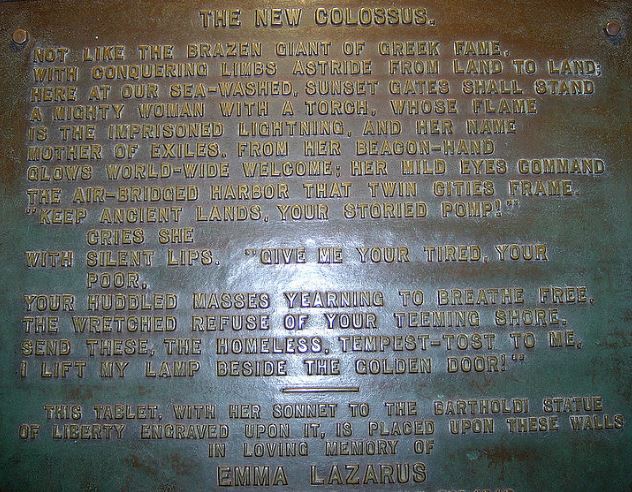
Plaque of the “The New Colossus” in the Statue of Liberty