Category Archives: Religious Leaders

Spiritual and Religious Greats of the Jewish People

Jew of the Week: Rabbi Abraham Joshua Heschel

The Rabbi Who Marched With Martin Luther King Jr.
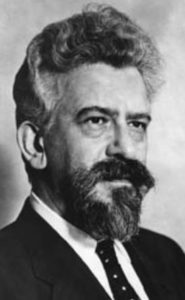
Rabbi Heschel

Avraham Yehoshua Heschel (1907-1972) was born in Poland to a long line of Hasidic rabbis from both his father’s and mother’s side. He was named after his ancestor, the Apter (or Apatower) Rebbe. After receiving semicha (rabbinic ordination) himself, Rabbi Heschel decided to pursue secular studies at the University of Berlin. (There he briefly crossed paths with three other future great rabbis: Yitzchak Hutner, Joseph B. Soloveitchik, and the Lubavitcher Rebbe.) While earning his Ph.D in philosophy, Heschel also studied at Berlin’s Reform seminary and received a liberal rabbinic ordination to go along with his Orthodox one. Meanwhile, he was part of a Yiddish poetry club and published his own book of Yiddish poems in 1933. Heschel was arrested by the Gestapo in 1938 and deported back to Poland. He moved to London just six weeks before Poland was invaded by the Nazis. (His mother and three sisters perished in the Holocaust.) Heschel eventually settled in New York. He first worked at the (Reform) Hebrew Union College for five years before switching over to the (Conservative) Jewish Theological Seminary. There he spent the rest of his career as a rabbi and professor of Jewish ethics and Jewish mysticism. Despite working at these institutions, Heschel never identified himself with any particular Jewish denomination, and was himself strictly Torah-observant. His discourses often weaved together Biblical, Kabbalistic, and Hasidic teachings. He especially focused on the ancient Hebrew prophets, and sought to revive their message in healing today’s world. Because of this, he was an active civil rights and peace activist. Heschel famously marched alongside Martin Luther King, Jr. in Selma. Later that year, he presented King with the ‘Judaism and World Peace Award’. The two formed a very close friendship. Heschel also wrote numerous books, including five bestsellers. These books have been credited both with bringing countless Jews back to traditional observance, as well as opening up the study of Judaism to the wider world. Heschel worked hard to build bridges between Jews and gentiles. He represented the Jewish world at the Second Vatican Council between 1962 and 1965, successfully getting the Catholics to formally abandon the belief that Jews were responsible for Jesus’ crucifixion—and therefore that all Jews are “accursed”—and to remove all prayers derogatory to Jews. Heschel is considered one of the most influential Jews of the 20th century, and remains among the most widely read and studied Jewish philosophers and theologians. Today, the 18th of Tevet, is his yahrzeit.

Words of the Week

Prophecy is the voice that God has lent to the silent agony, a voice to the plundered poor, to the profane riches of the world. It is a form of living, a crossing point of God and man. God is raging in the prophet’s words.
– Rabbi Abraham Joshua Heschel
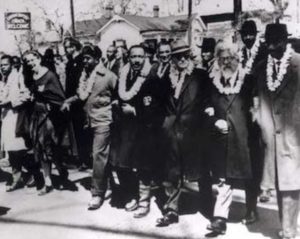
Rabbi Abraham Joshua Heschel (second from right) with Martin Luther King Jr. marching on Selma in 1965.
Jew of the Week: Ezra the Scribe

The Sage Who Saved Judaism

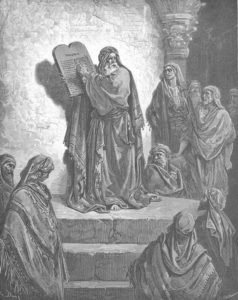
“Ezra Reads the Law to the People” by Gustave Doré

Ezra ben Serayah (c. 5th century BCE) was born in Babylon to a family of Jewish priests, kohanim, descendants of Aaron. He spent his early days immersed in Torah study, under the tutelage of Baruch ben Neriah, disciple of the prophet Jeremiah. Ezra soon became the most renowned scholar and scribe in Babylon’s community of exiled Jews. Earlier, the Persian Emperor Cyrus the Great had freed the Jewish community and permitted them to return to Israel and rebuild the Temple. While the majority stayed in Babylon, a group of 42,360 Jews returned to rebuild Jerusalem. Unfortunately, few among them were learned, and in those first decades many ended up intermarrying with the non-Jewish settlers that were brought to Israel by the Assyrians and Babylonians. Ezra soon decided to head to Israel himself, along with a second wave of 1,500 Jews. Upon arrival, he wept at the poor state that the Jewish community was in. He immediately started teaching Torah, decreed that the Torah must be read publicly every Monday and Thursday (which is still done in all synagogues today), and put an end to intermarriages. So successful were his campaigns that the Tanakh states the Jews started to keep the holidays as properly and fervently as they did in the times of Joshua, the successor of Moses. As a priest, Ezra was involved in restoring the new Temple’s services. More importantly, he was able to discover and prepare a new Red Heifer, allowing the entire nation to be spiritually purified. Ezra wrote numerous holy texts, and is fittingly known as Ezra HaSofer, “the Scribe”. He composed the majority of the Book of Chronicles, which concludes the Tanakh, as well as the Book of Ezra, which records the historical events of the time. Ezra was one of the last prophets of Israel, and penned his prophecies under the name Malachi, also a Biblical book. He was one of the co-founders of the Great Assembly, a group of 120 prophets and sages who, among other things, codified the Tanakh and composed the first formal Jewish prayers (including the Amidah). The Talmud credits Ezra with reviving the Torah in the Holy Land, and even states that had Moses not given us the Torah, Ezra would have been worthy of doing so. He passed away on the ninth of Tevet, which is next Monday.

Words of the Week

Predicting rain doesn’t count, building an ark does.
– Warren Buffet

Jew of the Week: Abba Hillel Silver

The Reform Rabbi Who Made Israel Happen

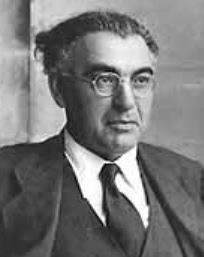
Rabbi Abba Hillel Silver

Abraham Silver (1893-1963) was born in what is today Lithuania (then Poland) to an Orthodox Jewish family, the son and grandson of rabbis. The family settled in New York when he was nine years old. He first studied at the Orthodox Yeshivat Etz Chaim (now Yeshiva University), where he founded a Zionist youth club that later became Young Judea, America’s first Zionist youth organization. He eventually took up studies at the University of Cincinnati and Hebrew Union College, America’s main seminary for Reform rabbis. (It was during this time that he changed his name to Abba Hillel Silver.) After graduating, he served as the rabbi of a small town in West Virginia for two years, and then took the helm of Temple Tifereth-Israel in Cleveland, which is still one of the largest Reform synagogues in America. He went on to serve in this position for nearly 46 years, and the synagogue would come to be known as “Silver’s Temple”. He made the congregation less “Reform” and more traditional—Sabbath services were held on Sunday (!) before he took over and moved them back to Saturday. He was also instrumental in making Zionism acceptable within Reform Judaism, which was staunchly anti-Zionist at the time. Meanwhile, he founded the Anti-Nazi League, and managed to form a successful boycott of Nazi German goods in the 1930s. Silver was not only concerned with the Jewish community, but became well known as a worker’s rights and civil rights activist. Among other achievements, he helped draft Ohio’s first unemployment insurance laws. His greatest passion was the re-establishment of a Jewish state in Israel. Silver campaigned across the country to raise funds and support (among both Jews and Christians). He co-founded the United Jewish Appeal, and between 1946 and 1949 headed the American branch of the Jewish Agency. Silver also met with President Truman numerous times to get him to recognize a Jewish state. It was Silver who gave the critical speech at the United Nations on May 8, 1947, convincing the international body to vote for Partition. His words were later described as “Israel’s acceptance speech”. He returned a year later in May of 1948 to deliver the news to the United Nations that Israel had declared independence. Had Chaim Weizmann not accepted, it is believed Silver would have been Israel’s first president. In 1952, Silver was selected to give the blessings at President Eisenhower’s inauguration. He won numerous awards, and also published seven popular books on Judaism, along with many penetrating sermons and essays. The town of Kfar Silver in Israel is named after him. Today is his yahrzeit.

Words of the Week

Generally his view was that it was not new liturgies we needed, but the reading of prayers in the kind of earnest and exalting way that could not help but uplift the mood of the worshippers. He himself conducted every service as though it were fresh, revelatory, almost with a Hasidic touch of intensity—with kavvanah, which was one of his favorite words. He constantly urged me to read, to study, and to write…
Leon I. Feuer, Abba Hillel Silver: A Personal Memoir