Category Archives: Law, Politics & Military

Jews in the World of Law and Politics

Jew of the Week: Shimon Peres

A young Shimon Peres with his wife Sonia

A young Shimon Peres with his wife Sonia

Szymon Perski (1923-2016) was born in the shtetl of Vishnyeva (then part of Poland, now in Belarus) to a wealthy Russian-Jewish family. He was the great-great-grandson of the famed Rabbi Chaim Volozhin, and was greatly influenced by his own grandfather, Rabbi Zvi Meltzer. At the young age of 11, Perski’s family moved to Tel Aviv and Hebraized their last name to Peres. (Their entire extended family back in Vishnyeva would later perish in the Holocaust). After finishing his schooling, young Shimon went to live on a kibbutz working as a dairy farmer and shepherd before co-founding his own kibbutz. He was soon elected secretary of a Labor Zionist youth organization. From there, he joined the Mapai party, whose leader David Ben-Gurion took a personal interest in him. At 21, Peres was imprisoned for two weeks by the British for leading an “illegal” expedition into the Negev to scout a new place for Jewish settlement. In 1947, now married, Peres was appointed to the Haganah and put in charge of recruitment and weapons purchases. The following year, he took charge of Israel’s nascent navy. In the 50’s, while part of Israel’s delegation to the US, he studied at NYU and Harvard. At 29, he became the head of Israel’s Ministry of Defence – the youngest person to ever hold the position. He was praised for building strong military alliances with other countries (particularly France, who awarded him their highest distinction, the Legion of Honor), and securing large amounts of modern weapons that propelled Israel into a regional powerhouse. He also helped establish the crucial Dimona nuclear reactor. In 1959, Peres was elected to the Knesset. At one time or another, he served as Minister of Immigrant Absorption, Minister of Transportation, Minister of Defence, Foreign Minister, Minister of Finance, and Information Minister. In 1984, Peres was elected Israel’s prime minister, and in 2007, Israel’s president. Among his other major achievements are the 1976 Entebbe rescue operation (which he pushed through the Cabinet), the 1994 peace treaty with Jordan, and his Peres Center for Peace, which has trained over 250 Arab doctors and brought life-saving treatment to thousands of Arab children. Peres was awarded the Nobel Peace Prize in 1994 for his work with the Oslo Accords, was knighted by Queen Elizabeth in 2008, presented with the Presidential Medal of Freedom in 2012 by Barack Obama, and with the US Congressional Gold Medal in 2014. He was also the author of 11 books. Sadly, following a debilitating stroke, the last of Israel’s founding fathers passed away in his sleep early Wednesday. Dignitaries from around the world are flying in to pay their respects, including past and present heads of state of Germany, France, Canada, Australia, Mexico, and the US – many of whom Peres had guided and advised. President Obama has ordered flags in America to fly at half mast. Despite his age, Peres worked tirelessly until the very last days of his life. He had once said, “Optimists and pessimists die the same way. They just live differently. I prefer to live as an optimist.”

Words of the Week

It’s better to be controversial for the right reasons than to be popular for the wrong reasons.
– Shimon Peres

Jew of the Week: Dalia Itzik

Dalia Itzik, Israel's First Female President (הצלם אלכס קולומויסקי וידיעות אחרונות)

Dalia Itzik, Israel’s First Female President (הצלם אלכס קולומויסקי וידיעות אחרונות)

Dalia Itzik (b. 1952) was born to an Iraqi-Jewish family in Jerusalem. She studied literature and history at the Hebrew University before becoming a teacher. At the young age of 21, Itzik was a co-founder of Jerusalem’s Katznelson School, where she taught for 17 years. In 1984, she became the chairwoman of Jerusalem’s Teachers Union. Due to her vast experience in education, Itzik was elected to the city council in 1989 and took over its education portfolio. From there, she rose to the position of Jerusalem’s deputy mayor. In 1992, she ran for the Knesset as a member of the Labor Party and won a seat. She would go on to serve in Israel’s parliament for nearly twelve years, and during that time filled the roles of Minister of Industry and Trade, Minister of the Environment, and Minister of Communications. She sat on the Finance Committee and the Education and Culture Committee, among others. In 2006, she became Israel’s first female Speaker of the Knesset, and shortly after, Israel’s deputy president. The following year, President Moshe Katzav took a leave of absence, making Itzik Israel’s first female president (though only in an interim position). Since leaving politics in 2013, Itzik has served on the board of Hadassah International – one of the largest women’s organizations in the world – and as the chairwoman of From the Depths, an organization which strives to preserve the memory of the Holocaust. She was also nominated for Israel’s presidency in 2014.

Words of the Week

Fundamental to our faith is the belief that every event in a person’s life is by Divine Providence. So expressions such as “If only I had…” or “If only I hadn’t…” smack of heresy.
Rabbi Sholom DovBer of Lubavitch (1860-1920)

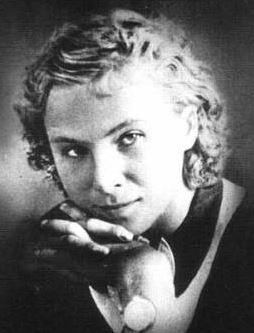
Jew of the Week: Lydia Litvyak

The White Lily of Stalingrad

Lydia Litvyak

Lydia Litvyak

Lydia Vladimirovna Litvyak (1921-1943) was born in Moscow in the early days of the Soviet Union. She was fascinated by flight from a young age, and enrolled in a flying club at 14. She flew her first plane at 15 before heading to a military flight school. After graduating, Litvyak became a flight instructor. In 1941, Nazi Germany invaded the Soviet Union. Litvyak immediately volunteered to join a fighter pilot unit. However, she was rejected based on “lack of experience”, even though she had already trained 45 other pilots! Meanwhile, Marina Raskova established an all-female fighter force, and Litvyak was accepted. In 1942, Litvyak flew her first combat missions. She was soon moved to a standard (male) air force unit. In the battle for Stalingrad, Litvyak scored her first two kills, setting her name in history as the first female fighter pilot to take down an enemy plane. She went on to run 66 combat missions, and logged 16 victories. In 1943, now promoted to junior lieutenant and awarded the Red Star, Litvyak was assigned to the okhotniki, “hunters”, experienced fighter pilots who were given permission to roam the skies on their own, and strike at will. Despite suffering multiple wounds, and recommended to go on medical leave, Litvyak refused. Shortly after, she went on her final mission, and did not return to base. Her whereabouts were unknown. She was either killed or taken captive – the latter possibility preventing her from being awarded the prestigious ‘Hero of the Soviet Union’ award. Litvyak was only 22 years old. In 1979, after decades of searching, the remains of her plane and body were found. She had been buried by local villagers, having died from a head wound. In 1990, she was posthumously awarded the Hero of the Soviet Union, with a rank of senior lieutenant. Nonetheless, some claim that she survived, and either perished in a German prisoner camp, or lived out the rest of her life in secret, marrying and having children. Litvyak’s story has been featured in several fiction novels, and even a stage production. In the Soviet Union, she was affectionately called the “White Lily of Stalingrad”.

Words of the Week

Everything is by Divine Providence. If a leaf is turned over by a breeze, it is only because this has been specifically ordained by God to serve a particular function within the purpose of creation.
– Rabbi Israel Baal Shem Tov

Litvyak2