Category Archives: Business & Finance

Jews in the World of Business and Finance

Jew of the Week: Joseph Seligman

America’s Financier

Seligman

Joseph Seligman

Born in Baiersdorf, Germany, Joseph Seligman (1819-1880) showed a creative entrepreneurial spirit from an early age. As a youth he would earn money by exchanging foreign coins for travellers while working at his family’s goods shop. At 17, Seligman decided to go out on his own, boarding a steamer for America. In Pennsylvania he worked as a cashier for a salary of $400 a year. From his earnings, Seligman started a small business delivering goods to rural farmers, saving them from having to travel to the city. His first $500 in savings was used to ferry over two of his brothers from Germany. After building a successful clothing business, the brothers went into banking, opening branches across Europe and America. Their wealth continued to skyrocket, so much so that during the Civil War Joseph Seligman disposed $200 million in bond loans to allow the war effort to continue. Historians have called this “scarcely less important than the Battle of Gettysburg”. Seligman was later offered the position of Secretary of the Treasury, but turned it down. He would go on to invest heavily in the development of the United States (as well as Russia and Peru), pumping money into railroads, bridges, shipbuilding, steel, oil and mining, even bicycles and communication lines. Together with the Vanderbilt family, Seligman financed much of New York’s public utilities. In one of the country’s most controversial events of the time, Seligman’s family was denied residence at the Grand Union Hotel by Henry Hilton, on the grounds that Jews were not welcome. Of this H.W. Beecher wrote “When I heard of the unnecessary offense that has been cast upon Mr. Seligman, I felt no other person could have been singled out that would have brought home to me the injustice more sensibly than he.”

Words of the Week

Time must be guarded… Every bit of time, every day that passes, is not just a day but a life’s concern.
Rabbi Menachem Mendel Schneerson, The Lubavitcher Rebbe (Hayom Yom, Cheshvan 17)

Jews of the Week: Nathan & Jeffrey Swartz

Jeffrey Swartz

Jeffrey Swartz

Hailing from a town near Chernobyl, Nathan Swartz was one of many Russian immigrants to the US in the early 20th century. In 1918 he started working as a shoemaker in Boston. After more than 30 years of hard work, Swartz saved enough to invest in a small shoe company (initially purchasing just half a share!) By 1955 he bought the company outright, and turned it into a family business with his sons. In 1960, the Swartz family released a new shoe made with their patented injection-molding technology that bound leather without using stitches, creating a perfectly waterproof and durable shoe. One shoe model was called Timberland, and became so incredibly popular worldwide, that the company changed its name to the Timberland Shoe Company. Timberland soon became a household name and expanded to clothing, backpacks, and other products. Today, it is a multi-billion dollar company which was run, until recently, by Jeffrey Swartz, grandson of founder Nathan Swartz. Jeffrey has become renowned for pushing corporate responsibility, green initiatives and worker’s rights. His employees receive 40 hours of pay every year to do charity work, and $3000 stipends to buy hybrid cars. Timberland has planted over one million trees worldwide, is carbon-neutral, and recycles rubber from tires. It has been listed on CNN’s “100 best companies to work for”. Meanwhile, Swartz has become a noted philanthropist and ‘social investor’. He is also a proud Orthodox Jew, waking up at 4 am each morning to study Torah. Timberland continues to be a shoe adored by construction workers and rappers alike. It has even lent its name to hit music producer Timbaland, who was nicknamed after the iconic shoe.

Words of the Week

…A shy person cannot learn, a short-tempered person cannot teach; nor does anyone who does much business grow wise.
– Hillel (Avot 2:5)

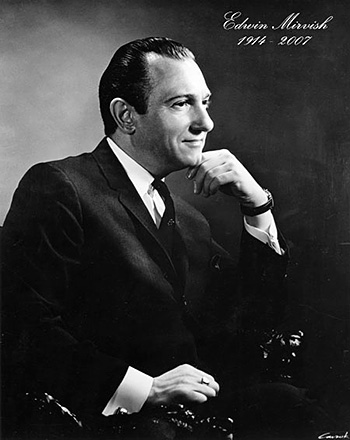
Jew of the Week: Ed Mirvish

Honest Ed

Yehuda Mirvish

Honest Ed Mirvish

Yehuda ‘Edwin’ Mirvish (1914-2007) was born in Virginia to Jewish immigrants from Austria and Lithuania. After going bankrupt, his family moved to Toronto, where Ed’s father initially worked as a door-to-door salesman before opening a small grocery store. The family lived in a space above the store, shared with a Hebrew school. When Mirvish was 15 his father died, forcing Ed to drop out of school in order to manage the store. The business wasn’t doing well, so Mirvish went on to try other store ideas including a dry cleaner and a dress shop. Finally, in 1948 Mirvish opened the famous “Honest Ed’s”, stocked with inexpensive items purchased at bankruptcy sales. The store became an instant hit, and over the years grew to fill an entire block. Mirvish purchased more buildings around the area, but was denied permission to demolish them. So he turned them into low-cost housing for artists, and this community, now known as “Mirvish Village” became Toronto’s art hub. A patron of the arts, Mirvish was also a noted philanthropist, donating 10,000 pounds of Turkey every year, among other things. Mirvish is famous for being a theatre tycoon. He bought the Royal Alexandra Theatre in 1962, saving it from demolition, built the Princess of Wales Theatre, and managed the Canon Theatre (now renamed the Ed Mirvish Theatre). His company, Mirvish Productions, brought many Broadway hits to Toronto, including The Lion King, Mamma Mia! and Hairspray. Beloved by the city, he held a free carnival every year on his birthday, which has been designated ‘Ed Mirvish Day’. He was awarded the Order of Canada, and Commander of the Order of the British Empire.

Words of the Week

The important thing is not to stop questioning. Curiosity has its own reason for existing. One cannot help but be in awe when he contemplates the mysteries of eternity, of life, of the marvelous structure of reality. It is enough if one tries merely to comprehend a little of this mystery every day. Never lose a holy curiosity.
– Albert Einstein