Category Archives: Business & Finance

Jews in the World of Business and Finance

Jew of the Week: William Fox & Joseph Schenck

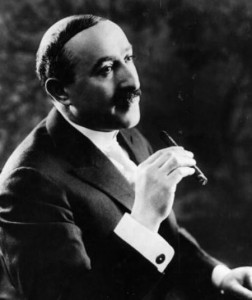
William Fox

Wilhelm Fried (1875-1952) was born in Hungary to German-Jewish parents that soon immigrated to the U.S. Growing up in New York City, Fried worked in various odd jobs in the fur and garment industry, and even as a newspaper boy. In 1904, having renamed himself William Fox, he purchased a “Nickelodeon” – the earliest kind of movie theatre (often just a converted store front) that showed short films for five cents (hence the term nickelodeon). In 1915 he founded Fox Film Corporation, which originally focused more on building theatres and studios than producing movies. In 1929, Fox attempted to buy out a major share in fellow company MGM. However, a scandal ensued and Fox’s opponents convinced the Justice Department to investigate him for violating anti-trust laws. At the same time, Fox was severely injured in a horrific car accident. Immediately after this, the stock market crashed (sparking the Great Depression). The combination of these three events drove Fox into total bankruptcy, and by 1930 he lost all control of his company. During his bankruptcy hearing several years later, Fox attempted to bribe the judge, and was thus sent to six months in prison. He never returned to the film industry, and died quietly with no Hollywood producers at his funeral.
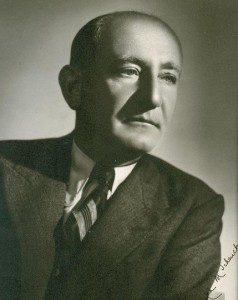
Joseph Schenck

Fox Film would be taken over by Joseph Michael Schenck (1878-1961), a fellow Jew, born in Russia. Like Fox, Schenck’s family immigrated to New York City. While working at the concession stand of Fort George Amusement Park, Schenck saw the potential of film, and saved up money, together with his brother, to buy Palisades Amusement Park in 1909. Soon after, the brothers parted and Joseph headed to Hollywood for a fresh start. He rose to become president of United Artists (a company co-founded by Charlie Chaplin). He later founded his own company – 20th Century Pictures – in 1933, together with Darryl Zanuck. Two years later, they took over Fox Film to create ’20th Century Fox’. This giant production company is behind such classics as Star Wars, Die Hard, Planet of the Apes, the Simpsons, Family Guy, the X-Files and countless other hits

Words of the Week

Do not judge your fellow until you have stood in his place.
Pirkei Avot 2:4

Jew of the Week: Charles Lazarus

Toys “R” Us!

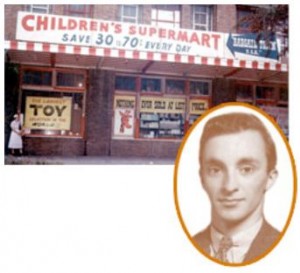
Charles Lazarus and the original Children’s Supermarket

Charles P. Lazarus (b. 1923) was born in Washington, D.C., and grew up working in his father’s bicycle shop. After returning from combat in World War II, he opened his first business, a baby furniture store called ‘Children’s Bargain Town’. In 1950, Lazarus responded to customer requests and began selling baby toys in his store. He quickly realized that toys are a much better business than furniture, as they break often, get boring quickly, and parents are always looking for new gifts for their kids. Lazarus had a vision of toys becoming an everyday commodity, as opposed to a seasonal item. He decided to try a new store concept, modelling on the self-serve grocery stores that were becoming very popular at the time. Thus, Lazarus opened the first ‘Children’s Supermarket’, which still stands today in Washington. His motto: “Give the customer what they want.” In 1957, as business boomed, Lazarus opened a second store, calling it ‘Toys “R” Us’. The chain has since expanded to over 1,600 locations around the world, employing over 100,000 people, and becoming one of the most recognizable brands globally. Lazarus personally oversaw the bulk of this growth, running his company for 46 years before stepping down as CEO and Chairman in 1994. The company continues to give back to the community with its Children’s Fund donating millions of dollars to countless children’s programs. Recently, Toys “R” Us began to cover the roof of its distribution centre with solar panels, creating a 5.4 megawatt, clean energy generator – the largest such project in North America.

Words of the Week

There is no such country as Palestine. ‘Palestine’ is a term the Zionists invented. There is no Palestine in the Bible. Our country was for centuries part of Syria. ‘Palestine’ is alien to us. It is the Zionists who introduced it.
Auni Bey Abdul-Hadi, Syrian Arab leader to British Peel Commission, 1937

Jew of the Week: Heather Reisman

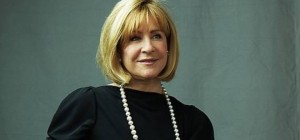
Heather Reisman, CEO of Chapters and Indigo Books

Heather Reisman (b. 1948) was born in Montreal and studied at McGill University to become a social worker. Looking for a fresh start after getting divorced, Reisman moved to Toronto and switched careers, entering the world of business. In 1979 she co-founded a consulting company which she directed for seventeen years. That experience led her to become the president of Cott Beverages in 1992 (a private Canadian soft-drink company that makes RC Cola, among others). Several years later, Reisman noticed an opportunity to expand Canada’s book retail market. In 1996 she founded Indigo Books & Music, with help from her husband Gerry Schwartz, who is listed by Forbes among the richest Canadians. In 2001, Indigo acquired its top competitor Chapters (and its subsidiaries Coles and SmithBooks) to become Canada’s largest book retailer. Reisman is still the CEO of the socially-responsible company, praised for its green initiatives, progressive policies, and for being among Canada’s top 100 employers. Indigo also produced Kobo, Canada’s most popular eReader. Reisman herself is a noted philanthropist, donating generously to the University of Toronto and Harvard, Mt. Sinai Hospital, the UJA and a host of other institutions, many of which are pro-Israel, such as the Heseg Foundation which assists Israeli lone soldiers, as well as Israeli Ethiopian and Druze soldiers. Indigo also commits $1.5 million every year to schools across Canada through its Love of Reading Foundation. For all of her efforts, Reisman has been listed among the world’s 50 top businesswomen. She has been awarded several honorary degrees, and has even served as the governor of the Toronto Stock Exchange and McGill University.


Words of the Week

When one eats and drinks, one must also feed the stranger, the orphan, the widow, and the other unfortunate paupers. But one who locks the doors of his courtyard, and feasts and drinks with his children and wife but does not feed the poor and the embittered – this is not the joy of mitzvah but the joy of his stomach.

– Maimonides (Mishneh Torah, Laws of Festivals 6:18)