
In honour of Jew of the Week’s 7th birthday this November, we will feature a month-long series on the most famous (and sometimes infamous) Jewish family of all time: the Rothschilds. This is part two of five. Click here to see part one.
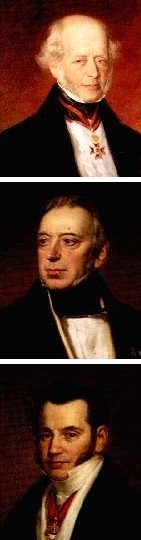 The eldest son of Mayer Rothschild was Amschel Rothschild (1773-1855). He continued his father’s business in Frankfurt, and was made a baron in 1817 (becoming “Von Rothschild”). He was the most religious of the brothers, and tremendously helped poor Eastern European Jews, who nicknamed him “the pious Rothschild”. Unfortunately, he died childless, so his Frankfurt branch was taken over by siblings and nephews. The branch was permanently shut down in 1901. Mayer’s second son was Salomon Rothschild (1774-1855), head of the Vienna branch. He played a huge role in Austria’s history, sparking its industrial revolution, igniting the Austrian economy, and financing massive public projects, including Austria’s first railway network. In honour of this, Emperor Francis made him a baron in 1822 (making him Salomon von Rothschild). Ironically, he was still not an Austrian citizen, which Jews were barred from! It was only twenty years later that he was officially made Austria’s first Jewish citizen, paving the way for equal rights for all Jews. Unfortunately, just a few years later, a wave of anti-Semitic riots broke out in Austria, with Rothschild being its main target. He had to hand over his bank, and fled to Paris. Many of the precious artworks that he collected he donated to the Louvre. The Vienna branch of the bank would ultimately be put to an end by the Nazis (having already suffered a devastating blow during the 1929 stock market crash). The Naples branch went under even earlier, during the Italian Reunification. It was founded by Kalman “Carl” Rothschild (1788-1855), the fourth son. He transformed his bank into the dominant financier in Italy, and was also made a baron. One of his clients was the Vatican Bank, and witnesses were shocked that Kalman never kissed the Pope’s feet, which everyone – even kings – had to do in those days when meeting the Pope. Kalman died in the same year as his oldest brothers, perhaps from grief after his wife and son tragically passed away as well. The remaining two sons, in London and Paris, would become the most influential Rothschilds by far, establishing institutions that continue to operate until this day. Their life and achievements will be explored next week. Click here to go to Part Three.
Words of the Week
The Rothschilds are the wonders of modern banking… we see the descendants of Judah, after a persecution of two thousand years, peering above kings, rising higher than emperors, and holding a whole continent in the hollow of their hands…
– Niles’ Weekly Register, Volume 49 (1836)
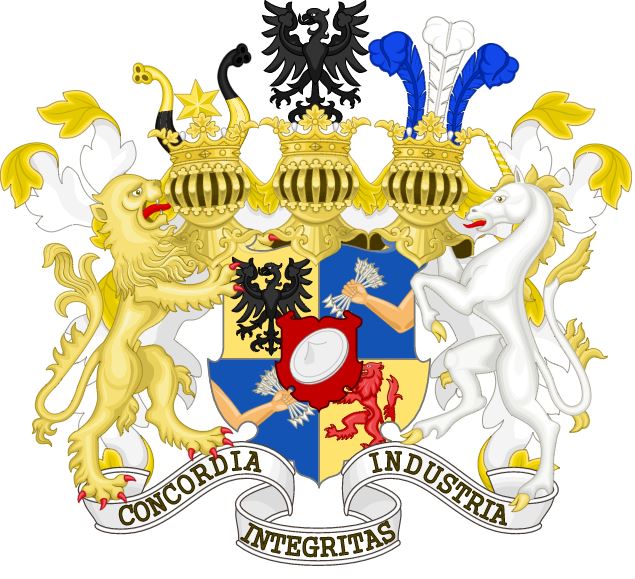
Rothschild Coat of Arms. Among the interesting symbols is a Star of David at the top left, and a hand holding five arrows, representing the five Rothschild sons, based on Psalm 127: “Like arrows in the hand of a warrior, so are the children of one’s youth.” At the centre of the logo is a red shield (for “Rothschild”) with an image of the “Judenhut”, a hat that Jews were forced to wear in Europe to distinguish them from others.
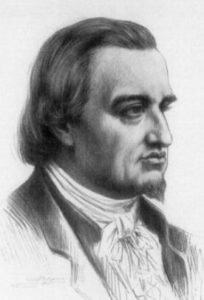 Mayer ben Anshel Rothschild (1744-1812) was born in the Jewish ghetto of Frankfurt. His father was a merchant and dabbled in currency exchange. The family had lived in the same house of the Frankfurt ghetto for over a century; a house with a red sign above the door. The family would thus become known as Rothschild meaning “red sign”, referring to that first house, even when they later moved to another property in the ghetto. Although his father wanted him to become a rabbi, Mayer Rothschild became an apprentice of Simon Wolf Oppenheimer, a banker and “Court Jew”. (Some say Mayer had to leave his rabbinic studies after his parents died.) From Oppenheimer he learned the financial business, and become a dealer of rare coins. This brought him into the court of the Prince of Hesse (a duchy within pre-Germany’s “Holy Roman Empire”). By 1785, Rothschild had become one of the Prince’s main bankers. The French Revolution erupted just a few years later, and Britain would handle its hiring of Hessian mercenaries in the conflict through Rothschild. This made Rothschild quite wealthy, and at the turn of the 19th century, he began loaning money internationally. This business was facilitated by the help of his five sons: Nathan in London, Jacob in Paris, Salomon in Vienna, Kalman in Naples, and the eldest son Amschel taking over in Frankfurt. As the family prospered and entered into the nobility, they adopted a coat of arms, the simpler version of which features a red shield with five arrows to represent the five sons (based on the words of Kings David and Solomon in Psalm 127: “Like arrows in the hand of a warrior, so are the children of one’s youth”), and a motto: concordia, integritas, industria, “Unity, Integrity, Diligence”. Mayer Rothschild also had five daughters, and instilled in all ten of his children the importance of maintaining Jewish values. Unlike other wealthy European Jews, the Rothschilds did not assimilate, intermarry, or convert to Christianity. They played a central role in easing the plight of Europe’s Jews, and later in the establishment of the State of Israel. They would amass the largest private fortune in modern history, and possibly of all time. As per Jewish tradition, Mayer and his five sons were generous philanthropists. The Rothschild model of a tightly-controlled family business, with multiple branches established by siblings, inspired many other successful banks and companies, both Jewish and gentile. Mayer Rothschild himself has been described as the “founding father of international finance”, and ranked by Forbes among history’s most influential businesspeople. Next week we will explore the lives and achievements of his sons.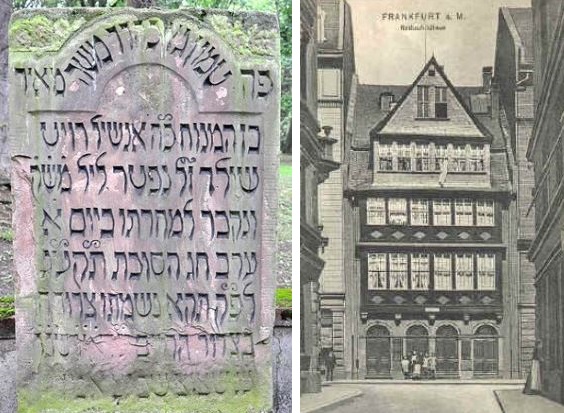
 Yuri Bentsionovich Milner (b. 1961) was born in Moscow. He studied theoretical physics at Moscow State University before working at the prestigious Lebedev Physical Institute. He found that his abilities in physics were not the best (especially because he was placed on a lower track due to his being Jewish), and decided to switch to business. He first tried selling computers, then went to do an MBA at the University of Pennsylvania, becoming the first person from the Soviet Union to officially study in the US. Upon graduation, he got a job at the World Bank, and in 1995 was made CEO of Russian oligarch Mikhail Khodorkovsky’s investment company. In 1999, Milner read an article and decided it was a good idea to start an online business. He began a series of ventures that brought American-style sites to Russia, including Molotok.ru (the Russian eBay), Boom.ru (free webhosting), and 24×7 (Russia’s Amazon). In 2005, Milner established his own investment fund, Digital Sky Technologies. Five years later, his Mail.ru went public on the London Stock Exchange with a valuation of $5.6 billion. That same year, Milner bought pioneering Israeli instant messaging company ICQ, and has since invested an additional $150 million in Israeli startups. Milner’s venture capital fund has become one of the world’s greatest. He was among the first to invest in Facebook, with an initial $200 million, and plenty more since. He also invested $800 million in Twitter, $125 million in WhatsApp, and $1.6 billion in Alibaba, in addition to Groupon, Snapchat, Airbnb, and Spotify. In 2012, Milner established the Breakthrough Prize, awarding $3 million to great achievements in Physics, Life Sciences, and Mathematics. This is now the largest scientific award in the world, trumping even the Nobel Prize. In 2015, Milner founded the Breakthrough Initiatives to investigate life on other planets. Its first project is a $100 million, 10-year endeavour called “Listen”, searching for radio and laser signals from distant stars with the most sensitive equipment in the world. The most recent Breakthrough Initiative is “Starshot”, investing $100 million to develop a spacecraft that will be accelerated to 20% of the speed of light and take a 20 year journey to our nearest star. Milner also awards (together with