Category Archives: World of Sport

Jews in the World of Sport

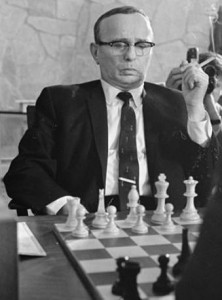
Jew of the Week: Samuel Reshevsky

Chess Prodigy Shmuel Reshevsky

Szmul Rzeszewski (1911-1992) was born near Lodz, Poland. By age 8 he was easily defeating skilled adults in the game of chess. In 1920, his family moved to the U.S., where the nine year old Reshevsky was supporting his family financially through his earnings playing in chess tournaments. In 1922, he was the youngest ever to compete in the New York Masters Tournament. This caught the ire of the government, since Reshevsky was not attending school. Thus, he gave up chess for 7 years while he zoomed through his formal education (and became, officially, an accountant). Reshevsky returned to chess and immediately won the US Open Chess Championship. He would win the championship an amazing 8 more times in his life. He still holds the record for most championship matches (21), most games played (269) and most games won (127). He was equally successful globally, winning his first international tournament in England in 1935, and receiving the title of International Grandmaster in 1950. Following this, Reshevsky won an 8-game match billed as the “Championship of the Free World”. Most famously was a 16-game match with rising star Bobby Fischer in 1961. Reshevsky would win many more awards over his career, and participated in a record 11 World Championships, defeating 7 world champions. Reshevsky also wrote several popular books on chess. Perhaps most impressively, he was a fully-observant Orthodox Jew, studied Torah every day, and never played a match on Shabbat. He once considered retirement and asked the Lubavitcher Rebbe for advice. The Rebbe suggested to keep playing, for it was a great Kiddush Hashem – sanctification of God. In the Jewish community of Crown Heights where he lived, he would always be known as “Shmulik der vunderkind”.

Words of the Week

If you are depressed, you are living in the past. If you are anxious, you are living in the future. If you are at peace, you are living in the present.
– Lao Tzu

Jew of the Week: Rafael Halperin

Rafael “Mr. Israel” Halperin

Rafael Halperin (1924-2011) was born in Vienna, immigrating to Israel as a child along with his family who fled rising tensions in Europe. Despite living in Ultra-Orthodox Bnei Brak, and studying in yeshiva, Halperin was drawn to body-building and exercise. To everyone’s surprise, Halperin’s rabbi, the famous Chazon Ish – one of the greatest Jewish leaders of the last century – actually permitted Halperin to pursue his new passion! After learning the depths of the sport in the U.S., Halperin returned to Israel and opened The Samson Institute – Israel’s first chain of gyms and health clubs. He soon organized the first ever Mr. Israel contest, and drew the attention of a wrestling promoter. As a professional wrestler, Halperin earned the nickname ‘Samson the Second’. Among the most famous wrestlers at the time, he refused to throw matches or participate in match-fixing, which has always been the norm in wrestling. [Click here to see Halperin in action.] Amazingly, he was also the personal trainer for Ethiopia’s emperor Haile Selassie, the father of Rastafarianism. Halperin was adept in business, opening many restaurants and hotels across Israel, as well as the country’s first automated car wash. His greatest success was ‘Optica Halperin’, Israel’s largest chain of optical stores. To the last days of his life, Halperin was a businessman. A year before his passing, he opened ‘Zisalek’, Israel’s newest glatt-kosher ice cream parlour. Devoutly religious throughout his life, Halperin officially received his rabbinic ordination in the 1970s, and in his later years worked to develop a credit card that wouldn’t function on Shabbat. Oh, and he also started his own political party called Otzma, published several books including an encyclopedia, worked as a diamond cutter, was once Israel’s karate champion, and fought in the Yom Kippur War. What have you done lately?

Words of the Week

Everybody is a genius. But if you judge a fish by its ability to climb a tree it will live its whole life believing it is stupid.
– Albert Einstein

Jews of the Week: Salita, Foreman and Greenberg

Jewish Boxers 

Yuri Foreman, Rabbi Boxer

From the beginnings of professional boxing early in the last century, Jews have played an enormous role in the sport. The tradition continues with today’s two young stars Dmitry Salita and Yuri Foreman. Most amazingly, both are practising Orthodox Jews! Salita was born Dmitry Lekhtman in Odessa, Ukraine (he uses the maiden name of his mother, who passed away from breast cancer). His family immigrated to Brooklyn where he began his career at age 13, building an amateur record of 59 wins to just 5 losses. At 19 he began his professional career, and his record stands at 33 wins, 1 draw and 1 loss, with 17 KOs. Salita has said, “I will never compromise my beliefs. Never. It’s not a question. I have a personal relationship with God… My boxing is such a big part of my life, but it won’t get in the way of my religion.” Meanwhile, Yuri Foreman was born in Belarus, where his mother signed him up to boxing so that he can stand up to anti-Semites. The family moved to Israel, then Brooklyn. Foreman recorded 75 wins to 5 losses in his amateur career, and since going pro has 28 wins and 2 losses. He is also studying to become an Orthodox Rabbi, and has said, “You have the physical and mental challenges in boxing, just like you have lots of challenges in exploring the different levels of Judaism. They are different but the same.” Final mention goes to rising star Roman Greenberg, nicknamed “the Lion from Zion”, a Moldovan-Israeli who was the youngest ever to win Israel’s heavyweight title. His record stands at 27-1. He says: “I represent Israel and myself. All through history, the Jews have always had to fight for their freedom and for their lives. When I come out wearing the Star of David, it shows the whole world that the Jews are still here and that they are successful.” Amen.

Kosher Boxer Dmitry Salita


Words of the Week

We can easily forgive a child who is afraid of the dark; the real tragedy of life is when men are afraid of the light.
– Plato