“The Jewish Avenger”
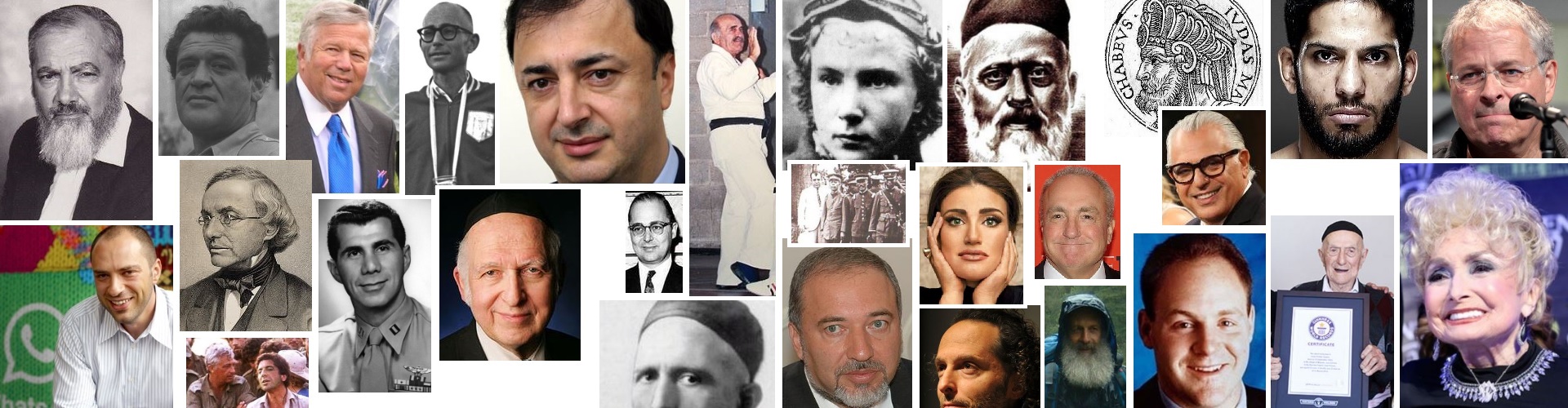
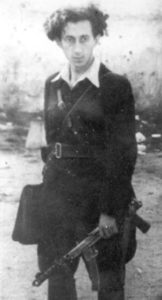 Abel “Abba” Kovner (1918-1987) was born in what is today Belarus and grew up in Vilnius (then part of Poland). As a young man, he was a member of HaShomer HaTzair, the Zionist youth movement. When the Nazis invaded Vilnius in 1941, Kovner escaped to a convent, but soon returned to the Vilna Ghetto to organize a Jewish resistance. At the start of 1942, Kovner secretly published a manifesto inside the Ghetto to inspire the Jews to fight back, writing that it was better to die than “go like lambs to the slaughter”. Along with several other young men, Kovner formed the United Partisan Organization, possibly the first armed underground Jewish group in Nazi Europe. Before they could launch their first large-scale attack, the Vilna Ghetto was liquidated in 1943, forcing the group to flee to the surrounding forests. From there, they launched a guerrilla warfare campaign against the Nazis. The small group began calling themselves “the Avengers” (HaNokmim) and were successful enough to draw the attention of the Red Army. They would go on to coordinate with the Soviets to crush the Nazis in Eastern Europe. Once the fate of the Nazis was sealed towards the end of 1944, Kovner was among the founders of a new group, called Bricha (“Escape”), which worked to get Jewish refugees out of Europe and to the Holy Land. Over the next couple of years, they would successfully move 250,000 Holocaust survivors to Israel. Having seen first-hand the horrific devastation inflicted by the Nazis, Kovner yearned for revenge. He started yet another group, called Nakam (“Vengeance”), seeking to punish Germany for the Holocaust. “Plan B” was to poison the water supply in Allied prisoner-of-war camps where Nazi SS soldiers were kept. The far more controversial and shocking “Plan A” was to poison the water supplies of several major German cities in order to kill 6 million Germans, one for each Jew lost in the Holocaust. Thankfully, Plan A was soon abandoned, though Kovner was still arrested by the British and held in a Cairo prison for several months. He did aim to accomplish Plan B, and Nakam members infiltrated a POW camp bakery in April 1946, coating the loaves of bread with arsenic. Over two thousands German soldiers fell ill, though no deaths were reported. In December 1947, Kovner joined the Haganah and fought in Israel’s Independence War as a captain of the Givati Brigade. Following this, he lived out the remainder of his life in a kibbutz, working tirelessly to strengthen the nascent state. He also helped to design several Holocaust museums, and testified at the Eichmann trial. More famously, Kovner wrote a series of poetry books (in Hebrew and Yiddish) describing the struggles he faced during the Holocaust and in Israel’s early years. This made him one of the country’s most celebrated poets and writers. For this, he won the Israeli Prize for Literature in 1970. A heavy smoker, Kovner succumbed to tracheal cancer before his 70th birthday.
Words of the Week
It is perfectly clear that the Arab nations do not want to solve the Arab refugee problem. They want to keep it as an open sore, as an affront against the United Nations, and as a weapon against Israel… Arab leaders don’t give a damn whether the refugees live or die.
— Sir Alexander Galloway, former head of UNRWA
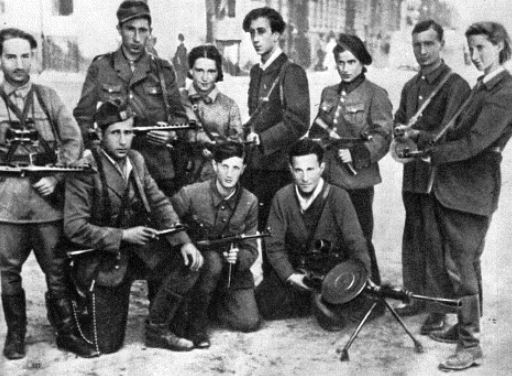
Abba Kovner (Centre) and his Avengers.
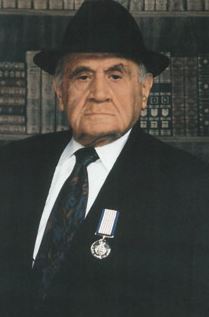
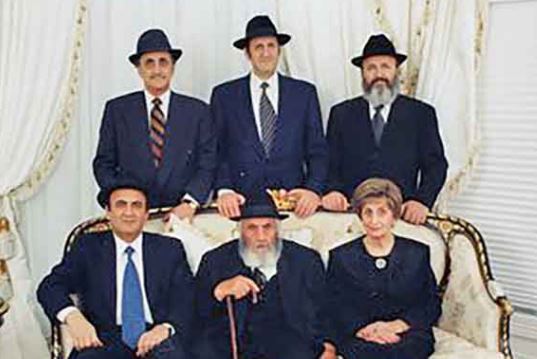
 Aharon Yehuda Leib Shteinman (1914-2017) was born in what is now the city of Brest, Belarus. To avoid being conscripted into the Polish army, the young yeshiva student fled to Switzerland with some classmates. He continued his diligent studies in a Swiss yeshiva until being arrested during World War II and sent to a labour camp. Shteinman was the only member of his family to survive the Holocaust. He settled in Israel after the war. There, the young rabbi quickly made a name for himself as a Torah prodigy, and was soon appointed rosh yeshiva, head of a Torah academy. He would serve as a rosh yeshiva for the next five decades, while also establishing a number of children’s schools for the underprivileged. Meanwhile, Rav Shteinman wrote profusely, authoring dozens of bestselling books and discourses on Torah, Talmud, and Jewish thought, as well as being recognized as an expert in the field of education. While abstaining from politics himself, Rav Shteinman was the spiritual leader of Israel’s Degel HaTorah party, playing an influential role in government. In his 90s, and in frail health, the Rav decided to journey around the world to strengthen Jewish communities. Countless thousands gathered to greet him and hear his wise words in Los Angeles, New York, Mexico City, Buenos Aires, Manchester, Odessa, Berlin, Gibraltar, Paris, and many more small towns. On these trips, he would give as many as 10 talks a day.
 Rav Shteinman was known for his extreme piety, humility, and modesty. His daily diet was nothing but a cucumber, a boiled potato, and one small bowl of oatmeal. He lived in a tiny apartment, with little furniture but walls lined end to end with books. He slept on the same thin mattress that was given to Jewish refugees upon arrival in Israel for some 50 years. Streams of people lined up at his open door each day seeking counsel and blessings. Rav Shteinman stood only for truth, even when it brought him adversity. This was particularly clear when he supported the Nachal Charedi, an IDF unit for yeshiva students. Even after some backlash from ultra-Orthodox communities, the Rav stood his ground and continued his support. He was widely recognized as the gadol hador, the world’s chief rabbi. Sadly, the great rabbi passed away yesterday, at 103 years of age. (His condition had turned critical two weeks ago after the tragic death of his 72-year old daughter from a heart attack, even though no one had told him of her passing.) Rav Shteinman wrote in his will that it would suffice to have just ten men to carry out his funeral, and requested no eulogies. Nonetheless, the funeral procession brought over 600,000 people. Israel’s President Reuven Rivlin stated that Rav Shteinman “bore the entire weight of the Jewish people’s existence on his shoulders… he knew how to convey his ideas gently, in a pleasant manner, and with a great love of the Jewish people… He was a man whose wisdom was exceeded only by his humility.”