Tag Archives: World War II

Jew of the Week: Sid Caesar

Greatest Comedian of All Time

Sid Caesar

Sid Caesar

Isaac Sidney Caesar (1922-2014) was born in New York, the third and youngest son of a mother from Russia and a father from Poland (given the name ‘Caesar’ by an immigration official). His parents ran a 24-hour eatery where, as a child, he would mimic and entertain the restaurant patrons. After high school, he intended to pursue a career in music as a saxophone player. From a small sax gig, he moved onto a dance band, then a comedy show when his jokes got more applause then his music. At the end of World War II (when he played for a military band), Caesar made his way to Hollywood and began starring in film. He also performed stand-up at comedy clubs, and had a stint on Broadway before focusing on television. Perhaps his most famous skit was double-talk, where he mimicked virtually any language perfectly, without actually saying anything intelligible (he only spoke English and Yiddish fluently). In the 1950s, Caesar was behind the greatest show on television, ‘Your Show of Shows’, watched by over 60 million people weekly. For this, he won his first Emmy, and was voted America’s Best Comedian. He would go on to make several other successful TV programs, and is even credited with helping make TV the dominant medium at a time when radio was still king. Caesar’s comedy is said to have revolutionized the entire genre, and inspired the next generation of comedians, many of which consider him the greatest funnyman of all time.  Meanwhile, he did a great deal of charity work (click here to see Caesar’s double-talk at Chabad fundraisers) and was happily married for 67 years. Sadly, Caesar passed away last week.

Words of the Week

When God created the first man, He showed him all the trees of the Garden of Eden, and said to him: ‘See My works, how beautiful and praiseworthy they are. And everything that I created, I created for you. Be careful not to spoil or destroy My world—for if you do, there will be nobody after you to repair it.’
– Midrash Kohelet Rabbah 7:13
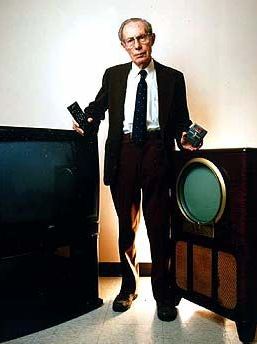
Jew of the Week: Robert Adler

Robert Adler & the TV Remote

Robert Adler & the TV Remote

Robert Adler (1913-2007) was born in Vienna where he received a Ph.D in physics. At the start of World War II, Adler fled to Belgium, then England, and finally to the US. He soon found a job working at Zenith Electronics, developing military technologies to support the war effort. After the war, Adler turned his attention to television. His first major breakthrough was the gated-beam tube, a revolutionary new type of vacuum tube that significantly reduced both TV costs and signal interference. Meanwhile, a fellow worker at Zenith, Eugene Polley, developed the first (wireless) TV remote control. However, this remote used flashes of light, and could therefore be triggered by sunlight. The company searched for a better solution, and one that required no batteries. Adler came up with a remote that used sound instead of light, and this became the standard for remote controls for the next 25 years (until replaced by infrared remotes that are common today – and unfortunately require batteries). Aside from the remote, Adler owned roughly 180 patents, including early forms of videodiscs and novel laser technologies. He filed his last patent (for improved touch-screen technology) at age 93! Working at Zenith for 41 years (and an additional 15 years as an adviser), he became the company’s vice-president and director of research. For his work, Adler received the coveted Edison Medal, as well as an Emmy Award.

Words of the Week

The people of Israel did not believe in Moses because of the miracles he performed. So why did they believe in him? Because when we stood at Sinai, our own eyes saw and our own ears heard the fire, the sounds and the flames, and how Moses approached the cloud and God’s voice called to him…
Maimonides

Jew of the Week: Paul Reichmann

Paul Reichmann

Paul Reichmann

Moshe Yosef “Paul” Reichmann (1930-2013) was born in Vienna to Hungarian Orthodox Jewish parents. By a miracle, the family escaped Austria right before the Nazi takeover of the country, then fled from Hungary to Paris to Morocco. At the end of World War II, Reichmann studied in yeshivas in England and Israel before returning to Morocco and working as a shirt salesman. Shortly after, he moved to Toronto to open a new branch of his brother’s tile company, Olympia. By 1964, he built a separate property development company called Olympia & York. In 1976, the company built First Canada Place – what was then Canada’s tallest building (and the tallest bank office tower in the world). The company would expand to New York and Tokyo, London and Israel, becoming the world’s largest property developer. Reichmann’s vision of magnificent buildings adorning the skyline prompted Prince Charles to comment: “Do they have to be so tall?” Despite the tremendous success, Reichmann never abandoned his Orthodox roots, maintaining his prayer and study regimen, and having his company cease all operations on Shabbat and holidays. He used a great part of his fortune to finance synagogues, yeshivas, and charitable institutions around the world. In 1992 he lost the bulk of his wealth when Olympia & York went bankrupt in the midst of a large economic recession (and a failed project for London’s Canary Wharf – considered one of the largest development projects in history). He managed to rebuild a sizable portion of his wealth over the next two decades, and continued donating millions of dollars every year to good causes. Very private and shunning luxury, Reichmann was famous for his business integrity. He would seal multi-million dollar deals with a handshake, and never failed to keep his word. Sadly, the man who touched so many lives passed away earlier this week. Click here to read more about one of the greatest philanthropists of the century, and watch a video here.

Words of the Week

Abraham was told that his descendants will be like the dust of the earth [Genesis 13:17], and as the stars of heaven [Genesis 15:5]. So it is with Israel: When they fall, they will fall as low as the dust; when they rise, they will rise as high as the stars.
– Midrash Pesikta Zutrati