Tag Archives: World War II

Jew of the Week: Emanuel Tanay

Emanuel Tanay (Photo Credit: John Lofy)

Emanuel Tanay (Photo Credit: John Lofy)

Emanuel “Emek” Tanay (1928-2014) was born in Vilnius, Lithuania and grew up in Poland. The Holocaust began while he was still young, and he spent the first part of it hiding in a Catholic monastery. After his father died in a concentration camp, Tanay led his family out of Poland, through Slovakia and Hungary, finding hiding places and falsifying papers to keep himself and his remaining family members alive. Following the war, he moved to the US and studied psychiatry. Tanay went on to become a professor of psychiatry at Wayne State University, and was internationally renowned in his field. He dedicated a major part of his career to treating Holocaust victims, as well as working with the German government to provide compensation for survivors. Because of his own experiences in the Holocaust, Tanay worked tirelessly for those suffering from Post-Traumatic Stress Disorder (PTSD). He was part of a group of scientists who got PTSD recognized as a real, treatable condition. At one point, he was described as “the nation’s premier psychiatric theorist on homicide”, and served as an expert witness in some of the most famous trials of recent history, including that of Jack Ruby and Ted Bundy. Meanwhile, Tanay worked for his local Jewish community, too, founding the Jewish Council in the town of Grosse Point, and serving as its president. Tanay wrote three important books, including his reflections on the Holocaust in a book called Passport to Life, highly praised by fellow Holocaust survivor Elie Wiesel. He appeared on numerous television shows, and his story is explored in the Oscar-nominated documentary Courage to Care. Sadly, Tanay passed away on the 5th of August from prostate cancer.

Words of the Week

If you wait until you find the meaning of life, will there be enough life left to live meaningfully?
– Menachem Mendel Schneerson, the Lubavitcher Rebbe

Jew of the Week: Moe Berg

Baseball Player, Lawyer… and Secret Agent 

Moe Berg

Moe Berg

Morris Berg (1902-1972) was born in New York to Russian-Jewish immigrants. He began playing baseball at age 7, and by 16 was on Newark’s baseball “dream team”. He studied first at New York University, then Princeton, and graduated with a degree in languages, learning to speak seven of them. By his senior year, he was captain of Princeton’s baseball team. A day after his last game with Princeton, Berg signed a contract with the Brooklyn Robins. In the off-season, he headed to Paris and continued his studies at the world-famous Sorbonne (University of Paris). There, he began a personal routine of reading as many as 10 newspapers every single day. Berg was never very good at baseball, and was often traded and loaned between many different teams. Always a scholar first, in 1926 he told the Chicago White Sox that he is skipping spring training because he was enrolled in law school at Columbia University. He earned his law degree in 1930, and then split his time between baseball in the summer and working at a prestigious Wall Street law firm in the winter.

In 1932, Berg toured Asia, visiting Japan, China, Siam, India, and Egypt. A couple of years later, he returned to Japan with a video camera, later traveling to the Philippines, Korea, and Russia, before returning to play with the Red Sox for 5 seasons, then coaching the team for 2 more. After the attack on Pearl Harbor, Berg joined the war effort and eventually became a spy. He shared his video footage of Japan, which was instrumental in planning American raids during the war. After serving in South America and the Caribbean, Berg was parachuted into Yugoslavia to assist resistance groups fighting the Nazis. His next mission was to travel across Europe and convince scientists working for the Nazis (particularly on their nuclear bomb project), to come work for the U.S. instead. In 1951, he requested that the CIA station him in Israel. Instead, they sent him to Europe to spy on Soviet nuclear work. In 1954, the CIA let him go and for the rest of his life Berg lived with his siblings, having never married. His wishes were to be cremated, and his ashes were scattered in Jerusalem. Berg was inducted into the Jewish Sports Hall of Fame, and Baseball’s Shrine of the Eternals. He was awarded the Medal of Freedom, and his baseball card is on display at CIA headquarters. Berg was described as “the most scholarly professional athlete”, and the “strangest man ever to play baseball.”

Words of the Week

If you begin a good deed, finish it, for a mitzvah is credited to the one who concludes the task.
– Talmud, Sotah 13b

Jew of the Week: Edwin Land

Say Cheese!

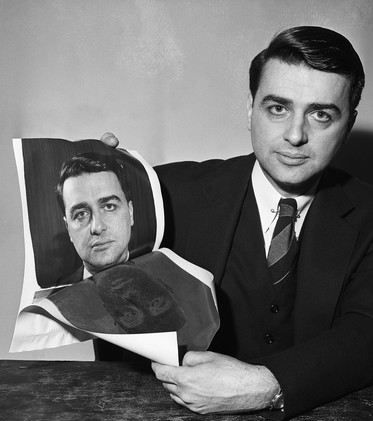
Edwin Land, Inventor of the Polaroid Camera

Edwin Land, Inventor of the Polaroid Camera

Edwin Herbert Land (1909-1991) was born in Connecticut, the son of a Russian-Jewish immigrant father. From a young age he loved taking things apart, and dreamed of inventions. He went to Harvard to study chemistry but left after just a few months. Land moved to New York, and there invented a filter that could polarize light. He returned to Harvard and spent three more years there, but once again dropped out, this time to start a company with his physics instructor, who came from a wealthy family and could provide the funds for Land’s work. Land first applied his filter technology to glasses, and invented polarized sunglasses. His technology spread rapidly, and was used in 3D movie glasses, LCD screens, windows, headlights and windshields. As the company grew larger, he renamed it the Polaroid Corporation in 1937. During World War II, Land focused his attention on military technology to assist the war effort. He helped develop some of the earliest night-vision goggles, smart bombs and heat-seeking bombs, as well as the Vectograph, which allows soldiers to identify camouflaged enemy troops. Land’s most famous invention would come after the war, when he put his mind towards making a camera that would generate a photograph immediately. Thus was born the instant camera, also known as a Polaroid camera, and originally called the Land Camera. Madly popular, the camera made Polaroid world-famous, and the “darling of Wall Street”. Land continued to assist the military and the government during the Cold War, spearheading the U2 spy plane, balloon cameras, satellite cameras, and various espionage technology. He was a regular adviser to American presidents. Land remained a scientist his whole life, running experiments daily. A true visionary, when he had an idea he wouldn’t rest until he could materialize it; he would often have to be reminded to eat, and once wore the same clothes for 18 days straight. Land was also a humanist and proponent of social justice, giving priority to hire women and African-Americans in his labs, at a time when it was highly unpopular to do so. He was beloved by the people and the press, won a long list of awards (including the Medal of Freedom), and was inducted into the National Inventors Hall of Fame. His original polarizer invention was said to be “the most significant invention in the field of optics, certainly within the last generation, probably in the last century.” He finally earned an honourary degree from Harvard in 1957.

Words of the Week

Our young people, for the most part – unless they are geniuses – after a very short time in college give up any hope of being individually great. They plan, instead, to be good. They plan to be effective. They plan to do their job… It has become our habit, therefore, to think that the age of greatness has passed, that the age of the great man is gone… But I submit to you that when in each man the dream of personal greatness dies, democracy loses the real source of its future strength.

– Edwin Land