Tag Archives: World War I

Jews of the Week: The Warner Brothers

Few people know that the Warner Brothers that brought you hundreds of great films (such as The Dark Knight and The Matrix trilogies) and amazing television programs (Bugs Bunny and the Looney Tunes) were Jewish immigrants from Poland. Their names were Hirsch Moshe, Avraham, Shmuel and Yakov. Struggling to make a living, the family moved to the U.S., then to Canada, then back to the U.S., at which point the father of the brothers adopted the name Warner, changing it from Wonsal. The brothers worked in various odd jobs – bowling alleys, bicycle shops, meat salesmen – until they finally pooled their earnings and invested in a film projector. They would travel across small mining towns and put on film screenings. Once they saved enough money, they opened a proper theatre in Pennsylvania. It was such a success that they could soon afford to open more than a dozen other theatres.

During World War I, the brothers began experimenting with making their own films. In 1918, they officially opened Warner Brothers Studio in Hollywood, with their first popular film My Four Years in Germany. However, WB only made it big with their famous dog Rin Tin Tin, a German shepherd rescued by an American soldier. The dog became such a celebrity that WB signed Rin Tin Tin to star in films for $1000 per week – a great deal of money at the time. WB’s fame continued to rise, and by 1924 they were already the most successful independent studio in Hollywood. WB became a pioneer in motion pictures, and was the first studio to produce a “talking picture”, sparking the “talkie” revolution and changing the course of film. They would do this again in the 1930s, ushering in the “realistic” film period, as well as popularizing children’s cartoons. The success of Warner Brothers would continue to grow over the decades and their reach was extended to music (Warner Brothers Records), television (the WB Network) and even comic books (DC Entertainment). Thanks to the success of the Harry Potter films, WB became the first studio to gross over $2 billion domestically in just one year. They continue to produce hits and elevate film-making to new heights.

Words of the Week

“Who the heck wants to hear actors talk?”
Hirsch “Harry” Warner, when first hearing of the talking picture.

Jew of the Week: Marcus Samuel

Oil & Seashells

Marcus Samuel, Oil Baron

Marcus Samuel (1853-1927) was born in London to a wealthy Iraqi-Jewish family originally from the Netherlands. On a trip to the Black Sea in 1890, he saw the potential in oil (still a novel resource at the time). Samuel ordered the construction of 8 tankers that met the highest safety standards, receiving permission to transport oil to Asia across the newly-built Suez Canal. Thus was born Shell Oil, taking the name of the Samuel family business, which began meagerly just a few decades earlier by selling painted seashells. Using one of his tankers, Samuel once saved the stranded ship HMS Victorious, a feat for which he was knighted. Previously, Sir Samuel had served as the Sheriff of London, and even its Mayor! For his role in fueling the Allies in World War I, he was made 1st Baron of Bearsted, and later 1st Viscount of Bearsted. Lord Samuel was known for his incredible devotion to his wife and four children. So much so, in fact, that he died less than 24 hours after the passing of his beloved wife. At death, he left his large estate to be transformed into a public park, an orphanage and a nursing home. Today, his company is known as Royal Dutch Shell, after having merged in 1907 with the Royal Dutch oil company in order to compete with Rockefeller’s Standard Oil. Shell is currently the 5th largest company in the world, with a yearly revenue of over $360 billion.

Today is Tu B’Shvat!

Words of the Week

If you live as though there will always be a tomorrow, then you’ll never make much of today.
– Rabbi Noah Weinberg

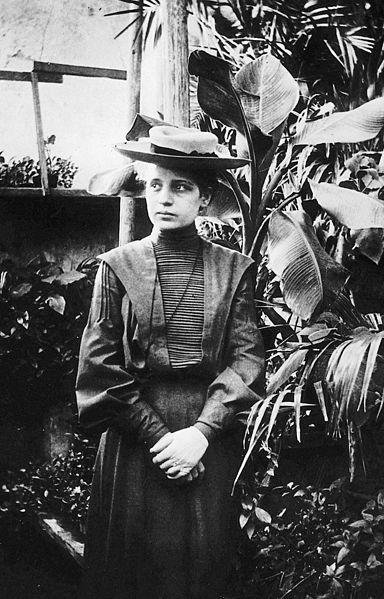
Jew of the Week: Lise Meitner

The Mother of the Atomic Bomb

Lise Meitner

Lise Meitner (1878-1968) was born in Vienna, the daughter of the first Jewish lawyer in Austria. Meitner showed an early interest in nuclear physics, working alongside such greats as Max Planck and Neils Bohr. Following World War I (in which she served as an x-ray nurse), Meitner discovered the famous “Auger effect”, but all the recognition was taken from her and given to Pierre Auger, hence the name. Soon after, she became the first-ever female professor of physics in Germany, but it did not last. Meitner was forced to flee from the Nazis. Over the course of her career, she helped discover many new elements of the periodic table, but by far her greatest achievement was the discovery of nuclear fission. Meitner was the first to show a nuclear chain reaction can release tremendous amounts of energy, the basis for nuclear bombs (and power plants). This inspired celebrity genius Albert Einstein to write a letter to President Roosevelt, initiating the Manhattan Project. Meitner was asked to work on the Project, but she refused with the words: “I will have nothing to do with a bomb!” Nonetheless, she is often called the Mother of the Atomic Bomb. Unbelievably, she was slighted once again when the Nobel prize for nuclear fission was given to Otto Hahn. If it is any consolation, the element Meitnerium (Mt, number 109) is named after her. November 17 was her birthday.

Words of the Week

When something is broken below, repair it above. And know that it is never truly repaired above until it is in order below.
– The Chassidic Masters


Jew of the Week is One Year Old! See the Jew that started it all…