Greatest of Sages
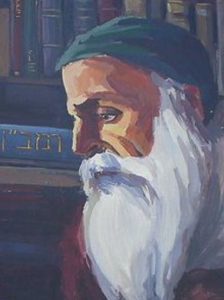
 Hillel (c. 110 BCE-10 CE) was born in Babylon to a poor Jewish family, descended from the tribes of Judah and Benjamin. To make a living, Hillel worked as a lumberjack. At the age of 40, he decided to move to Israel and further his Jewish studies. He went to work each morning and earned just enough to pay for his family’s needs, and for the tuition to the Jerusalem yeshiva of the sages Shemaiah and Avtalion. One winter, when he didn’t have the funds to pay the yeshiva fee, Hillel climbed up to the roof to listen in to the classes from the chimney. He was so engrossed in the learning that he didn’t realize the snowstorm that began to brew around him. In the morning, the yeshiva students noticed the clogged chimney and went up to find Hillel frozen on top of it. For his dedication, he was granted free tuition for life. Hillel went on to become the greatest rabbi in the world. He headed the Jerusalem yeshiva, and was also elected president (nasi) of Israel, and chief of the Sanhedrin. He had eighty pairs of disciples, including the famed rabbis Yonatan ben Uziel and Yochanan ben Zakkai. Hillel was famous for his incredible patience. In one account, a man made a bet that he could get Hillel angry so he bothered Hillel incessantly on the eve of Shabbat, yet Hillel remained calm and pleasant. When the man admitted to the bet and told Hillel how he lost 400 zuz, a huge sum of money, Hillel replied: “It is better that you lose 400 zuz, and even another 400 zuz, than that I should get angry!” The school of Hillel became the dominant school in Judaism, and to this day Jewish law always rules according to Beit Hillel. He is one of the most-oft cited sages in the Mishnah, the ancient corpus of Jewish law. Among his most well-known teachings is the Golden Rule: “That which is hateful to you, do not do to your fellow”, and “If I am not for myself, who will be for me? If I am only for myself, what am I? And if not now, when?” Finally, it was Hillel who instituted the prozbul: In the sabbatical Shemitah year (such as the one beginning next week), the Torah commands that all personal debts between Jews must be cancelled. Because of this, Jews started to avoid handing out loans in the months before the sabbatical, worried that they would never be repaid. To ensure that the needy could still draw loans, Hillel crafted an important legal loophole known as the prozbul, still widely used. According to tradition, Hillel lived 120 years. He stood up for the poor and oppressed, and was beloved for his kindness, charity, and positivity. The Sages would later remark that each person should strive “to be humble and patient like Hillel.”
Shana Tova u’Metuka! Have a Wonderful 5782!
The Kabbalah of Hillel and Shammai
Words of the Week
Gems from Hillel the Elder:
“Do not judge your fellow until you are in his place.”
“Whoever destroys one soul, it is as though he had destroyed the entire world. And whoever saves a life, it is as though he had saved the entire world.”
“Where there are no men, strive to be a man!”
“Do not say ‘When I have free time I shall study’ – for you may never have any ‘free time’.”
“Be like the disciples of Aaron: loving peace and pursuing peace, loving all of God’s creations, and drawing them closer to the Torah.”
 Eilat Mazar (1956-2021) was born in Israel to a family of archaeologists, and grew up playing and learning on excavation sites. Her grandfather, Benjamin Mazar, was the State of Israel’s first official archaeologist, and was the president of the Hebrew University. Eilat studied archaeology at the same university, and began her field work in 1981. She made a big splash right away by discovering the Royal Quarter of the ancient City of David in Jerusalem, including what is thought to be the royal palace of King David himself. She went on to uncover some of the biggest finds of the last century, including parts of the walls built by King Solomon, the seal of King Hezekiah, and the seal of the Prophet Isaiah. Mazar was driven by her belief that the Tanakh records actual historical events (whereas many of her secular colleagues often viewed the Tanakh as mythology). She would say that “I work with the Bible in one hand and the tools of excavation in the other.” Over the decades, her work played a major role in helping to prove the authenticity of the Bible. Mazar discovered countless treasures from the First and Second Temples in Jerusalem, and was a vocal activist trying to stop Palestinian and Jordanian authorities from