First Female Secretary of State
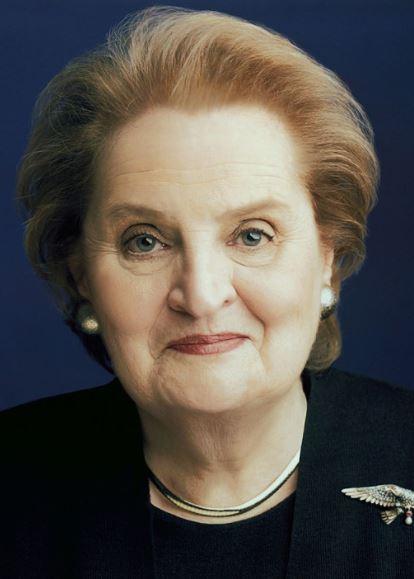 Marie Jana Korbelova (1937-2022) was born in Prague to a Jewish family. Her father was a Czech diplomat and when Hitler occupied Czechoslovakia in 1938, the family fled and ended up in Britain. Traumatized by what they had experienced, and distraught over the loss of their parents and many other relatives in the Holocaust, the Korbels decided to convert to Catholicism and bury their Jewish identity for good. They did not tell their children that they were Jewish. After the war, the family return to Prague and Marie Jana went on to study in Switzerland, where she changed her name to Madeleine. When the Communists took over Czechoslovakia in 1948, the family fled again, this time to the US. Madeleine studied political science and wrote for The Denver Post, where she met her husband, journalist Joseph Albright. She went on to earn her Ph.D, focusing on the Soviet Union, and became fluent in Russian. In 1980, she was given a research grant at the Woodrow Wilson International Center for Scholars and explored Poland’s solidarity movement. She traveled across Poland for a long time and became fluent in the language. When she returned, Albright became a professor at Georgetown University, and also a foreign policy advisor for the Democratic Party. In 1993, Bill Clinton selected Albright to be the ambassador to the UN, and in 1997 she became the US Secretary of State, the first woman to hold the post and the highest-ranking women in the history of US government. One of her key moves was getting the US involved to stop the massacres in Bosnia, arguing that there was no point having a “superb military… if we can’t use it”. In 1998, she formulated NATO’s “3D” policy of “no diminution, no discrimination, no duplication”. After leaving government, Albright briefly served on the board of the New York Stock Exchange. Although she had been vocal about stopping Saddam Hussein back in the 90’s, she opposed the Iraq War. She ran a consulting firm, and also returned to teaching at Georgetown. Albright was awarded multiple honourary degrees and was inducted into the National Women’s Hall of Fame. Last year, she was on Forbes’ list of “50 Over 50” influential people. Altogether, she spoke 8 languages. Sadly, Madeleine Albright passed away last week after a battle with cancer.
When Madeleine Albright Found Out She’s Jewish
Russia, Ukraine, and the Coming of Mashiach
Words of the Week
Such is the way of fools: Once they achieve a little knowledge and awe, they think they have achieved a high level and don’t realize how ignorant they are.
– Rabbi Simcha Bunim of Peshischa

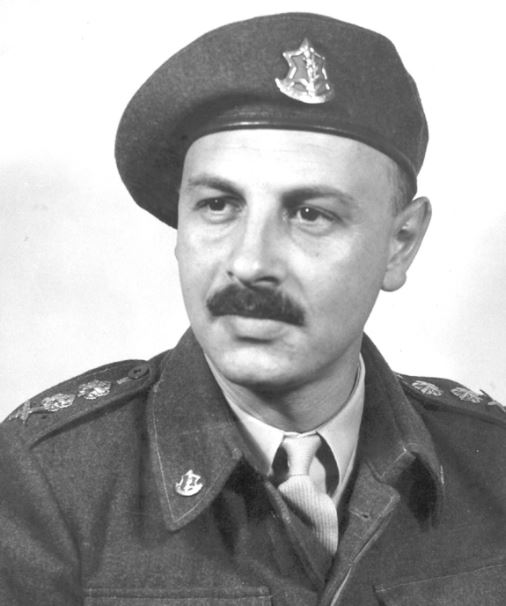
 Aharon Yehuda Leib Shteinman (1914-2017) was born in what is now the city of Brest, Belarus. To avoid being conscripted into the Polish army, the young yeshiva student fled to Switzerland with some classmates. He continued his diligent studies in a Swiss yeshiva until being arrested during World War II and sent to a labour camp. Shteinman was the only member of his family to survive the Holocaust. He settled in Israel after the war. There, the young rabbi quickly made a name for himself as a Torah prodigy, and was soon appointed rosh yeshiva, head of a Torah academy. He would serve as a rosh yeshiva for the next five decades, while also establishing a number of children’s schools for the underprivileged. Meanwhile, Rav Shteinman wrote profusely, authoring dozens of bestselling books and discourses on Torah, Talmud, and Jewish thought, as well as being recognized as an expert in the field of education. While abstaining from politics himself, Rav Shteinman was the spiritual leader of Israel’s Degel HaTorah party, playing an influential role in government. In his 90s, and in frail health, the Rav decided to journey around the world to strengthen Jewish communities. Countless thousands gathered to greet him and hear his wise words in Los Angeles, New York, Mexico City, Buenos Aires, Manchester, Odessa, Berlin, Gibraltar, Paris, and many more small towns. On these trips, he would give as many as 10 talks a day.
 Rav Shteinman was known for his extreme piety, humility, and modesty. His daily diet was nothing but a cucumber, a boiled potato, and one small bowl of oatmeal. He lived in a tiny apartment, with little furniture but walls lined end to end with books. He slept on the same thin mattress that was given to Jewish refugees upon arrival in Israel for some 50 years. Streams of people lined up at his open door each day seeking counsel and blessings. Rav Shteinman stood only for truth, even when it brought him adversity. This was particularly clear when he supported the Nachal Charedi, an IDF unit for yeshiva students. Even after some backlash from ultra-Orthodox communities, the Rav stood his ground and continued his support. He was widely recognized as the gadol hador, the world’s chief rabbi. Sadly, the great rabbi passed away yesterday, at 103 years of age. (His condition had turned critical two weeks ago after the tragic death of his 72-year old daughter from a heart attack, even though no one had told him of her passing.) Rav Shteinman wrote in his will that it would suffice to have just ten men to carry out his funeral, and requested no eulogies. Nonetheless, the funeral procession brought over 600,000 people. Israel’s President Reuven Rivlin stated that Rav Shteinman “bore the entire weight of the Jewish people’s existence on his shoulders… he knew how to convey his ideas gently, in a pleasant manner, and with a great love of the Jewish people… He was a man whose wisdom was exceeded only by his humility.”