Tag Archives: Spanish Jews

Jew of the Week: Francisco Maldonado

Doctor with a Mission
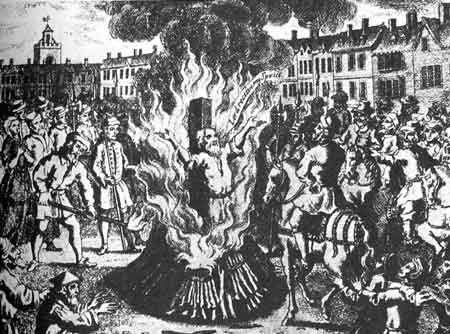
A Scene from the Inquistion

Francisco Maldonado de Silva (1592-1639) Raised as a devout Catholic, de Silva is one of the most famous Marranos in history [Marranos were the Spanish Jews forcibly converted to Christianity by the Inquisition]. His family migrated to Chile where de Silva became a doctor. He learned of his Judaism from his father, took an interest in it and started to learn more. He returned to Judaism wholeheartedly, circumsizing himself with a pair of scissors (relax, he was a doctor). Unfortunately, being Jewish was a crime and de Silva was arrested and thrown in jail for 12 years. He refused to eat their un-kosher food and would fast for 40 days at a time. De Silva was endlessly interrogated by no less than 13 inquisitors. Amazingly, he escaped from his cell after weaving a rope of corn stalks. Instead of running away, he climbed into the adjacent cell and converted two Catholics to Judaism. Tragically, he was burned at the stake with 11 other Jews in Lima, Peru on January 23, 1639.

Words of the Week

“The [Torah] has been a Magna Carta of the poor and of the oppressed; down to the modern times no State has a constitution which the interests of the people are so largely taken into account, in which the duties so much more than the privileges of the rulers are insisted upon, as that drawn up for Israel in Deuteronomy and Leviticus.”

– T.H. Huxley, famous biologist and paleontologist, father of the Huxley dynasty which includes Julian Huxley, Aldous Huxley, Francis Huxley and Andrew Huxley.

Jew of the Week: Don Joseph Nasi

Prince of Europe

NasiDon Joseph Nasi (1524-1579) I’m not sure why they haven’t made a movie about this man yet, but they should. His story is quite fascinating. In a nutshell, he was the head of a banking empire, the Duke of Naxos, the Count of Andros, and the Lord of Tiberias. He actively sought a national homeland for the Jews, initially hoping for Cyprus, later receiving a grant from the Ottomans to start settling Israel. He single-handedly triggered a war between Turkey and Venice, sparked the Dutch uprising against Spain and brokered a peace treaty with Poland. At one point, he went by the secret name Juan Miguel to escape the inquisition. He monopolized the wine industry in Moldavia and the beeswax industry in Poland, financed the Yeshiva of Constantinople (today’s Istanbul), established a printing press for Jewish texts and maintained a vast library in his house to be used freely by Torah scholars. For his foundational work in seeking to establish an independent Jewish state in the Holy Land all the way back in the 16th century, he has been called the first real “proto-Zionist”.

Constantinople (Modern Instanbul) – where Don Nasi financed the Yeshiva

Words of the Week

The entire people of Israel comprise a single soul; only the bodies are separate
Rabbi Schneur Zalman of Liadi, the Alter Rebbe (Tanya, ch. 32)

Jew of the Week: Don Isaac Abravanel

Treasurer of Torah, Treasurer of Spain

Don Isaac Abravanel (1437-1508) is perhaps the most famous member of the illustrious Abravanel (or Abarbanel) Sephardic dynasty, which traces its lineage back to King David. He served as Royal Treasurer for both King Afonso V of Portugal, and later, King Ferdinand and Queen Isabella of Spain, helping the new Spanish kingdom rise to greatness. Nonetheless, the Spanish decided to expel all the Jews from their domain in 1492. Incredibly, Ferdinand and Isabella gave Don Isaac an exemption, and begged him to stay in Spain as their treasurer. Don Isaac refused, and chose to go with his people. A man of vast wealth, he offered 600,000 crowns to the Spanish monarchy to rescind the expulsion of the Jews. The offer would have been accepted were it not for Torquemada, the Grand Inquisitor (murder of thousands of Jews, who, ironically, had Jewish ancestry himself). Don Isaac was a huge philanthropist, supporting the Jewish community in Spain financially, and guiding them spiritually. He is most famous for writing dozens of treatises on Judaism and the Torah (the first of which he wrote before age 20), including a profound commentary on the Tanakh.

Words of the Week

Character is a person’s only real possession.
– Rabbi Israel Salanter