Tag Archives: Russian Jews

Jew of the Week: Judith Resnik

First Jewish Woman in Space
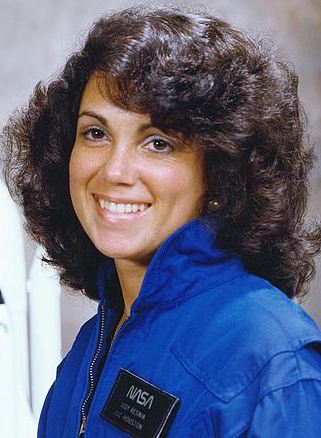
Judith Resnik - First Jewish Woman in Space

Judith Resnik, the First Jewish Woman in Space

Judith Arlene Resnik (1949-1986) was born in Akron, Ohio to Jewish-Russian immigrants from Ukraine. As a child she went to Hebrew school, then attended a public high school where she was the only female student to achieve a perfect SAT score. She went on to become an electrical engineer, eventually earning a Ph.D in the subject. Resnik first worked as a circuitry designer for tech giant RCA, as well as serving as a biomedical engineer for the National Institutes of Health (at the Laboratory of Neurophysiology) and a systems engineer for Xerox. In 1978 she joined NASA, going on her first space flight in 1984 on the maiden voyage of the space shuttle Discovery. That made her the first American Jew in space and the first Jewish woman in space. She quickly became beloved by the public for her on-board humour and space acrobatics. Resnik went on her second tour in space with the Challenger in January of 1986. Sadly, the mission ended quickly when the space shuttle tragically exploded in Earth’s atmosphere, killing all 7 crew members. It took nearly 6 weeks to find the crew compartment at the bottom of the ocean floor. Resnik’s body was among those that were identifiable. She was laid to rest in Arlington National Cemetery. That same year, the Institute of Electrical and Electronics Engineers (IEEE) established the Judith A. Resnik Award for outstanding contributions to space engineering. The moon’s Resnik Lunar Crater is named in her honour.

Words of the Week

A man without a woman is not a man.
– Rabbi Elazar (Talmud, Yevamot 63a)

Jew of the Week: Rabbi Abraham Isaac Kook

Rabbi Kook

Rabbi Kook

Avraham Itzhak Kook (1865-1935) was born in what is now Latvia (then part of the Russian Empire). Recognized as a young prodigy, he spent only a year and a half at the famous Volozhin Yeshiva, and yet, it was said that it was worthwhile for the yeshiva to have been founded just for him. After serving as head rabbi of several European towns, in 1904 Kook settled in Israel to become rabbi of Jaffa (Yafo), overseeing predominantly secular Zionists, whom he was able to inspire with Torah, and lead them to incorporate more observance into their lives. World War I broke out while he was on a trip to Europe, preventing him from returning to the Holy Land. Wasting no time, he served as a rabbi in London, England until the end of the war, then returned to Israel and took up the post in Jerusalem. He was instrumental in establishing the Chief Rabbinate of Israel, and saw it as a stepping stone towards reinstating the Sanhedrin. In 1921 he was appointed Ashkenazi Chief Rabbi of Palestine.

Rabbi Kook wrote excessively on Jewish law and exegesis. Many of these profound writings were only published after his death, and continue to make a powerful impact on people around the world. Kook founded Yeshivat Mercaz HaRav (“Centre of the Many”), Israel’s central academy for religious Zionists. He was beloved as a figure who tried to bridge the gaps between various sectors of Jewish society, especially between secular and religious. He also tried to win over the non-Zionist religious groups, and often preached that the re-establishment of the state of Israel was a necessary precursor for the coming of Mashiach. Kook remained totally apolitical, and refused to join any parties, working to unify groups instead of separating them into even smaller factions. His love for the Torah, the land of Israel, and the Jewish nation was renowned, and at his passing, over 20,000 mourners attended his funeral in Jerusalem (out of a total population of roughly 130,000!) He commanded a photographic memory and it was said there was no mystical secret he did not know. Some consider him to be the most influential religious Jewish thinker of the 20th century.


Words of the Week

The truly righteous do not complain about evil, but rather add justice; they do not complain about heresy, but rather add faith; they do not complain about ignorance, but rather add wisdom.
– Rav Kook

Jew of the Week: Stephen Lewis

Stephen Lewis

Stephen Lewis

Stephen Henry Lewis (b. 1937) was born in Ottawa on Remembrance Day, and thus named Shalom by his parents. His grandfather was a member of the Jewish Bund in Russia, while his father was a key figure in the CCF – the predecessor to the modern NDP party. Lewis studied at the University of Toronto where he was a member of the debating team and went head-to-head with notable figures such as future president John F. Kennedy. Lewis also studied at the University of British Columbia. After dropping out from both U of T and UBC, he joined Socialist International and was sent to a conference in Ghana. Inspired by what he saw, Lewis stayed in Africa to work and teach across the continent. Returning to Canada, he became head of Ontario’s NDP, and quickly propelled the party to new popularity, doubling their seats in Parliament to become the Official Opposition. He moved on to be Canada’s ambassador to the United Nations, also working as the director of UNICEF, and later a UN Special Envoy for HIV/AIDS in Africa. Lewis has written a popular book, Race Against Time, based on his experiences in Africa, and chairs the Stephen Lewis Foundation, which works to combat Africa’s HIV/AIDS epidemic. He is also a co-founder of AIDS-Free World. Lewis has received the Order of Canada, the World Citizenship Award, and has been described as one of the world’s “most powerful feminists”. Recently, he has had two schools named after him in the Greater Toronto Area, both called Stephen Lewis Secondary School.


Words of the Week

…any man of all the inhabitants of the earth, whose spirit has moved him and whose mind has given him to understand to set himself aside to stand before God to serve Him, to worship Him, to know God and walk justly as God has created him, and he cast from his neck the yoke of the many calculations that men seek – this man has become sanctified, a holy of holies, and God shall be his portion and his lot forever, and shall grant him his needs in this world…
– Maimonides (Mishneh Torah, Laws of Sabbaticals and Jubilees 13:13)