Mission: Impossible
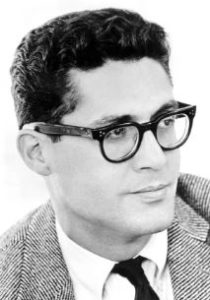
Bruce Geller
Baruch Bruce Geller (1930-1978) was born in New York City. Although he studied psychology at Yale University, he was far more interested in theatre, and ended up working as a screenwriter. Finding little success in New York, he moved to Hollywood and worked on a number of television shows. In 1965, Geller had an idea for a new secret agent thriller TV show, and created Mission: Impossible. The show ran from 1966 to 1973, with Geller as producer, writer, and director. The hit series went on to win 8 Emmy Awards, including two for Geller as producer and as writer. The show was resurrected in 1988 for another couple of seasons. (Its extremely popular theme song was written by former Jew of the Week Lalo Schifrin.)

Sydney Pollack
In the early 1990s, Sydney Irwin Pollack (1934-2008) began working on a film adaptation of Mission: Impossible. Starring Tom Cruise, the movie became a huge hit, and spawned five sequels, become one of the highest-grossing film franchises of all time, and earning over $2.7 billion, so far. (The latest installment of the film series, Mission: Impossible – Fallout, opens tomorrow.) Pollack was born in Indiana to Russian-Jewish immigrants. After finishing high school, he moved to New York City and studied acting. Pollack served two years in the armed forces, then returned to theatre as a stage assistant. He moved to Hollywood in 1960 to coach child actors, and slowly shifted from acting to directing. Pollack first worked on television shows, then made the jump to feature films, and was hugely successful right from the start. His films went on to earn 48 nominations and 11 wins at the Oscars. Pollack eventually went back to acting, and appeared in numerous films and TV shows. He died of cancer in 2008. Both Pollack and Geller were avid pilots, and enjoyed flying their Cessnas. Sadly, Geller’s life was cut short when his plane crashed in 1978.
Tu b’Av Begins Tonight – Chag Sameach!
Why Tu b’Av Is More Important than Yom Kippur
Words of the Week
I’ve lived through Israel’s entire 70-year history and I believe it is one of the most remarkable countries in the world.
– Warren Buffett

Steven Hill in the lead role of the 1966 pilot episode of Mission: Impossible, and Tom Cruise in the lead role of the 1996 film, together with the film’s most famous (and oft-spoofed) scene.

 David Wolffsohn (1856-1914) was born to a poor, religious Jewish family in the Lithuanian-Polish town of Darbenai (then part of Russia). His father was a Torah scholar and teacher, and Wolffsohn, too, was learning in yeshiva with the same goal in mind. In his teens, he was sent to live with relatives in Germany to avoid being conscripted to the Russian army. There, he met the rabbi, philosopher, and early Zionist leader Isaac Rülf, and became his devoted disciple. Meanwhile, Wolffsohn took up secular studies and went on to apprentice at a trading company. In 1877, he started his own flouring business, and was soon one of the most prominent Jewish businessmen in Europe. Henceforth, he dedicated his life to realizing that ancient dream of his people’s return to Israel. He played a key role within the Hovevei Zion movement, and in 1894 was a cofounder of the Society for the Promotion and Support of Jewish Agriculture in Syria and Palestine. When Herzl’s The Jewish State was published two years later, Wolffsohn immediately journeyed to Vienna to meet him. The two became very close and traveled the Holy Land together, setting the foundations for what would become the State of Israel. Not surprisingly, when the World Zionist Congress was founded, Herzl was made its president and Wolffsohn its vice-president. Upon Herzl’s death shortly after, Wolffsohn succeeded him. As president, he was instrumental in reinvigorating Jewish life in the Holy Land (among other things, it was under his tenure that the city of Tel-Aviv was founded). However, Wolffsohn is most famous for being the one who created the flag of modern Israel. Back in 1896, Herzl had written: “We have no flag, and we need one. If we desire to lead many men, we must raise a symbol above their heads. I would suggest a white flag, with seven golden stars…” Herzl’s proposal was good, but his flag gained little support. Wolffsohn responded to Herzl thus: “We have a flag—and it is blue and white. The talit with which we wrap ourselves when we pray: that is our symbol. Let us take this talit from its bag and unroll it before the eyes of Israel and the eyes of all nations…” Wolffsohn designed a simple flag with blue talit-like stripes and a