Tag Archives: Polish Jews

Jew of the Week: Frank Gehry

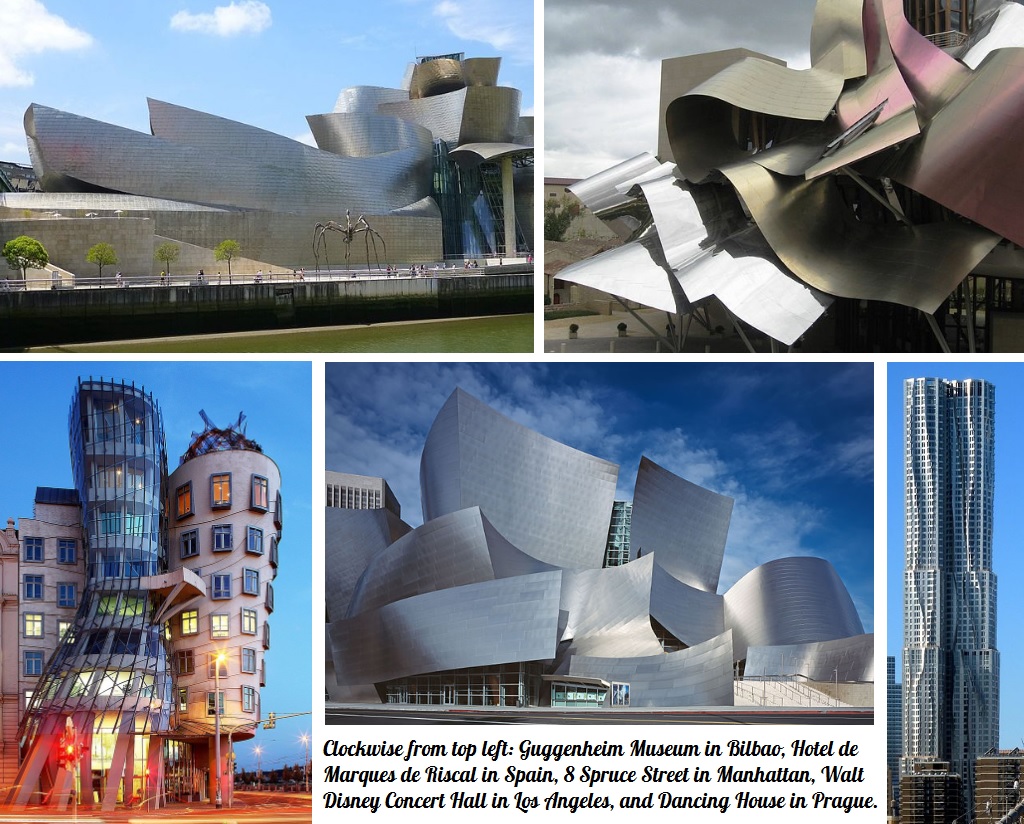
gehryFrank Owen Ephraim Goldberg (b. 1929) was born in Toronto, the son of a Russian-Jewish father from New York, and a Polish-Jewish mother. As a child, he enjoyed constructing model buildings and cities with his grandmother, using scraps from his grandfather’s hardware store. After he finished high school, the family moved to California and he soon enrolled in architecture studies. It was there, because of ceaseless anti-Semitism, that he changed his last name to “Gehry”. Meanwhile, he worked as a truck driver, radio announcer, and served in the US Army before going to Harvard for graduate studies in design. Gehry got an architecture job back in Los Angeles and started wowing people with his unique designs. After a stint in Paris, he opened up his own practice. In 1989, he won the Pritzker Architecture Prize, bringing him even more fame. His Guggenheim Museum in Bilbao, Spain was described as “the greatest building of our time”. It inspired what is now called the Bilbao Effect – a “revitalization of cities through iconic, innovative architecture.” Since then, Gehry has become the world’s most influential and well-known architect, and is regularly involved with some of the most high profile projects around the globe. In addition to lecturing as Professor of Architecture at the University of Southern California, Gehry also designs museum sets and exhibitions, furniture, sculptures, and has created six lines of jewellery for Tiffany & Co. He also designed the World Cup of Hockey, and developed new architectural software. Gehry has won countless awards, including the Order of Canada, and last week received the Presidential Medal of Freedom. Sydney Pollack made a documentary about Gehry’s work, and Vanity Fair described him as “the most important architect of our age.”

Words of the Week

I never wanted to be the next Bruce Lee. I just wanted to be the first Jackie Chan.
– Jackie Chan
gehry-project

Jew of the Week: Ada Yonath

The Woman Who Revolutionized Biochemistry

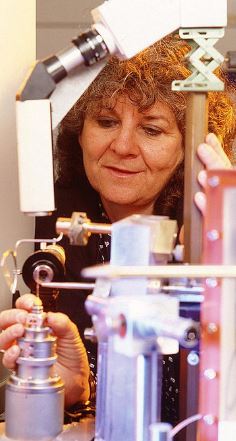
Yonath at the Weizmann Institute (Credit: Miki Koren)

Yonath at the Weizmann Institute (Credit: Miki Koren)

Ada Yonath (b. 1939) was born in Jerusalem, the daughter of Polish Zionists that immigrated to Israel in 1933. Growing up in poverty, she found solace in books, and was inspired by the Polish-French scientist Marie Curie. Yonath studied chemistry at Jerusalem’s Hebrew University and earned a Ph.D from the Weizmann Institute in 1968. Her focus was on x-ray crystallography, a technique for visualizing biochemical structures. After postdoc studies at Carnegie Mellon and MIT, Yonath returned to Israel to establish the country’s only protein crystallography lab. In the 1980s, she started developing a new crystallography technique that was initially met with a lot of resistance from the scientific community. Yonath silenced her critics with amazing results, and discovered some of the key mechanisms in the body’s production of proteins. By 2001, she unraveled the mysteries of the ribosome, the structure responsible for producing protein from the body’s genetic code. In addition to this, she discovered how dozens of antibiotics impact the ribosome, contributing tremendously to our understanding of antibiotics and drug resistance. The technique she invented, cryo bio-crystallography, is now standard in top biochemistry labs around the world. In 2009, Yonath was awarded the Nobel Prize in Chemistry. That made her the first Israeli woman to win a Nobel Prize, the first Middle Eastern woman to win a Nobel Prize in science, and the first woman to win the Prize in Chemistry in 45 years (and only the fourth overall). Yonath has won a handful of other awards, including the Harvey Prize, the Rothschild Prize, the Wolf Prize, the Albert Einstein World Award of Science, and the L’Oréal-UNESCO Award for Women in Science. Despite being in her 70s, Yonath is still doing very important research in her lab at the Weizmann Institute. Some say she may even be up for a second Nobel Prize! She also hopes to write a novel as soon as she has some extra time. (Click here to see an incredible video of a ribosome working in the body, based on Dr. Yonath’s research.)

Words of the Week

Family is not punishment! When I sit with young people and they say, “You’re a mother and you took care of the kids”, I say: “It’s a privilege.”
– Ada Yonath

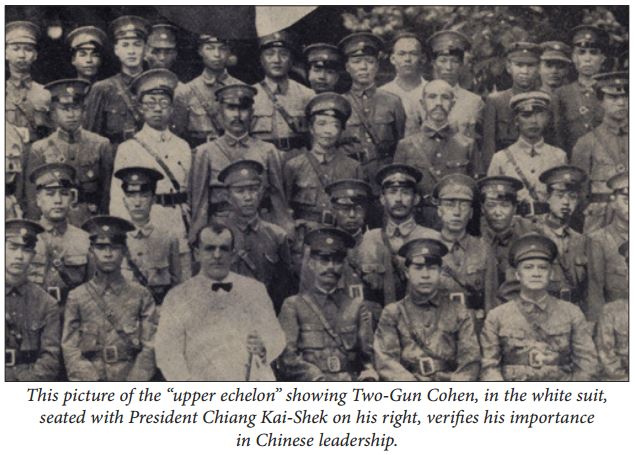
Jew of the Week: Morris Cohen

China’s “Uncrowned Jewish King”

Morris Cohen sitting next to Chinese President Chiang Kai-Shek (Credit: Joe King)

(Credit: Joe King)

Moshe Morris Abraham Cohen (1887-1970) was born in Poland to a poor Orthodox Jewish family. While he was still an infant, his family fled the pogroms and settled in London, England. Growing up, Cohen often got in trouble so his parents sent him to work on a farm in Saskatchewan, Canada, hoping to mend his ways. There, he learned the value of hard work, in addition to playing cards and shooting guns. He became good friends with Chinese railroad workers, and even defended a Chinese man who was being robbed – a big deal at a time when white people rarely stood up for the Chinese in those days. Cohen’s friends invited him to join the revolutionary party of Dr. Sun Yat-sen, who would become modern China’s founding father and first president. Cohen agreed to train Chinese-Canadians in military combat and helped secure weapons for China’s revolutionary army. Meanwhile, he settled in Edmonton and became a successful real estate broker. Cohen was soon appointed as the province of Alberta’s Commissioner of Oaths. With the outbreak of World War I, he fought valiantly with the Canadian Railway Troops. Finding it hard to make a living in Canada after the war, he moved to China. Cohen was hired by Sun Yat-sen to train his forces, procure arms, and serve as his personal bodyguard. After once taking a bullet while protecting Sun Yat-sen in an assassination attempt, he started carrying two guns, and henceforth was known as “Two-Gun Cohen”, though the Chinese called him Ma Kun, “Clenched Fist”. Following Sun Yat-sen’s death, Cohen continued working for China as a military commander and head of their secret service. During World War II, it was Cohen that proved the Japanese were using poison gas against Chinese civilians. Cohen was captured in battle by Japanese soldiers. He was nearly beaten to death before being freed in a prisoner exchange. Cohen then returned to Canada, settled in Montreal, and finally married. He spent the rest of his life in relative quiet, working as a consultant in various capacities, and often traveling to China. (He had the distinction of being the only person allowed to travel freely between China and Taiwan – as he was friendly with leaders of both nations, despite their antagonism towards each other.) Perhaps his last great act was convincing the Taiwanese not to oppose the UN Partition Plan that gave birth to the State of Israel. Taiwan’s position on the UN Security Council made their vote critical, and they intended to oppose the plan until Cohen stepped in. He also helped to arm the nascent State of Israel in its War of Independence. Cohen’s life inspired two books, as well as the 1936 film The General Died at Dawn, and the 1984 film The Gunrunner, starring Kevin Costner. As a major general in China’s revolutionary army (to this day, the only Westerner to hold such a high rank in the Chinese military), one-time head of China’s secret service, and Sun Yat-sen’s personal aide, Cohen played an instrumental role in the founding of modern China. He was once described as China’s “uncrowned Jewish king”.

Yom Kippur Begins Tonight! Gmar Chatima Tova!

Words of the Week

All lovers of democracy cannot help but support… the movement to restore your wonderful and historic nation which has contributed so much to the civilization of the world and which rightly deserves an honourable place in the family of nations.
Dr. Sun Yat-sen, on his support for the Zionist movement