The Polish Nobility’s Hasidic Pharmacist
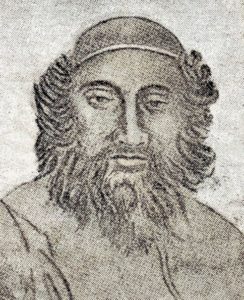
A 19th century woodcut engraving of Simcha Bunim of Peshischa
Simcha Bonhomme “Bunim” Bonhart (c. 1765-1827) was born in Vodislav, Poland, the son of a wealthy German-Jewish merchant father (who was also a rabbi and rationalist philosopher) and a mother that came from a long line of rabbis going all the way back to Rashi. After studying at the top yeshivas in Hungary and Czechia, Simcha Bunim went to Leipzig to also get a solid secular education at one of the world’s top universities. He studied science and majored in pharmacology. After marrying, he settled in Peshischa (Przysucha) and opened up his own pharmacy. His concoctions were so potent and famous that he soon served the Polish nobility. He also continued his father’s merchant business, sold exotic woods, and regularly appeared at the Danzig trade fair. Meanwhile, Simcha Bunim joined the local Peshischa Hasidic group, then under the leadership of a rabbi and mystic known simply as HaYid HaKadosh, “the Holy Jew”. When the Holy Jew died in 1813, Simcha Bunim took over as the new leader. Unlike other Hasidic groups, Peshischa was all about enlightenment and rationalism. Their aims were to synthesize science with Judaism, to develop each member’s personal autonomy, and to inspire people to discover who they are and to think critically on their own. They encouraged people to pray when they really felt like it (instead of praying by rote three times a day) and to walk confidently with an upright posture. Instead of wearing the classic Hasidic robes, Simcha Bunim dressed in a regular suit. His internal Hasidic revolution spread like fire across Eastern Europe—causing Simcha Bunim to nearly be excommunicated by other Hasidic rabbis! Simcha Bunim is also credited with being perhaps the first kiruv (“outreach”) rabbi. While other Hasidic groups at the time simply ignored the secular Jewish world, Simcha Bunim went out of his way to bring secular Jews back into the faith. In fact, he would regularly go to theatres on Jewish holidays in the hopes of inspiring Jews there to come with him to the synagogue instead. While the Peshischa Hasidic movement itself died out shortly after Simcha Bunim’s death, it sparked multiple new Hasidic groups, and had a significant impact on the wider Jewish world as well. Today is Rabbi Simcha Bunim’s yahrzeit.
Words of the Week
I know who I am irrespective of how I am perceived by others.
– Rabbi Simcha Bunim of Peshischa
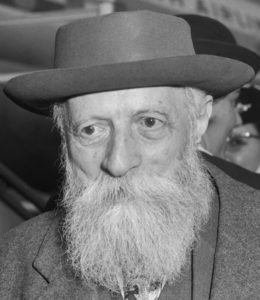 Mordechai Martin Buber (1878-1965) was born in Vienna to a religious Jewish family. His parents got divorced when he was just three years old, so Buber was raised in what was then Poland by his grandfather. Despite growing up in a richly Hasidic home, Buber began reading secular literature and returned to Vienna as a young man to study philosophy. Around the same time, he became active in the Zionist movement and soon became the editor of Die Welt, the main newspaper of Zionism. It wasn’t long before Buber became dissatisfied with the secularism and “busyness” of Zionism and returned (partially) to his Hasidic roots. He saw in Hasidic communities the right model for a new Israel, and a better alternative to the entirely-secular kibbutz. Buber ultimately saw Zionism not as a nationalist or political movement, but as a religious movement that should, first and foremost, serve to spiritually enrich the Jewish people—along with the rest of the world. He would later be credited with being the father of “Hebrew humanism” and “spiritual Zionism”. In 1908, he was invited to address a group of Jewish intellectuals known as the “Prague Circle”, and to “remind them about their Judaism”, as the group’s leader had requested. Among the members of the Circle was (former Jew of the Week)