The Polish Nobility’s Hasidic Pharmacist
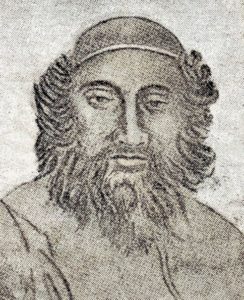
A 19th century woodcut engraving of Simcha Bunim of Peshischa
Simcha Bonhomme “Bunim” Bonhart (c. 1765-1827) was born in Vodislav, Poland, the son of a wealthy German-Jewish merchant father (who was also a rabbi and rationalist philosopher) and a mother that came from a long line of rabbis going all the way back to Rashi. After studying at the top yeshivas in Hungary and Czechia, Simcha Bunim went to Leipzig to also get a solid secular education at one of the world’s top universities. He studied science and majored in pharmacology. After marrying, he settled in Peshischa (Przysucha) and opened up his own pharmacy. His concoctions were so potent and famous that he soon served the Polish nobility. He also continued his father’s merchant business, sold exotic woods, and regularly appeared at the Danzig trade fair. Meanwhile, Simcha Bunim joined the local Peshischa Hasidic group, then under the leadership of a rabbi and mystic known simply as HaYid HaKadosh, “the Holy Jew”. When the Holy Jew died in 1813, Simcha Bunim took over as the new leader. Unlike other Hasidic groups, Peshischa was all about enlightenment and rationalism. Their aims were to synthesize science with Judaism, to develop each member’s personal autonomy, and to inspire people to discover who they are and to think critically on their own. They encouraged people to pray when they really felt like it (instead of praying by rote three times a day) and to walk confidently with an upright posture. Instead of wearing the classic Hasidic robes, Simcha Bunim dressed in a regular suit. His internal Hasidic revolution spread like fire across Eastern Europe—causing Simcha Bunim to nearly be excommunicated by other Hasidic rabbis! Simcha Bunim is also credited with being perhaps the first kiruv (“outreach”) rabbi. While other Hasidic groups at the time simply ignored the secular Jewish world, Simcha Bunim went out of his way to bring secular Jews back into the faith. In fact, he would regularly go to theatres on Jewish holidays in the hopes of inspiring Jews there to come with him to the synagogue instead. While the Peshischa Hasidic movement itself died out shortly after Simcha Bunim’s death, it sparked multiple new Hasidic groups, and had a significant impact on the wider Jewish world as well. Today is Rabbi Simcha Bunim’s yahrzeit.
Words of the Week
I know who I am irrespective of how I am perceived by others.
– Rabbi Simcha Bunim of Peshischa
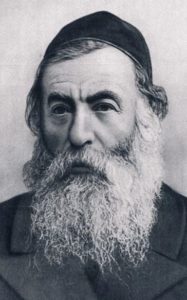 Yitzchak Yaacov Reines (1839-1915) was born near what is now Pinsk, Belarus to a long line of rabbis. He studied at the famous Volozhin Yeshiva where he received his rabbinic ordination in 1867. Rabbi Reines became the rabbi of the town of Svintsyan, Lithuania, just north of Vilnius. There, he opened his own yeshiva which, for the first time, included a secular studies curriculum as well. In 1882, a large assembly of rabbis gathered in St. Petersburg to discuss easing the plight of Russian Jewry, then suffering immense persecution and poverty. Reines proposed spreading his successful yeshiva model across Russia, allowing Jews to integrate into mainstream society (and economy) without abandoning their faith and traditions. The assembly rejected his plan, so Reines continued his mission on his own. His Svintsyan Yeshiva created a ten-year program that would give students both rabbinic ordination and a government-approved job. Unfortunately, the yeshiva faced too much opposition and shut down after four years. Meanwhile, Rabbi Reines was an active member of Hovevei Zion. In 1893, together with Rabbi Shmuel Mohilever, he proposed that Jews settle in their ancestral Holy Land and organize a mercaz ruhani, “spiritual centre”, that would combine Torah with good-old-fashioned agricultural labour. In 1899, Reines participated in the Third Zionist Congress, following which he kept a regular correspondence with
  Adin Even-Israel Steinsaltz (1937-2020) was born in Jerusalem to parents who had made aliyah from Eastern Europe a decade earlier. His father was completely secular, and a devoted socialist who had fought in the Spanish Civil War on behalf of Communist International. Nonetheless, his father wanted his son to know what Judaism was all about, and made sure to have him tutored by a rabbi. Meanwhile, young Steinsaltz studied math and science at Hebrew University. He then took up rabbinical studies at Chabad’s Yeshivat Tomchei Temimim. After receiving semicha (rabbinic ordination), Steinsaltz tried to establish a neo-Hasidic community in the Negev, but was unsuccessful. He then became a school principal and, being just 24 years old, was the youngest principal in Israel’s history. In 1965, he embarked on a life-long journey to translate the Talmud into Modern Hebrew, along with composing a detailed commentary to explain its complexities. He finished the massive 42-volume set in 2010, after which it was translated into English, too, and shared freely online to make Talmudic learning accessible for everyone. Rabbi Steinsaltz also wrote profusely about topics that span the gamut of Judaism, including bestsellers on Kabbalah and Hasidism. Altogether, he penned over 60 books and some 200 other original texts of Jewish thought. (He even wrote an unpublished science fiction novel!) Meanwhile, Rabbi Steinsaltz helped found several yeshivas in Israel, as well as the Jewish University in Russia, with campuses in Moscow and St. Petersburg. He had spent several years in the former Soviet Union to help re-establish Jewish life there, and in 1995 was given the title of Russia’s duchovny ravin, the “spiritual head” of Russian Jewry. In 2004, a large gathering of rabbis in Israel sought to re-establish the ancient Sanhedrin. Rabbi Steinsaltz accepted the nomination to head the court, being given the title nasi, “president”. Before he suffered a stroke in 2016, he was known to regularly give classes until two in the morning. He spent time at Yale University as a scholar-in-residence, and received honourary degrees from five universities. Among his many awards is the prestigious Israel Prize. His motto was “Let my people know!” and he has been compared to a modern-day