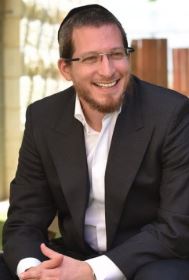
 Rabbi Menachem Bombach was born in the ultra-Orthodox Satmar community of Meah Shearim in Jerusalem. His father passed away when he was just a toddler, and Bombach was raised in a very insular environment. Despite living in Israel, he spoke no Hebrew at all until he was 20 years old. Bombach had a sharp mind, though, and studied at some of Israel’s most prestigious yeshivas, including the famous Mir Yeshiva. When he got married and sought to find a job, he realized that he knew very little and was completely unprepared for adult life. Despite protests from his family and community, Bombach pursued secular studies. He learned Hebrew and English, earned a BA in Education, and then a Master’s from Hebrew University. To make sure other young Ultra-Orthodox men do not struggle like he did, Bombach decided to start a new kind of yeshiva, one where secular studies are given equal weight to religious studies, and students are prepared for future careers and financial independence. Encouraged and inspired by Rabbi Aharon Lichtenstein, he founded Hamidrasha Hahasadit academy in Beitar Ilit. There, his carefully crafted program weaves together Biblical and Talmudic studies with math, language, and computer science. He has since opened a girls seminary, too, and planted the seeds for a network of similar schools. His vision is to bring the Haredi majority in Israel above the poverty line, to integrate them with technology in a kosher way, and to end the country’s divide between the secular and the ultra-Orthodox. He estimates that if he can reach 10% of the Haredi community, the impact would completely transform Israel economically and socially. Many are already feeling the impact that Bombach’s schools are making. He recently taught a class on Yom HaZikaron about being grateful for Israeli soldiers that have given their lives for Israel. The touching video of the class went viral. Although he has faced a great deal of adversity, Bombach continues to make waves in the Haredi community and Israeli society at large. His schools have become so popular that they cannot keep up with demand, and Bombach now hopes to expand his “Netzach” network of schools across the country. He is currently campaigning to receive more funding from New York’s UJA Israel@70 Fund – click here to watch his campaign video and vote for his school.
How is Jewish Spirituality Different?
Words of the Week
When God created the first man, He showed him all the trees of the Garden of Eden, and said to him: “See My works, how beautiful and praiseworthy they are. And everything that I created, I created it for you. Be careful not to spoil or destroy My world, for if you do, there will be nobody after you to repair it.
– Midrash (Kohelet Rabbah 7:13)
 Dennis Mark Prager (b. 1948) was born in New York City to an Orthodox Jewish family. He attended religious schools, and during his time at the Yeshiva of Flatbush met the future renowned rabbi Joseph Telushkin. Prager majored in history and Middle Eastern studies at Brooklyn College before spending several years at Columbia University studying both the Middle East and Russia, followed by a stint at the University of Leeds learning Arabic and comparative religions. In the mid-70s, Prager teamed up with Rabbi Telushkin to co-author The Nine Questions People Ask About Judaism. The bestselling book was a huge success and shot Prager into the spotlight. Shortly after, he was hired to be the director of the Brandeis-Bardin Institute of the American Jewish University. (He would later teach Hebrew Bible at the University between 1992 and 2006.) In 1982, he met an executive of Los Angeles’ KABC Radio who was struck by Prager’s impressive knowledge, and instantly hired him to host a Sunday radio show called Religion on the Line. It was so popular that Prager was soon doing radio shows every day except Friday and Saturday (because of Shabbat). Meanwhile, he co-authored another bestseller with Rabbi Telushkin, Why the Jews? The Reason for Antisemitism. By 1999, Prager’s radio show was nationally syndicated, as was his newspaper column. He was called “One of America’s five best speakers”, as well as “one of the three most interesting minds in American Jewish Life”, and was described by the LA Times as “An amazingly gifted man and moralist”. All in all, Prager has published seven books (including The Ten Commandments: Still the Best Moral Code) and produced five films (including Israel in a Time of Terror, and the forthcoming No Safe Spaces about the extremes of political correctness). He continues to host one of America’s most popular radio shows, and is among the most sought-after political commentators in the world. Today, Prager is perhaps most famous for his Prager University, which he co-founded in 2009 in response to the growing trend of squashing conservative voices in the media and on campus. PragerU’s concise and informative five-minute videos have become hugely popular. To date, they have garnered over 1 billion views, with hundreds of millions of followers across social media sites. The videos have been so successful that PragerU has been called “the right-wing YouTube empire that’s quietly turning millenials into conservatives.” Perhaps because of this, Google recently started blocking some of PragerU’s videos, perplexingly citing them as “inappropriate”. Regardless of whether one agrees with Prager’s views or not, the blatant suppression of free speech sets a dangerous precedent. For this reason, Prager has launched a lawsuit against Google and YouTube, together with a campaign to draw support for the preservation of free speech (see their video,
  David Wolffsohn (1856-1914) was born to a poor, religious Jewish family in the Lithuanian-Polish town of Darbenai (then part of Russia). His father was a Torah scholar and teacher, and Wolffsohn, too, was learning in yeshiva with the same goal in mind. In his teens, he was sent to live with relatives in Germany to avoid being conscripted to the Russian army. There, he met the rabbi, philosopher, and early Zionist leader Isaac Rülf, and became his devoted disciple. Meanwhile, Wolffsohn took up secular studies and went on to apprentice at a trading company. In 1877, he started his own flouring business, and was soon one of the most prominent Jewish businessmen in Europe. Henceforth, he dedicated his life to realizing that ancient dream of his people’s return to Israel. He played a key role within the Hovevei Zion movement, and in 1894 was a cofounder of the Society for the Promotion and Support of Jewish Agriculture in Syria and Palestine. When Herzl’s The Jewish State was published two years later, Wolffsohn immediately journeyed to Vienna to meet him. The two became very close and traveled the Holy Land together, setting the foundations for what would become the State of Israel. Not surprisingly, when the World Zionist Congress was founded, Herzl was made its president and Wolffsohn its vice-president. Upon Herzl’s death shortly after, Wolffsohn succeeded him. As president, he was instrumental in reinvigorating Jewish life in the Holy Land (among other things, it was under his tenure that the city of Tel-Aviv was founded). However, Wolffsohn is most famous for being the one who created the flag of modern Israel. Back in 1896, Herzl had written: “We have no flag, and we need one. If we desire to lead many men, we must raise a symbol above their heads. I would suggest a white flag, with seven golden stars…” Herzl’s proposal was good, but his flag gained little support. Wolffsohn responded to Herzl thus: “We have a flag—and it is blue and white. The talit with which we wrap ourselves when we pray: that is our symbol. Let us take this talit from its bag and unroll it before the eyes of Israel and the eyes of all nations…” Wolffsohn designed a simple flag with blue talit-like stripes and a