
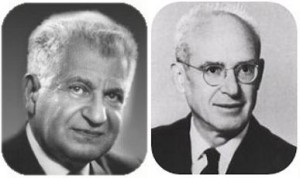
Podolsky and Rosen
Nathan Rosen (1909-1995) was born in Brooklyn and studied at MIT during the Great Depression. While still young, he published several famous papers, including ‘The Neutron’, which predicted the structure of the nucleus a year before it was discovered. Between 1935 and 1945 he was Albert Einstein’s personal assistant at Princeton. Together, they discovered (mathematically) a “bridge” connecting distant areas of space – now called a wormhole. With Einstein’s encouragement, Rosen moved to the nascent State of Israel and joined Haifa’s Technion in 1953. He later served as President of Ben-Gurion University, founded the Israel Academy of Sciences and Humanities, the Physical Society of Israel, and the International Society for General Relativity and Gravitation. Aside from all this, he is most famous for coming up with the well-known “EPR Paradox” together with Einstein and a fellow Jewish scientist named Podolsky (hence “EPR”).
Boris Yakovlevich Podolsky (1896-1966) was born in Russia to a poor Jewish family which immigrated to the U.S. in 1913. He served in the US Army and worked as an electrical engineer before returning to school and earning a PhD from Caltech. In 1933 he was given a fellowship at Princeton, which led to his collaboration with Einstein and Rosen on the EPR Paradox. Interestingly, some have suggested that Podolsky was a Soviet spy, codenamed “Quantum”, and helped the Soviets start their nuclear program during World War II. His major legacy, however, is in the great work he did on solving various complex physics problems of the day.
Words of the Week
Education is not the learning of facts, but the training of the mind to think.
– Albert Einstein
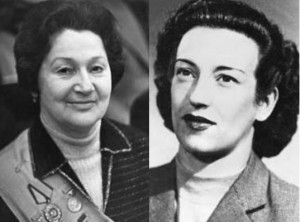
 Meir Schneider (b. 1954) was born in Ukraine and moved with his family to Israel at age 5. Both of his parents were deaf, and Schneider was born with severe vision problems. After undergoing five major unsuccessful eye surgeries, doctors pronounced him permanently legally blind. At the age of 17 he discovered the work of American ophthalmologist William Bates, who devised a method for natural vision correction through various eye exercises. Schneider started training diligently, sometimes up to 13 hours per day, and saw results very quickly. Within 6 months he could recognize objects; within a year and a half, he could already read without glasses. He would eventually improve his vision to the point of being allowed a driver’s license, which he still holds. Recognizing the need for countless other people to improve their vision naturally, Schneider created his own vision-healing program which is now practiced by millions of people around the world. In addition to vision therapy, Schneider has a Ph.D for his work on muscular dystrophy. His books are bestsellers and he was listed among the “Top Ten Most Inspirational Israelis”. Learn more about the Schneider method