Tag Archives: Israel

Jew of the Week: David Ben-Gurion

David Ben-Gurion

David Ben-Gurion

David Grün (1886-1973) was born in Poland and at just 14, already started a Zionist youth club with friends to promote immigration to Israel and study of Hebrew. While a student at the University of Warsaw in 1905, he was arrested twice as a member of the socialist Poalei Tzion party. The following year he made his way to the Holy Land and settled there. Just 20 years old, he became the chairman of Poalei Tzion in Yafo. Due to various disputes, Grün left politics and focused on farming in Petah-Tikva and the Galilee. He joined an armed defence group in 1908 to protect Jewish settlements increasingly under attack. In 1912 he temporarily relocated to Istanbul to study law, and it was there that he Hebraized his name to Ben-Gurion (and would convince countless others to do the same over the course of his life, wanting them to drop their old “diaspora” names for a fresh start in a newly resurrected Jewish Homeland). He returned to Jerusalem, only to be deported to Egypt due to World War I, then made his way to the U.S. where he toured for 3 years raising support for the Jewish cause. In 1918 he enlisted in the Jewish Legion of the British Army. After the war, Ben-Gurion resettled in Israel and established the Histadrut, Israel’s first labour union (which is 650,000 members strong today). By 1935, he became the chairman of the Jewish Agency – the largest Jewish non-profit organization in the world – overseeing the immigration and settlement of Jews in Israel. He served in this role until 1948, when he became the new State of Israel’s first Prime Minister. One of his first acts in the ensuing War of Independence was the fusion of all militias into one unified army: the IDF. After the war, he worked tirelessly to establish the state and its institutions, overseeing massive construction projects and mass immigration of Jews from around the world, not to mention an international hunt for Nazi war criminals. Although he worked to create a free, modern, non-theocratic state of Israel, he ensured that the Jewish essence would remain, setting Shabbat as an official rest day, kosher food in all state institutions, and autonomy in religious education. He also focused on Israel’s military might, ordering the creation of special operations units while pushing heavily for attaining nuclear capability. He would serve as prime minister in two stints lasting nearly 14 years, in addition to being minister of defence. After retiring in 1970, he wrote an 11-volume history of Israel’s beginnings, adding to two previous tomes he had written. He passed away shortly after, and is commemorated as the central founder of the modern State of Israel.

Words of the Week

Oil, which saturates everything it comes in contact with, represents innerness. Wine, which causes the heart to spill out its deepest secrets, represents outwardness. Chanukah is oil, Purim is wine.
The Lubavitcher Rebbe

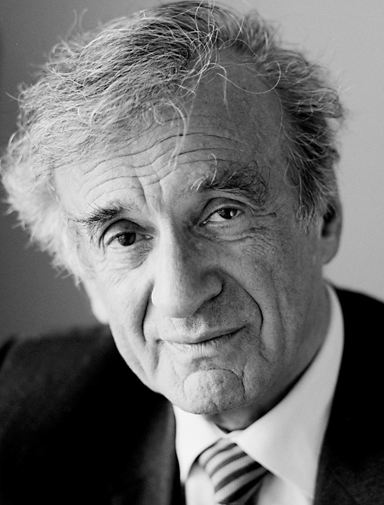
Jew of the Week: Elie Wiesel

Messenger to Mankind

Elie Wiesel

Elie Wiesel

Eliezer Wiesel (b. 1928) was born in Romania in a home that regularly spoke Hungarian, German, Romanian, and Yiddish. During the Holocaust he suffered in multiple labour and concentration camps, including Buchenwald and Auschwitz, and lost both parents and a younger sister. After the war, he resettled in Paris, studied at the Sarbonne, and worked as a journalist. In 1949, Wiesel became the Paris correspondent (later the international correspondent) for Yediot Ahronot. Though originally not wanting to write at all about the horrors of the Holocaust, he was convinced by a friend and published Night in 1958 – a shortened French version of his 900-page memoir in Yiddish. Though it took a while to hit the mainstream, the book now sells hundreds of thousands of copies every year and has been translated into 30 languages. Wiesel has subsequently authored many more publications, and has become an internationally-renowned speaker. In 1986, he won the Nobel Peace Prize for his efforts against racism, violence, and genocide, and was called a “messenger to mankind”. He has also won the Presidential Medal of Freedom, the Congressional Gold Medal, and was knighted, among many other awards. He has even been nominated as President of Israel, but did not wish to take up the post. Wiesel has taught at Boston and Columbia Universities, the City University of New York, and served as a visiting scholar at Yale. He has spent a great deal of his life as a political activist for international causes. He stood strongly against apartheid South Africa and raised support for intervention during the Bosnian genocide, and more recently in Darfur. He has assisted the plight of Kurds, Native Americans, Argentinian Desaparecidos, as well as Soviet and Ethiopian Jewry. Wiesel remains a vocal supporter of Israel, and Jerusalem as its undivided capital. For the past 58 years, he has lived in the US and to this day has authored 57 books.

UPDATE: Sadly, Elie Wiesel passed away on July 2, 2016.

Words of the Week

For me, the Jew that I am, Jerusalem is above politics. It is mentioned more than six hundred times in Scripture – and not a single time in the Koran.
– Elie Wiesel

Jew of the Week: Paul Reichmann

Paul Reichmann

Paul Reichmann

Moshe Yosef “Paul” Reichmann (1930-2013) was born in Vienna to Hungarian Orthodox Jewish parents. By a miracle, the family escaped Austria right before the Nazi takeover of the country, then fled from Hungary to Paris to Morocco. At the end of World War II, Reichmann studied in yeshivas in England and Israel before returning to Morocco and working as a shirt salesman. Shortly after, he moved to Toronto to open a new branch of his brother’s tile company, Olympia. By 1964, he built a separate property development company called Olympia & York. In 1976, the company built First Canada Place – what was then Canada’s tallest building (and the tallest bank office tower in the world). The company would expand to New York and Tokyo, London and Israel, becoming the world’s largest property developer. Reichmann’s vision of magnificent buildings adorning the skyline prompted Prince Charles to comment: “Do they have to be so tall?” Despite the tremendous success, Reichmann never abandoned his Orthodox roots, maintaining his prayer and study regimen, and having his company cease all operations on Shabbat and holidays. He used a great part of his fortune to finance synagogues, yeshivas, and charitable institutions around the world. In 1992 he lost the bulk of his wealth when Olympia & York went bankrupt in the midst of a large economic recession (and a failed project for London’s Canary Wharf – considered one of the largest development projects in history). He managed to rebuild a sizable portion of his wealth over the next two decades, and continued donating millions of dollars every year to good causes. Very private and shunning luxury, Reichmann was famous for his business integrity. He would seal multi-million dollar deals with a handshake, and never failed to keep his word. Sadly, the man who touched so many lives passed away earlier this week. Click here to read more about one of the greatest philanthropists of the century, and watch a video here.

Words of the Week

Abraham was told that his descendants will be like the dust of the earth [Genesis 13:17], and as the stars of heaven [Genesis 15:5]. So it is with Israel: When they fall, they will fall as low as the dust; when they rise, they will rise as high as the stars.
– Midrash Pesikta Zutrati