The Church’s Greatest “Heretic”
Lope de Vera y Alarcon (c. 1619-1644) was born to the Spanish nobility in San Clemente, Spain. Despite being a Christian knight, de Vera wished to learn Hebrew and study the Bible in its original language. He enrolled at the University of Salamanca at 14. His studies drew him to Judaism, and at just 20 years old, he rejected the New Testament and his old Christian faith. The Inquisition immediately arrested him and threw him in prison. He refused to eat their non-kosher meat. His trial lasted for over a year, in which he continually affirmed that Judaism is the only true faith. Soon, de Vera formally converted to Judaism, circumcised himself with a bone knife, and took on the name Juda el Creyente, “Judah the Faithful” or “Judah the Believer”. His imprisonment lasted six years, during which time many priests and missionaries tried to win him back. Instead, he managed to convince at least a couple of them to abandon their Christianity, too! The frustrated Inquisition had enough and sentenced him to execution. He was burned at the stake on July 25, 1644. His final words were reportedly a verse from King David’s Psalms: “Into Your hand, Lord, I commit my spirit.” Despite his apostasy, one Inquisitor wrote of him: “Never has such firmness been witnessed as that displayed by this young man. He was well reared, scholarly, and otherwise blameless.” Another Inquisitor declared that “de Vera was the Church’s greatest heretic”. At the time, his story inspired and strengthened Jews all over the world, and caused countless Marranos (Spanish Jews forced to convert to Christianity) to return to their faith. Today, many Spanish and Portuguese people are rediscovering their Sephardic Jewish roots and converting back to Judaism, and see Judah the Faithful as a role model and hero.
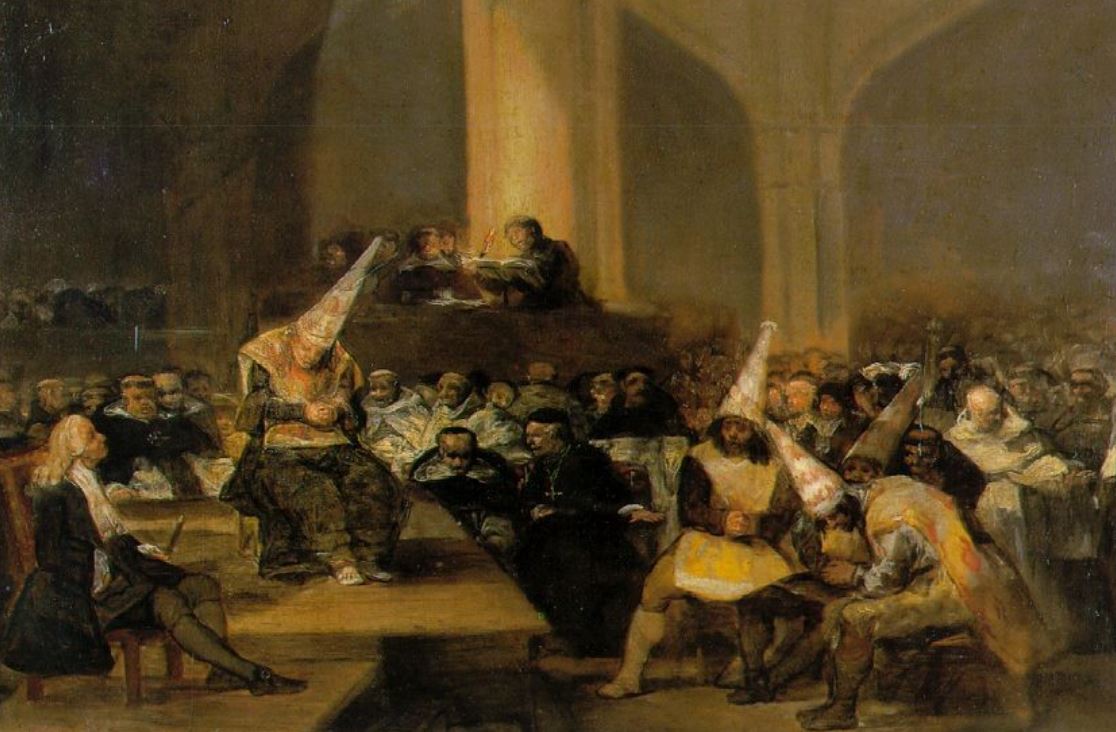
‘The Spanish Inquisition Tribunal’, by Francisco Goya
Growing Number of Latin Americans Turn to Judaism
Intriguing Stories of Latinos Converting to Judaism
Words of the Week
Our Sages taught: Those who are insulted but do not insult others, who hear their shame but do not respond, who act out of love and are joyful in their suffering, about them the verse states: “And they that love Him are as the sun going forth in its might.” (Judges 5:31)
– Talmud, Gittin 36b

 Fernão de Loronha (c. 1470-1540) was born in Lisbon, Portugal to a Sephardic Jewish family that had been forcibly converted to Christianity by the Inquisition. Like many such families, they continued to practice Judaism in secret. Loronha became a wealthy merchant, and also worked for the German Augsburg banking family. He was knighted by King Manuel I of Portugal (and for this reason, was often associated with the Noronha nobility, being incorrectly referred to as “Fernando de Noronha”.) In 1501, he financed a Portuguese expedition to explore the newly-discovered lands of South America, then called Vera Cruz. Scholars believe his primary motivation was finding a new home for persecuted Jews, where they could finally live free of the Inquisition. Some say Loronha captained the expedition himself, and we know for sure that on board was Amerigo Vespucci (after whom “America” is named). At the time, Europeans imported expensive red dyes made from brazilwood from India. Loronha came back to Portugal in 1502 describing the abundant brazilwood in the new lands and the opportunity for great riches. King Manuel gave him an exclusive ten-year charter for all the commercial rights to brazilwood in Vera Cruz. In exchange, Loronha had to send at least six ships per year on behalf of Portugal, build a fort for the Portuguese military, explore new coasts, and pay the crown 4000 ducats per year. His first six-ship fleet set forth the following year, establishing the first brazilwood factories in the New World. Soon, vast amounts of the precious dye were being imported to Europe, making it the continent’s second most valuable commodity (after gold). The fleet also discovered a new group of islands, which Vespucci named São Lourenço, or São João. Shortly after, a grateful King Manuel gave the islands as a gift to Loronha and his descendants, and made him the first official donatario (“administrator”) in South America. Today, the idyllic islands are still referred to as “Fernando de Noronha” in his honour. Unlike many other colonists, Loronha did not employ slaves, and obtained all the brazilwood through trade with local natives. Most interestingly, it was Loronha who was responsible for renaming the new land to “Brazil” instead of its original name, Vera Cruz. Still a Jew at heart (and soul), Loronha did not want to use the Christian term Vera Cruz (meaning “True Cross”), so he would always refer to it in all of his business dealings as “Brazil” instead. The new name stuck. Similarly, he renamed his main ship from São Cristóvão (“Saint Christopher”) to A Judia (“The Jewess”). In 1506, his crew on that ship discovered a set of islands in Mozambique, named Bassas da Judia. Today, the name has been corrupted to “Bassas da India”.