Tag Archives: German Jews

Jew of the Week: Albert Ballin

The Inventor of Cruises
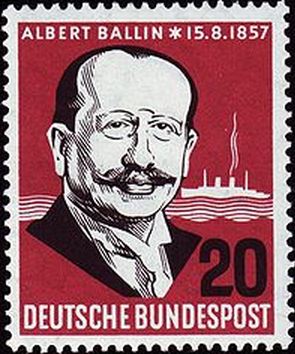
Commemorative Stamp of Albert Ballin

Commemorative Stamp of Albert Ballin

Albert Ballin (1857-1918) was born in Hamburg, Germany to a lower-middle class family. At 17, Ballin’s father died so the young man took over his father’s work at an emigration agency. By 22, he owned the agency, and at 29 he was the director of HAPAG, a ship liner providing service from Hamburg to New York. Ballin transformed the company into the world’s largest sea company with 175 ships. He revolutionized the business, focusing on providing customer service and a comfortable voyage. By using return voyages to deliver goods, Ballin was able to cut the price of a Transatlantic trip by nearly 40%. This work made it possible for myriads of Jews to escape Eastern Europe before, and during, the World Wars, saving countless lives. He would often sail on his own ships and ask the customers how their voyage could be improved. To make sea travel even better, Ballin constructed a massive neighbourhood on an island near Hamburg’s port (later called BallinCity) where voyagers could relax, shop, pray, and receive health inspections and travel documents. Ballin pioneered the production of ever larger and more luxurious ships. Perhaps his greatest legacy is the invention of the cruise ship. When Transatlantic voyages were perilous in the winter, Ballin had an idea to use his idle ships in other ways, outfitting them for “pleasure cruises”, where the voyage was not only a means to get somewhere, but the destination itself. Many scoffed at the idea (some said Ballin totally lost his mind), but the first such voyage, a 57-day Mediterranean adventure in 1891, was a huge success and sparked the cruise ship industry. Ballin became the German Emperor’s ship operator, and was nicknamed the “Kaiser’s Jew”, though his religion cost him many great opportunities. The Kaiser once admitted that Ballin would have been made Chancellor if he weren’t a Jew. A gentle and kind man, Ballin also donated anonymously to a great many causes, and strove to make peace between the European powers. Unable to prevent World War I, he was labelled as a “pacifist traitor” of Germany, and at 61, overdosed on sleeping pills. His home in Hamburg is now the UNESCO Institute for Lifelong Learning.


Words of the Week

Why is the Torah called “fire”? Just as fire receives no impurities, so too the words of Torah.
– Talmud, Berachot 22a

Jew of the Week: Bernard Baruch

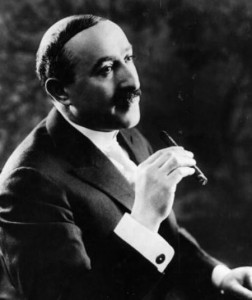
Bernard Baruch

Bernard Baruch

Bernard Mannes Baruch (1870-1965) was born in South Carolina to German-Jewish immigrants. His father was a doctor specializing in hydrotherapy and appendectomies, and a key military surgeon in the Civil War. The family moved to New York City, where Baruch first worked as an office boy for $3 a week. After college, he became a stock broker and made a fortune trading sugar (though he would lose and regain his fortune several times). By 30, he was among the most successful financiers of all time, nicknamed “The Lone Wolf of Wall Street” as he worked independently and resisted joining a financial house. In 1916, Baruch left finance and became an adviser to President Woodrow Wilson. He was soon the chairman of the War Industries Board and managed America’s economic mobilization for World War I. At the end of the war, Baruch attended the Paris Peace Conference and was a central supporter of the League of Nations (the precursor of the UN). Baruch continued to advice future presidents, including Roosevelt, whom he helped to create the National Recovery Administration for fair business, industry and labour practices. After World War II, Baruch worked at the UN, particularly to stem nuclear arms proliferation. He would be sought as an adviser until the last days of his life, counselling a total of nine American presidents. He was famous for discussing global issues and politics while sitting on public benches in Central Park (in NYC) and Lafayette Park (in Washington, DC) and was thus called the “Park Bench Statesman”. Baruch was also a noted philanthropist throughout his life, contributing millions to charities and colleges. Click here to learn a few investment tips from Bernard Baruch.


Words of the Week

There are free men with the spirit of a slave, and slaves whose spirit is full of freedom. He who is true to his inner self is a free man, while he whose entire life is merely a stage for what is good and beautiful in the eyes of others, is a slave.
Rabbi Avraham Itzhak Kook

Jew of the Week: William Fox & Joseph Schenck

William Fox

Wilhelm Fried (1875-1952) was born in Hungary to German-Jewish parents that soon immigrated to the U.S. Growing up in New York City, Fried worked in various odd jobs in the fur and garment industry, and even as a newspaper boy. In 1904, having renamed himself William Fox, he purchased a “Nickelodeon” – the earliest kind of movie theatre (often just a converted store front) that showed short films for five cents (hence the term nickelodeon). In 1915 he founded Fox Film Corporation, which originally focused more on building theatres and studios than producing movies. In 1929, Fox attempted to buy out a major share in fellow company MGM. However, a scandal ensued and Fox’s opponents convinced the Justice Department to investigate him for violating anti-trust laws. At the same time, Fox was severely injured in a horrific car accident. Immediately after this, the stock market crashed (sparking the Great Depression). The combination of these three events drove Fox into total bankruptcy, and by 1930 he lost all control of his company. During his bankruptcy hearing several years later, Fox attempted to bribe the judge, and was thus sent to six months in prison. He never returned to the film industry, and died quietly with no Hollywood producers at his funeral.

Joseph Schenck

Fox Film would be taken over by Joseph Michael Schenck (1878-1961), a fellow Jew, born in Russia. Like Fox, Schenck’s family immigrated to New York City. While working at the concession stand of Fort George Amusement Park, Schenck saw the potential of film, and saved up money, together with his brother, to buy Palisades Amusement Park in 1909. Soon after, the brothers parted and Joseph headed to Hollywood for a fresh start. He rose to become president of United Artists (a company co-founded by Charlie Chaplin). He later founded his own company – 20th Century Pictures – in 1933, together with Darryl Zanuck. Two years later, they took over Fox Film to create ’20th Century Fox’. This giant production company is behind such classics as Star Wars, Die Hard, Planet of the Apes, the Simpsons, Family Guy, the X-Files and countless other hits

Words of the Week

Do not judge your fellow until you have stood in his place.
Pirkei Avot 2:4