Tag Archives: German Jews

Jew of the Week: Irene Rosenfeld

Irene Rosenfeld

Irene Rosenfeld

Irene Blecker Rosenfeld (b. 1953) was born in New York to a Jewish family of Romanian and German descent. She studied psychology at Cornell, then earned a Master’s in business, followed by a Ph.D. in marketing. Soon after, she got a job with an ad agency in New York, then worked in consumer research for General Foods, the company famous for its cereals, Jell-O, and Maxwell House coffee (and now owned by Altria Group Inc., formerly known as Philip Morris). In 2004, Rosenfeld was elected CEO of Frito-Lay, the company that makes Cheetos, Doritos, Tostitos, Lay’s, and Ruffles. During her successful tenure, she shifted the focus of the company towards healthier ingredients and products. Two years later, she moved on to become CEO of Kraft Foods (also owned by Altria). After overseeing a great deal of growth within Kraft, including the acquisition of Cadbury, the largest confectioner in the UK, Rosenfeld engineered the company’s split into two new corporations. She remained as chairwoman and CEO of the snacks division, now known as Mondelez International. This new multi-billion dollar company employs over 100,000 people globally, and makes popular foods like Oreos, Chips Ahoy!, Peek Freans, Toblerone, Halls, Ritz, and both Trident and Dentyne gums. Not surprisingly, Rosenfeld has been ranked by Forbes among the world’s most powerful women on multiple occasions. She currently lives in a Chicago suburb, where she is a central member of the local Reform synagogue. Rosenfeld is a noted philanthropist, too, known for discretely donating large sums of money to hospitals, schools, and other institutions. She is also an avid basketball player, tennis player, and rollerblader.

Today is the 3rd Day of Sukkot. Chag Sameach!

Words of the Week

Just as it is incumbent upon every Jew to put on tefillin every day, so is there an unequivocal duty which rests upon every individual, from the greatest scholar to the most simple of folk, to set aside a half-hour each day in which to think about the education of his children.
Rabbi Sholom DovBer Schneersohn, the 5th Lubavitcher Rebbe

Jew of the Week: Ernst Gräfenberg

Ernst Grafenberg (courtesy of muvs.org)

Ernst Grafenberg

Ernst Gräfenberg (1881-1957) was born in Adelebsen, Germany, where his father was a successful businessman and head of the Jewish community. Gräfenberg studied medicine and earned a Ph.D by the time he was just 23. He first worked as an ophthalmologist, then shifted his focus to gynecology. At the same time, he did important research on cancer, presenting a theory on metastasis. Following his World War I service as a medical officer, for which he was decorated with an Iron Cross, Gräfenberg became the chief of gynecology at a Berlin hospital. He did simultaneously did research on reproduction at Berlin University. In 1929, he invented the first modern contraceptive intrauterine device (IUD), then called the “Gräfenberg ring”. Today, IUDs are the most widely used form of female contraception, with nearly 200 million users around the world. Unfortunately, the Nazis forced Gräfenberg to give up his posts in 1933. Despite pressure to leave Germany, he continued his gynecology practice, thinking that he would be safe since many of his patients were the wives of Nazi officials. Nonetheless, Gräfenberg was arrested and spent three years in prison. It wasn’t until 1940 that he was finally able to flee to the US (through Siberia and Japan). There, Gräfenberg continued his studies on female physiology. Among other things, he described a little-known erogenous zone that was later named after him: the “Gräfenberg spot”, better known as the “G-spot”. He also did important work on egg implantation and pathology. The effects of Parkinson’s Disease forced Gräfenberg to retire in 1953, and he passed away several years later in New York City.

Words of the Week

Humility is not a question of thinking less of yourself, it’s a question of thinking of yourself less.
– Larry Bossidy

Jew of the Week: Uzi Gal

The Machine Gun that Saved President Reagan

Uzi Gal

Uzi Gal

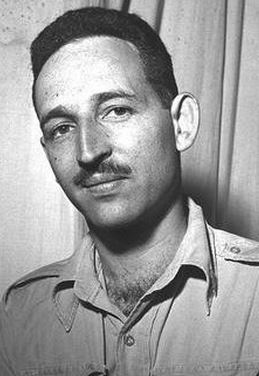
Uziel Guthardt Glass (1923-2002) was born in Weimar, Germany. His family fled from the Nazis to England in 1933, and from there made their way to Israel in 1936. They joined a kibbutz and changed their last name to Gal. From his youth, Gal was interested in weapons engineering, and designed his first automatic gun (which shot arrows) at age 15. At 20, now a member of the Jewish Haganah defense force, he was arrested by British troops for carrying a gun (forbidden to Jews in Israel at the time) and spent three years in prison. It was during his service in Israel’s War of Independence that he began designing a new, smaller, safer, and more effective submachine gun. In 1951, the IDF adopted his design, giving birth to the famous “Uzi” (although Gal requested that the weapon not be named after him). The weapon was also adopted by over 90 different countries, and became the most popular submachine gun in history, with over $2 billion in sales. It has been used primarily as a personal defense weapon by officers, tank infantry, and special forces units. Most famously, it was the weapon of choice for the US Secret Service – typically hidden in a small briefcase – and was used to save President Ronald Reagan from an assassination attempt in 1981. Along with other military decorations, Gal was the first person to be granted the Israel Security Award. With the high rank of Colonel, Gal retired from the IDF in 1975 in order to take care of his daughter, and moved to Philadelphia for her medical treatment. He continued designing weapons in the US until his passing due to cancer in 2002. In 2003, the Uzi was officially retired by the IDF, praised for its instrumental role in Israel’s many military victories.

Words of the Week

The truth is, we are all living in Israel. It’s just that some of us haven’t realized it yet.
– Sam Harris