
The Jew Who Negotiated with the Nazis—and Saved Thousands
 Chaim Vitaly Arlozorov (1899-1933) was born in what is today Ukraine to a traditional Russian-Jewish family. His grandfather was a renowned rabbi and Talmud commentator. When Arlozorov was six years old, his town of Romny experienced a terrible pogrom, causing his family to flee to Germany. He went on to study economics at the University of Berlin and became a socialist, though he rejected and opposed both Marxism and Communism. During that time Arlozorov become involved with HaPoel HaTzair, the Zionist-socialist youth organization. He worked tirelessly on behalf of the Zionist movement to re-establish an independent state for the Jewish people. Arlozorov argued such a state should be based on socialism so that all Jews could equally own a piece of the Holy Land, thereby also allowing a return to fulfilling the Sabbatical (shemittah) and Jubilee (yovel) years as mandated by the Torah. While many Ashkenazi Zionists wanted Yiddish to become the official language of the future state, Arlozorov played a key role in ensuring it would be Hebrew. In 1921, he participated in the defence of the Jewish town of Neve Shalom when it was attacked by Arab mobs. This inspired him to work towards establishing a peaceful relationship between Jews and Arabs. In 1933, he organized a conference at the King David Hotel in Jerusalem between Zionist and Arab leaders—possibly the first of what would be many future “peace talks” throughout the Arab-Israeli conflict. Back in 1930, it was Arlozorov who initiated the merger between the two big Zionist-socialist parties, forming Mapai (which later became Israel’s Labour Party). In 1931, he was appointed political director of the Jewish Agency and oversaw Jewish immigration to the Holy Land. When the Nazis came to power and began instituting their anti-Jewish policies, Arlozorov sought to save Germany’s Jews by bringing them Israel. In a deeply controversial move, he started negotiations with the Nazis and eventually prevailed with the Ha’avara Agreement where German Jews could make aliyah provided that they use all of their money to buy only German goods that would be exported to Israel. Over the next several years, the agreement brought 60,000 German Jews to Israel—saving their lives—as well as some $100 million in resources and goods. These resources allowed for countless other Jews to make aliyah as well, and to develop the infrastructure of the future state. Unfortunately, not everyone was thrilled with the Ha’avara Agreement—both in the Jewish world and within the Nazi party. Two days after returning from the negotiations, Arlozorov was assassinated while taking a Shabbat-evening walk on a Tel-Aviv beach with his wife. To this day, it is a mystery who was behind the assassination, some blaming right-wing Zionists, others finding connections to Nazi agents, or to Arab thugs, or even to the Soviets. His funeral was presided by as many as 100,000 people. It is widely agreed that had he been alive, Arlozorov would have become Israel’s first prime minister. Among other honours, nearly every major town in Israel today has an “Arlozorov Street” or neighbourhood named after him.
Words of the Week
A return to Jewishness is an absolute condition for a return to the Land of Israel.
– Theodor Herzl
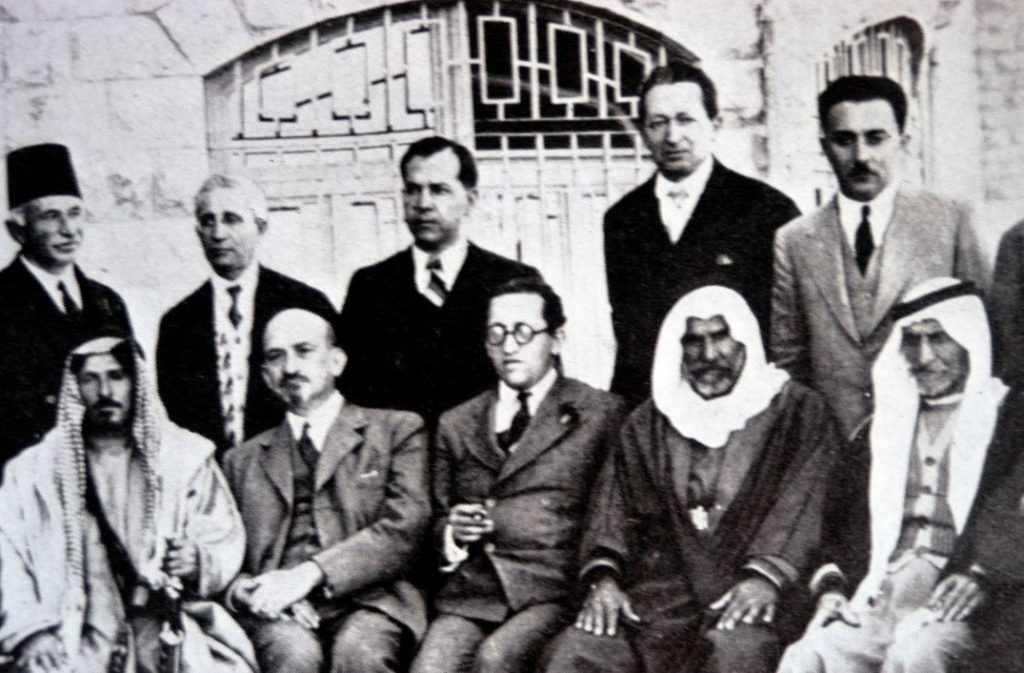
Arlozorov (centre, seated) with Weizmann on his right and other political leaders at the 1933 King David Hotel Conference
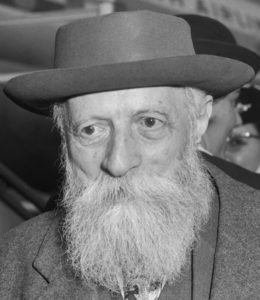 Mordechai Martin Buber (1878-1965) was born in Vienna to a religious Jewish family. His parents got divorced when he was just three years old, so Buber was raised in what was then Poland by his grandfather. Despite growing up in a richly Hasidic home, Buber began reading secular literature and returned to Vienna as a young man to study philosophy. Around the same time, he became active in the Zionist movement and soon became the editor of Die Welt, the main newspaper of Zionism. It wasn’t long before Buber became dissatisfied with the secularism and “busyness” of Zionism and returned (partially) to his Hasidic roots. He saw in Hasidic communities the right model for a new Israel, and a better alternative to the entirely-secular kibbutz. Buber ultimately saw Zionism not as a nationalist or political movement, but as a religious movement that should, first and foremost, serve to spiritually enrich the Jewish people—along with the rest of the world. He would later be credited with being the father of “Hebrew humanism” and “spiritual Zionism”. In 1908, he was invited to address a group of Jewish intellectuals known as the “Prague Circle”, and to “remind them about their Judaism”, as the group’s leader had requested. Among the members of the Circle was (former Jew of the Week)