
Jewish Super Bowl Showdown
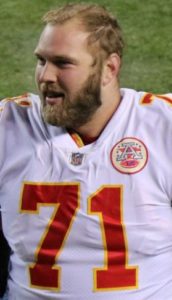
Mitchell Schwartz
(Credit: Jeffrey Beall)
Mitchell Bryan Mendel Schwartz (b. 1989) was born in California and raised in a religious Conservative Jewish home. By the time he started high school, he was 6’5″ and weighed 240 pounds—so he started playing football. Very quickly, he dominated the game, and just a couple of years later was California high schools’ Offensive Lineman of the Year. He was also an all-star baseball pitcher, and an honour roll student with a near-perfect GPA. Not surprisingly, many colleges wanted him, and he chose to go to UC Berkeley where he majored in American Studies. Over his four-year college career, he didn’t miss a single game. In 2012, Schwartz was drafted to the NFL by the Cleveland Browns. He went on to play all 16 games in his impressive rookie season. After several more successful seasons, he signed a 5-year, $33 million contract with the Kansas City Chiefs, making him one of the highest paid tackles in the sport. Schwartz wears his Judaism proudly, and co-authored a book with his brother Geoff (also an NFL player) called Eat my Schwartz: Our Story of NFL Football, Food, Family, and Faith. He is a big supporter of Kansas City’s Chabad of Leawood, and has lit the city’s public menorah. Last year, he helped lead the Chiefs to a Super Bowl victory. Until then, he had never missed a single game in his entire NFL career. Unfortunately, that incredible streak ended earlier this season, though his team still made it to the Super Bowl, and will face the Tampa Bay Buccaneers this Sunday. Meanwhile, Tampa Bay has their own Jewish all-star:
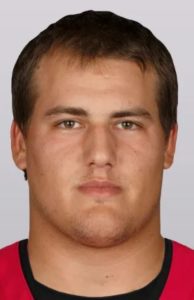
Ali Marpet
(Credit: buccaneers.com)
Alexander “Ali” Marpet (b. 1993) was born in New York to a traditional Jewish family. He was also a big high school football (and basketball) success. Marpet studied economics and public policy at Hobart College, which is not a particularly strong athletic school and doesn’t even award athletic scholarships. Only one other player in the history of the college ever made it to the NFL. Marpet went there anyways, and led their football team to multiple championship appearances. He was drafted to the NFL in 2016 by the Tampa Bay Buccaneers. In his rookie season, he was voted the best pass-blocker among rookies and 12th-best run-blocking guard overall. In 2018, he signed a 5-year, $55 million extension with the Buccaneers, making him one of the highest paid guards in the NFL. Marpet once described how, while on Birthright Israel, the classic camel ride in the desert didn’t go so well for him since he weighed over 300 pounds and the camel wasn’t too happy about that! He has stated that he is honoured to represent all Jews as a professional athlete. Marpet hopes to win his first championship ring this Sunday.
Words of the Week
Mastering others is strength; mastering yourself is true power.
– Chinese Proverb
 Yonah Yosipovich Leibensohn Kremenezky (1850-1934) was born in Odessa, Ukraine to a Russian-Jewish family. He studied electrical engineering and worked on designing Russia’s first railways. In 1874, Kremenezky moved to Berlin to further his studies at the city’s Technical University. He then got a job working for Siemens, and was sent across Europe to build the continent’s first street lighting systems, starting in Paris and ending up in Vienna in 1878, where he settled permanently. Two years later, Kremenezky founded his own factory that produced lamps and batteries—the first of its kind in the Austro-Hungarian Empire. By 1883, he had become very well-known as a scientist-industrialist (a European Edison), and Crown Prince Rudolf personally asked him to help “electrify” his empire. Kremenezky did just that, laying electrical cables and setting up lighting systems, as well as building the empire’s first power plant. Meanwhile, his lamp factory designed all sorts of new lights, including ornamental bulbs and what we now know as “Christmas lights”. Kremenezky lights were a huge hit, exported around the world, even to the United States. For playing a key role in rebuilding and repowering Vienna after World War I, Kremenezky was awarded with the Ehrenbürgerrecht, the city’s highest decoration for citizens (a street in Vienna was named after him, too). Meanwhile, back in 1896, Kremenezky had met
 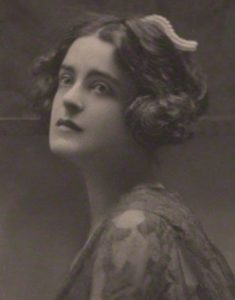 Harriet Pearl Alice Cohen (1901-1967) was born in London, England to a Jewish family with Russian heritage. She started playing piano in early childhood, and by age 13 won the Ada Lewis Scholarship and the Sterndale Bennett Prize from the Royal Academy of Music. A year later, she made her professional debut and soon became one of the most popular musicians in England. She was noted for resurrecting old English compositions that had been forgotten, as well as opening up Spanish and Russian music to the wider world. In fact, she was permitted to visit the Soviet Union (and perform there) in 1935, bringing back great compositions by contemporary Russians that she then performed around the world. While visiting Vienna in 1933, Cohen first recognized the plight of refugees fleeing Nazi Germany. She decided to devote herself to their cause. Cohen went on to raise large sums of money to support the refugees, and worked with several organizations to bring them to safety. In 1934, she performed a special benefit concert, with