Category Archives: Science & Technology

Jews in the World of Science and Technology

Jew of the Week: Dean Kamen

Inventor of the Segway
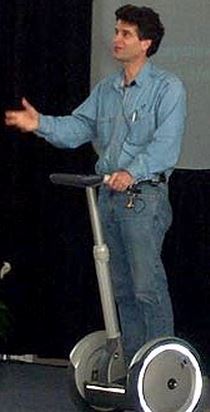
Dean Kamen on a Segway

Dean Kamen on a Segway

Dean Kamen (b. 1951) was born in New York, the son of famous illustrator Jack Kamen. He dropped out of Worcester Polytechnic Institute to focus on his career as an inventor and entrepreneur. His first big success was inventing a wearable drug infusion pump, after which he started his first company AutoSyringe. Following this, he worked on portable kidney dialysis machines, robotic arms, insulin pumps, the Stirling engine, water purification systems, as well as solar power and off-grid electricity in the hopes of raising the standard of life in developing countries. Among his more interesting inventions are an all-terrain wheelchair, and a device that launches people into the air, used by law enforcement agents and emergency workers to get to the top of tall or inaccessible rooftops and buildings. Above all though, his most well-known invention is undoubtedly the Segway – the cool, self-balancing, two-wheeled personal transporter. Though it has yet to catch-on among the public, it was once thought to be an invention “more important than the internet”, and Steve Jobs said it was “as big a deal as the PC”. Meanwhile, Kamen founded an organization called FIRST, aimed at inspiring students to enter technology and engineering programs. The organization provides over $15 million in scholarships. It also runs the famous FIRST Robotics Competition, now held in some 60 locations around the world, with over one million students having participated over the years. All in all, Kamen holds over 440 patents. He has already been inducted into the National Inventors Hall of Fame, and has won a great number of awards and honourary degrees, including the National Medal of Technology, and the UN’s Global Humanitarian Action Award. In 2010, he also starred in the TV show Dean of Invention. Kamen is a hobbyist pilot, and owns a collection of jet aircraft and helicopters, which he usually flies to work.

Words of the Week

He was this little guy David, and he had this really big problem, Goliath, and he took him out because he had a little piece of technology, and I thought, “Wow, technology is cool.”
Dean Kamen, on being inspired by the Biblical story of David and Goliath

Jew of the Week: Fritz Haber

Fritz Haber

Fritz Haber

Fritz Haber (1868-1934) was born to a traditional Jewish-German family in what is today Poland. He studied chemistry in Berlin, receiving his doctorate in 1891 and then going to apply his expertise in his father’s successful dyes and pharmaceuticals business. The two didn’t work well together, though, and Haber returned to academia. (In order to obtain a higher position at a time when Jews were barred from such posts, Haber nominally converted to Christianity.) His research in organic chemistry, electrochemistry, dye technology, gasses, and textiles brought him a great deal of recognition. In 1898 he was made an associate professor, and by 1906 a full professor at Karlsruhe University, among the most prestigious schools in Germany. It was there that Haber made his biggest breakthrough. Together with Carl Bosch, he invented a process that would quickly and cheaply produce ammonia (the key component of fertilizer) from abundant atmospheric nitrogen. Until then, ammonia had to be mined from very limited reserves. Today, over 100 million tons of ammonia is made annually using the “Haber Process”, helping to feed half of the world’s population. Haber won the 1918 Nobel Prize for this work. Unfortunately, Haber also applied his know-how to less honourable endeavours. Aside from the fact that ammonia is a central ingredient of explosives, too, and the Haber Process helped to arm the German military, Haber headed the Ministry of War’s Chemistry Section during World War I, developing gasses for chemical warfare (as well as the gas masks to protect from them). To be fair, many of the world’s top chemists during this time period worked on chemical warfare to assist in their nation’s war effort. As Haber himself said, “During peace time a scientist belongs to the World, but during war time he belongs to his country.” His wife did not agree, and committed suicide after failing to convince him to abandon his project. After the war, Haber started a company that produced pesticides. Incredibly, their most famous product was Zyklon B, later used in the gas chambers of the Holocaust. Haber fled Germany when the Nazis came to power. He accepted a position in what would later be the Weizmann Institute in Israel, but passed away on the journey there. Few people have at once been able to cause both so much harm and so much good. While half of the world’s food production today depends on the Haber process, so do much of its explosives, and Haber is often called “the father of chemical warfare”. Haber’s work simultaneously brought death to millions of people, and life to millions more.

Words of the Week

When God desired to create man, Truth said: “He should not be created, for he is full of lies.” Kindness said: “He should be created, for he is full of kindness.”
– Midrash Rabbah, Bereshit 8:5

Jew of the Week: Emile Berliner

Inventor of the Gramophone and Helicopter

Emile Berliner, inventor of the Gramophone and the helicopter

Emile Berliner, inventor of the Gramophone and the helicopter

Emile Berliner (1851-1929) was born in Hanover, Germany. Though he studied to be a merchant like the rest of his family members, he was always more interested in invention. With the outbreak of the Franco-Prussian War in 1870, Berliner fled to the US and settled in New York. During the day, he struggled to make ends meet by delivering newspapers and doing other petty jobs, while at night he studied physics. He became interested in the new technology of telephone and began working on sound transmission. Berliner first invented a new phone transmitter that was later adapted to make the first microphone. Bell Telephone Company bought out his patent and hired Berliner. He worked for Bell until 1883, when he established his own company. Building on previous phonograph technology, Berliner revolutionized the world in 1887 by inventing the gramophone and the flat disc record. At first, it was sold as just a toy, and only in Europe. In 1895, Berliner managed to get a $25,000 investment for his invention, and started the US Berliner Gramophone Company. Unfortunately, others stole his patents and sold unauthorized records, and Berliner was eventually unable to sell his own invention. He moved to Canada, started a new company, and soon focused on other technologies. One of these was an automatic loom for mass-producing clothes. Another, more famous, was the first helicopter. For over twenty years, Berliner focused on developing vertical flight machines, with the help of a number of other inventors and scientists. He designed the vertical rotor that made modern helicopters possible. In 1922, Berliner demonstrated the first helicopter to the US Army. Meanwhile, Berliner wrote and published five books, and was a noted advocate for public health and better sanitation. He won a number of prestigious awards for his work, which forever transformed the music, clothing, and flight industries.

Words of the Week

The souls of all the living… On Rosh Hashanah will be inscribed and on Yom Kippur will be sealed: how many will pass from the earth and how many will be created; who will live and who will die… Who will rest and who will wander, who will live in harmony and who will be harried, who will enjoy tranquility and who will suffer, who will be impoverished and who will be enriched, who will be degraded and who will be exalted. But repentance, prayer, and charity avert these severe decrees!
– Verses from Unetanneh Tokef, sung during Rosh Hashanah prayers