Category Archives: Law, Politics & Military

Jews in the World of Law and Politics

Jew of the Week: Anne Heyman

Mother of Rwanda’s Orphans
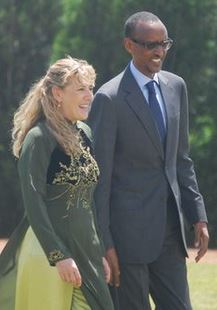
Anne Heyman with Rwandan President Paul Kagame

Anne Heyman with Rwandan President Paul Kagame

Anne Elaine Heyman (1961-2014) was born in South Africa and moved to the US with her family when she was 15. After doing a year of high school in Israel, she studied at the University of Pennsylvania, and then got a law degree from Columbia University. She was soon Manhattan’s assistant district attorney, focusing on fighting white-collar crime. In 1994, she began devoting her time to philanthropic causes, first volunteering with an organization that assists the elderly, as well as Hillel, Young Judea, and the Jewish Community Centers of America. In 2005, she learned that the Rwandan genocide left over a million orphans. Inspired to make a change, she realized she could apply the same model that Israel used in caring for orphans following the Holocaust. Heyman raised $12 million and convinced the Rwandan government to give her 144 acres of land on which she built a village for orphans (called Agahozo-Shalom). To power the village, Heyman built a solar plant – one of the largest in sub-Saharan Africa – which provides electricity for the rest of Rwanda as well. To help her, she brought in Israeli Ethiopian Jews to serve as councilors and teachers. The orphans, some of whom didn’t even know their names, were given a home, an education, a trade, and a new family. They affectionately called Heyman “Mom”, “Grandmother”, and “Angel”. Over 500 teenagers continue to live and prosper in Heyman’s village today. Sadly, Heyman passed away a year ago in a tragic horse-riding accident. Her husband and children are continuing her important work.

Words of the Week

I see Israel as one of the great outposts of democracy in the world… as a marvelous example of what can be done… how desert land can be transformed into an oasis of brotherhood and democracy.
– Dr. Martin Luther King, Jr.

Jew of the Week: Naftali Bennett

Software Entrepreneur, Special Forces Commander

Naftali Bennett

Naftali Bennett

Naftali Bennett (b. 1972) was born in Haifa to Modern Orthodox parents who made aliyah to Israel (from San Francisco) following the Six-Day War. He studied at Yavne Yeshiva, where he became a youth leader for Bnei Akiva, the religious Zionist organization. After his studies, Bennett joined the IDF and served in the Sayeret Matkal and Maglan special forces units, rising to the rank of company commander. His primary area of operations was in Lebanon. After completing his service, Bennett studied at the Hebrew University, earning a law degree. In 1999, he moved to New York and co-founded the software company Cyota. As its CEO, Bennett built the start-up into a successful tech firm and sold it in 2005 for $145 million. Bennett then returned to Israel and continued his work as a software entrepreneur. At one point he served as CEO of Soluto, which was recently sold for nearly $130 million. Not long after his return to Israel, the Lebanon War broke out and Bennett returned to the IDF, leading a number of search-and-destroy missions in Hezbollah territory. Following the war, Bennett joined Netanyahu’s Likud party and soon became his Chief of Staff. Between 2010 and 2012, Bennett was the director-general of Yesha, the organization that represents Jewish settlements in Judah and Samaria (commonly known as the “West Bank”). After founding a number of other organizations promoting Israel and the Zionist cause, Bennett left Likud and joined HaBayit HaYehudi (The Jewish Home), a religious Zionist political party. He immediately ran for party leadership and won by a landslide. Just a few months later, Bennett was able to win 12 seats for the party in Israel’s Knesset (compared to just 3 seats for the party in the previous election). Among other roles, he became the Minister of the Economy and Minister of Religious Services, as well as a member of the Foreign Affairs and Defense Committee. He has been praised for his work as Minister of the Economy, opening up new trade agreements with emerging markets around the world, boosting trade with Russia, China, Brazil, and India, as well as dealing with increasing boycotts of Israeli products. Bennett is continuing to lead HaBayit HaYehudi into Israel’s coming elections in March. Some of his platform positions have been controversial, among them opposing a Palestinian state, and fighting Israel’s big unions. At the same time, he is pushing education reform, more investment in underprivileged parts of Israeli society and in small businesses, and providing affordable housing and land provisions for veterans. He is also focused on integrating Israeli-Arabs and Ultra-Orthodox Jews more tightly into Israel’s society and workforce. Bennett remains a reservist in the IDF, holding the rank of Major.

UPDATE: On June 13, 2021, Naftali Bennett became Israel’s 13th prime minister, as the head of the Yamina party. He is the first religious prime minister in the country’s history.

Words of the Week

The fact that the entire world says something does not mean it is correct.
Naftali Bennett, in an interview for Israel’s Channel Two.

Jews of the Week: The Sons of Matityahu

The Warrior-Priests of Chanukah

A 16th-Century Drawing of Yehuda Maccabee, by Rouille

A 16th-Century Drawing of Yehuda Maccabee, by Rouille

In 166 BCE, after the passing of Matityahu – the Jewish priest (kohen) who instigated the revolt against the Seleucid Greeks – his third son Yehuda (Judah) was chosen as the new leader of the resistance. By this time, Yehuda had made a name for himself as a fearless warrior and skilled military strategist. Nicknamed HaMakabi, “the hammer” (or alternatively, Makab-Yahu, “the one designated by God”), he continued to win battle after battle primarily through guerrilla tactics and surprise attacks. In 164 BCE, Yehuda recaptured Jerusalem and the Temple, re-purifying it, restoring its holy Jewish rituals, and relighting its menorah. Contrary to popular belief, the war did not end at that point. Two years later, Matityahu’s fourth son Eleazar died at the Battle of Beit Zechariah. Identifying what he thought was the war elephant carrying the Greek king, Eleazar slid under it and thrust his spear into its flesh. The dead elephant collapsed unto Eleazar, killing him as well. Perhaps the most pious of the sons, Eleazar was known to publicly read from the Torah before battle. To gain support, in 161 BCE Yehuda signed an alliance with the Roman Empire, though it helped little. A year later, Yehuda died at the Battle of Elasa. His oldest brother Yochanan (John), of whom the least is known, died shortly after in the ensuing troubles. The youngest son Yonatan (Jonathan) was elected the new leader, by now earning a reputation almost equal to that of Yehuda. He continued the victories against the Greeks, and soon after signed a peace treaty with them. The Greeks left the Holy Land, and Yonatan focused his efforts on rebuilding the state, and removing Greek influences and idolatry from the land. In 153 BCE, a civil war erupted among the Greeks, and Yonatan sided with the winning party. He was given the special Greek title of “strategos”, and appointed as the High Priest (kohen gadol). Yonatan was able to further expand the territories of the semi-autonomous Jewish state. Years later, a different Greek king rose to power, and tricked Yonatan into a fatal trap, imprisoning, and then killing him. The last remaining son of Matityahu was Shimon (Simon), who gathered his forces in response to Yonatan’s death, and helped another Greek king come to power. This king then granted Judea its independence, and Shimon established the Hashmonean dynasty which would rule the Holy Land for the next century. Shimon was its first king and High Priest, reigning for five years of peace and prosperity. Tragically, he was assassinated in 135 BCE. His third son John Hyrcanus took power, continuing the Hashmonean dynasty until its ultimate end at the hands of the Romans.

Words of the Week

A person should always be pliant as a reed, and let him never be unyielding as the cedar.
– Talmud, Taanit 20b

Happy Chanukah!