Category Archives: Law, Politics & Military

Jews in the World of Law and Politics

Jew of the Week: Jonas Phillips

Revolutionary War Hero
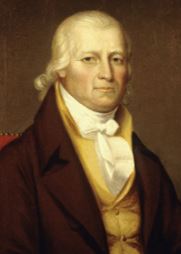
phillipsJonas Phillips (1736-1803) was born in Germany to an observant, Yiddish-speaking family. When he was 21, Jonah set forth for the New World. He first made his way to London, anglicizing his father’s name “Phaibush” to “Phillips”. There, he sold himself into indentured servitude in order to pay for his passage to America. After working several years on an indigo plantation, Phillips earned his freedom and moved to New York to work as a merchant. He became a wealthy man and married a prominent Sephardic Jewish woman, with whom he would have 21 children. Unfortunately, Phillips lost much of his wealth because of British restrictions on commerce. Not surprisingly, Phillips became a strong supporter of the American Revolutionary War, and joined the Philadelphia Militia. He fought valiantly, and earned a reputation as an American war hero. In 1787, he took part in the Constitutional Convention that drafted the United States Constitution. He played a key role in ensuring that the Constitution would protect people’s religious freedoms, and give equal civil rights to all citizens. Meanwhile, Phillips was a founding father of one of America’s oldest synagogues, Philadelphia’s Mikveh Israel. One of his grandsons became the Chief Justice of South Carolina’s Supreme Court, while another was America’s first Jewish commodore in the US Navy, and also a famous war hero. His great-grandson was a governor of South Carolina.

Words of the Week

Brothers, half of the Palestinians are Egyptians and the other half are Saudis. Who are the Palestinians? Egyptian! They may be from Alexandria, from Cairo, from Dumietta, from the North, from Aswan, from Upper Egypt. We are Egyptians. We are Arabs.
— Hamas Minister Fathi Hammad on Al-Hekma TV (Egypt), March 23, 2012 (Click here to watch)
Jews of the Week: Isaac Leeser and Warder Cresson

Isaac Leeser

Isaac Leeser

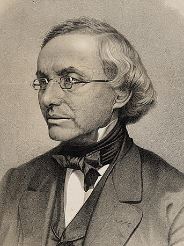
Isaac Leeser (1806-1868) was born in the Germanic kingdom of Westphalia. Growing up, he received both a religious Jewish education, as well as a secular German one, and was fluent in Latin, German, and Hebrew. He immigrated to the United States at the young age of 17 and lived with his wealthy uncle. While working in his uncle’s business, Leeser started to teach Judaism in his local synagogue, and vocally defended his religion when it was under attack in the public sphere. By age 22, he was quite well known, and was invited to take over Philadelphia’s Congregation Mikveh Israel, one of America’s oldest Sephardic synagogues. Leeser introduced American Jewry to the German custom of delivering a sermon between prayers (something now common in all synagogues). He wrote a book about Judaism in 1829 but found no publisher willing to print it. So, he started his own press, establishing the Jewish Publication Society. In 1845, he published his English translation of the Torah – the first by a Jew. Eight years later, he published a complete English Tanakh. This translation was the authoritative Jewish version for decades, and is still widely used today. Leeser helped found some of America’s first Jewish schools, seminaries, and magazines. He was also a civil rights activist and worked hard on behalf of all minorities. He is regarded as one of America’s most important Jewish pioneers.

Michael Boaz Israel, aka. Warder Cresson

Michael Boaz Israel, aka. Warder Cresson

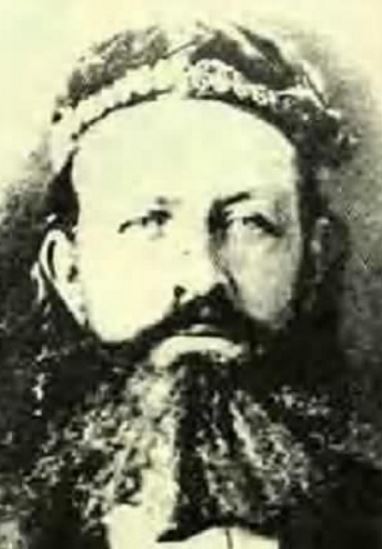
In 1840, Leeser met a wealthy farmer named Warder Cresson (1798-1860). Cresson was a very religious Quaker, a preacher and writer. After some discussions with Leeser, Cresson took a deep interest in Judaism. In 1844, he was appointed America’s first consul in Jerusalem. This brought him face-to-face with Judaism and he grew close to Jerusalem’s ancient Sephardic community. He started writing for Leeser’s magazine, The Occident, and even began doing counter-missionary work to stop Christian proselytizing of Jews. In 1848, Cresson converted to Judaism, was circumcised, and took on the Hebrew name Michael Boaz Israel ben Avraham. Upon his return to Philadelphia, his wife divorced him, sued him, and sought to have him declared insane. The case made headlines across the US. Cresson ultimately won the suit, proving his absolute sanity and wisdom. He returned to Jerusalem, married a Sephardic woman and had three kids. In 1852, he established a Jewish agricultural colony – predating the Zionist movement by several decades, and in fact, helping to inspire it. He continued writing on Jewish topics, and died as a respected and prominent leader in Israel’s Sephardic community. His original tomb and burial place on the Mount of Olives was recently rediscovered.

Words of the Week

Just as the olive yields oil for light only when it is pounded, so are man’s greatest potentials realized only under the pressure of adversity.
– The Talmud

Jew of the Week: Morris Cohen

China’s “Uncrowned Jewish King”

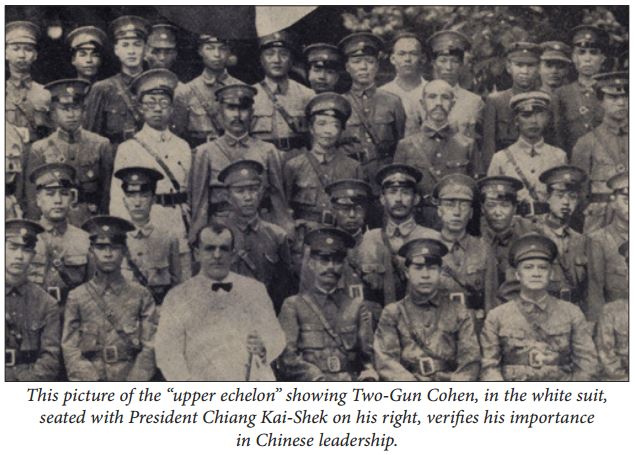
Morris Cohen sitting next to Chinese President Chiang Kai-Shek (Credit: Joe King)

(Credit: Joe King)

Moshe Morris Abraham Cohen (1887-1970) was born in Poland to a poor Orthodox Jewish family. While he was still an infant, his family fled the pogroms and settled in London, England. Growing up, Cohen often got in trouble so his parents sent him to work on a farm in Saskatchewan, Canada, hoping to mend his ways. There, he learned the value of hard work, in addition to playing cards and shooting guns. He became good friends with Chinese railroad workers, and even defended a Chinese man who was being robbed – a big deal at a time when white people rarely stood up for the Chinese in those days. Cohen’s friends invited him to join the revolutionary party of Dr. Sun Yat-sen, who would become modern China’s founding father and first president. Cohen agreed to train Chinese-Canadians in military combat and helped secure weapons for China’s revolutionary army. Meanwhile, he settled in Edmonton and became a successful real estate broker. Cohen was soon appointed as the province of Alberta’s Commissioner of Oaths. With the outbreak of World War I, he fought valiantly with the Canadian Railway Troops. Finding it hard to make a living in Canada after the war, he moved to China. Cohen was hired by Sun Yat-sen to train his forces, procure arms, and serve as his personal bodyguard. After once taking a bullet while protecting Sun Yat-sen in an assassination attempt, he started carrying two guns, and henceforth was known as “Two-Gun Cohen”, though the Chinese called him Ma Kun, “Clenched Fist”. Following Sun Yat-sen’s death, Cohen continued working for China as a military commander and head of their secret service. During World War II, it was Cohen that proved the Japanese were using poison gas against Chinese civilians. Cohen was captured in battle by Japanese soldiers. He was nearly beaten to death before being freed in a prisoner exchange. Cohen then returned to Canada, settled in Montreal, and finally married. He spent the rest of his life in relative quiet, working as a consultant in various capacities, and often traveling to China. (He had the distinction of being the only person allowed to travel freely between China and Taiwan – as he was friendly with leaders of both nations, despite their antagonism towards each other.) Perhaps his last great act was convincing the Taiwanese not to oppose the UN Partition Plan that gave birth to the State of Israel. Taiwan’s position on the UN Security Council made their vote critical, and they intended to oppose the plan until Cohen stepped in. He also helped to arm the nascent State of Israel in its War of Independence. Cohen’s life inspired two books, as well as the 1936 film The General Died at Dawn, and the 1984 film The Gunrunner, starring Kevin Costner. As a major general in China’s revolutionary army (to this day, the only Westerner to hold such a high rank in the Chinese military), one-time head of China’s secret service, and Sun Yat-sen’s personal aide, Cohen played an instrumental role in the founding of modern China. He was once described as China’s “uncrowned Jewish king”.

Yom Kippur Begins Tonight! Gmar Chatima Tova!

Words of the Week

All lovers of democracy cannot help but support… the movement to restore your wonderful and historic nation which has contributed so much to the civilization of the world and which rightly deserves an honourable place in the family of nations.
Dr. Sun Yat-sen, on his support for the Zionist movement