“The Jewish Avenger”
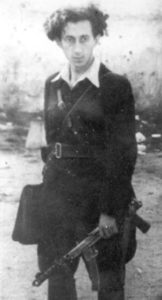 Abel “Abba” Kovner (1918-1987) was born in what is today Belarus and grew up in Vilnius (then part of Poland). As a young man, he was a member of HaShomer HaTzair, the Zionist youth movement. When the Nazis invaded Vilnius in 1941, Kovner escaped to a convent, but soon returned to the Vilna Ghetto to organize a Jewish resistance. At the start of 1942, Kovner secretly published a manifesto inside the Ghetto to inspire the Jews to fight back, writing that it was better to die than “go like lambs to the slaughter”. Along with several other young men, Kovner formed the United Partisan Organization, possibly the first armed underground Jewish group in Nazi Europe. Before they could launch their first large-scale attack, the Vilna Ghetto was liquidated in 1943, forcing the group to flee to the surrounding forests. From there, they launched a guerrilla warfare campaign against the Nazis. The small group began calling themselves “the Avengers” (HaNokmim) and were successful enough to draw the attention of the Red Army. They would go on to coordinate with the Soviets to crush the Nazis in Eastern Europe. Once the fate of the Nazis was sealed towards the end of 1944, Kovner was among the founders of a new group, called Bricha (“Escape”), which worked to get Jewish refugees out of Europe and to the Holy Land. Over the next couple of years, they would successfully move 250,000 Holocaust survivors to Israel. Having seen first-hand the horrific devastation inflicted by the Nazis, Kovner yearned for revenge. He started yet another group, called Nakam (“Vengeance”), seeking to punish Germany for the Holocaust. “Plan B” was to poison the water supply in Allied prisoner-of-war camps where Nazi SS soldiers were kept. The far more controversial and shocking “Plan A” was to poison the water supplies of several major German cities in order to kill 6 million Germans, one for each Jew lost in the Holocaust. Thankfully, Plan A was soon abandoned, though Kovner was still arrested by the British and held in a Cairo prison for several months. He did aim to accomplish Plan B, and Nakam members infiltrated a POW camp bakery in April 1946, coating the loaves of bread with arsenic. Over two thousands German soldiers fell ill, though no deaths were reported. In December 1947, Kovner joined the Haganah and fought in Israel’s Independence War as a captain of the Givati Brigade. Following this, he lived out the remainder of his life in a kibbutz, working tirelessly to strengthen the nascent state. He also helped to design several Holocaust museums, and testified at the Eichmann trial. More famously, Kovner wrote a series of poetry books (in Hebrew and Yiddish) describing the struggles he faced during the Holocaust and in Israel’s early years. This made him one of the country’s most celebrated poets and writers. For this, he won the Israeli Prize for Literature in 1970. A heavy smoker, Kovner succumbed to tracheal cancer before his 70th birthday.
Words of the Week
It is perfectly clear that the Arab nations do not want to solve the Arab refugee problem. They want to keep it as an open sore, as an affront against the United Nations, and as a weapon against Israel… Arab leaders don’t give a damn whether the refugees live or die.
— Sir Alexander Galloway, former head of UNRWA
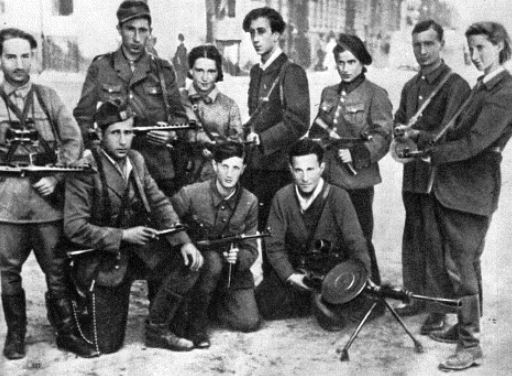
Abba Kovner (Centre) and his Avengers.
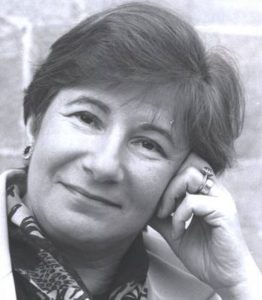 Ruth Lynn Fraenkel (b. 1943) was born in London to Jewish-Polish refugees who fled the Nazis. She studied law at Oxford University’s prestigious St. Anne’s College, and there met her future husband John Deech. After getting her MA, she briefly taught law at Windsor University in Canada, then returned to St. Anne’s and taught there for two decades before being elected its principal in 1991. As a specialist in family law and bioethics, she also headed Oxford’s Health Authority, and eventually became the governor of the UK Department of Health’s Human Fertilisation and Embryology Authority (HFEA). The HFEA regulates fertility treatments, in-vitro fertilization, and embryological research across the UK. As its governor, Deech made some difficult and controversial decisions, including one case where a woman was forbidden from having a baby with her dead husband’s frozen sperm. She also fought against the decision to allow birth certificates not to name a father, stating “I regret the downgrading of the father as a person of importance – the legislative dismissal of the contribution of half the population to the upbringing of the next generation” and that “Tolerance of both types of parenting has to be ensured.” In 2002, Deech was knighted as a Dame Commander of the Order of the British Empire. That same year she was appointed governor of the BBC. Following this role, she was made a life peer of the House of Lords, and given the title Baroness Deech of Cumnor. At the same time, she served as the chairman of the Bar Standards Board, which regulates lawyers across England and Wales, and sat on the Jewish Leadership Council. Deech remains one of the world’s most renowned academics and ethicists. Oxford University recently named one of its buildings after her, and she was once ranked on “The God List” of the fifty most influential “people of faith” in Britain. She also regularly stands up for the Jewish community, and for Israel – at
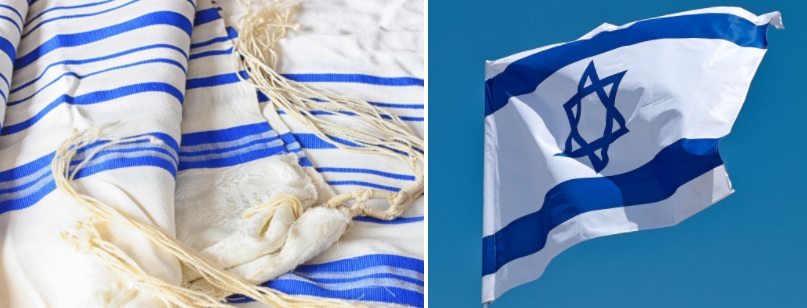
  David Wolffsohn (1856-1914) was born to a poor, religious Jewish family in the Lithuanian-Polish town of Darbenai (then part of Russia). His father was a Torah scholar and teacher, and Wolffsohn, too, was learning in yeshiva with the same goal in mind. In his teens, he was sent to live with relatives in Germany to avoid being conscripted to the Russian army. There, he met the rabbi, philosopher, and early Zionist leader Isaac Rülf, and became his devoted disciple. Meanwhile, Wolffsohn took up secular studies and went on to apprentice at a trading company. In 1877, he started his own flouring business, and was soon one of the most prominent Jewish businessmen in Europe. Henceforth, he dedicated his life to realizing that ancient dream of his people’s return to Israel. He played a key role within the Hovevei Zion movement, and in 1894 was a cofounder of the Society for the Promotion and Support of Jewish Agriculture in Syria and Palestine. When Herzl’s The Jewish State was published two years later, Wolffsohn immediately journeyed to Vienna to meet him. The two became very close and traveled the Holy Land together, setting the foundations for what would become the State of Israel. Not surprisingly, when the World Zionist Congress was founded, Herzl was made its president and Wolffsohn its vice-president. Upon Herzl’s death shortly after, Wolffsohn succeeded him. As president, he was instrumental in reinvigorating Jewish life in the Holy Land (among other things, it was under his tenure that the city of Tel-Aviv was founded). However, Wolffsohn is most famous for being the one who created the flag of modern Israel. Back in 1896, Herzl had written: “We have no flag, and we need one. If we desire to lead many men, we must raise a symbol above their heads. I would suggest a white flag, with seven golden stars…” Herzl’s proposal was good, but his flag gained little support. Wolffsohn responded to Herzl thus: “We have a flag—and it is blue and white. The talit with which we wrap ourselves when we pray: that is our symbol. Let us take this talit from its bag and unroll it before the eyes of Israel and the eyes of all nations…” Wolffsohn designed a simple flag with blue talit-like stripes and a