Category Archives: Business & Finance

Jews in the World of Business and Finance

Jews of the Week: Philips Family

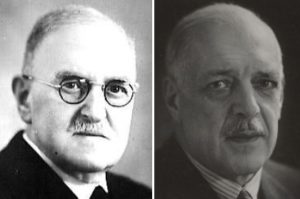
Gerald and Anton Philips

Gerald Leonard Frederik Philips (1858-1942) was born in the Netherlands, the son of a wealthy Dutch-Jewish financier (who was the first cousin of Karl Marx). In 1891, inspired by the recent invention of the light bulb, he decided to open his own light bulb and electronics company. His father purchased an abandoned factory where they set up shop and started producing carbon-filament lamps under the Philips brand the following year. The company did poorly, and nearly went bankrupt before younger brother Anton Frederik Philips (1874-1951) joined the business. A great salesman, with terrific innovations of his own, Anton quickly changed the company’s fortunes. Philips got another boost during World War I, when it filled the void left by the embargo on German electronics. By the 1920s, Philips had become a large corporation, and would soon establish the model for future electronics multinationals. After making their own vacuum tubes and radios, Philips’ introduced a new type of electric razor, the wildly popular Philishave. (It was invented by lead engineer and fellow Jew Alexandre Horowitz.) During the Holocaust, the family fled to the United States and ran the business from there. One son, Frits Philips, remained behind, and spent several months in an internment camp. He would save the lives of 382 Jews that he employed in his factory, convincing the Nazis that they would assist the war effort. In 1963, Philips introduced the compact audio cassette, revolutionizing the world of music forever. They did it again less then a decade later with the first home video cassette recorder. In the 1980s, Philips developed the LaserDisc, and together with Sony, brought about the age of the CD. Similarly, in 1997 Philips and Sony developed the Blu-ray disc. Today, Philips is still the world’s largest lighting manufacturer, employing over 100,000 people, with revenues of nearly €25 billion. In 2012, Greenpeace ranked Philips first among energy companies and tenth among electronics companies for their green initiatives and commitment to sustainability. This is very much in line with Gerald and Anton Philips’ original vision. The brothers were noted philanthropists, and supported many educational and social programs in their native Netherlands.

Words of the Week

Incidentally, Europe owes the Jews no small thanks for making people think more logically and for establishing cleanlier intellectual habits – nobody more so than the Germans, who are a lamentably déraisonnable race who to this day are still in need of having their “heads washed” first. Wherever the Jews have won influence they have taught men to make finer distinctions, more rigorous inferences, and to write in a more luminous and cleanly fashion; their task was ever to bring a people “to listen to raison.”
– Friedrich Nietzsche

A 1968 Philips audio cassette recorder; a Philips Magnavox video recorder; Philishave rotary razor; and an early LaserDisc player model


Jews of the Week: Bernie Marcus and Arthur Blank

The Home Depot

Bernie Marcus

Bernard Marcus (b. 1929) was born in New Jersey to Russian-Jewish immigrants. His dream was to become a doctor, but he could not afford the tuition. Instead, he studied pharmacy at Rutgers University (where he was part of the Jewish AEPi fraternity) and paid his way by building cabinets with his father. While working at a drug store after graduating, Marcus realized that he is far more interested in business than pharmacy. He went on to work in various retail jobs, eventually becoming the CEO of a home improvement store. There he met Arthur Max Blank (b. 1942). Blank had studied business in college, and worked in various accounting jobs until becoming VP of finance at the same home improvement store as Marcus. The two were both fired from the company in 1978. Undeterred, they decided to start their own home improvement store, with a new “warehouse” concept, and a focus on superb customer service and a vision of giving back to the community. The two hired a fellow employee who had been fired, Ron Brill, as well as businessman Pat Farrah, who had once owned a home improvement store. The following year they opened the first Home Depot in Atlanta. Just two years later, they branched out into Florida and went public. Within a decade, Home Depot had become America’s largest home improvement store. Today, it has over 2200 stores across the US, Canada, and Mexico, with some 385,000 employees, and is the world’s largest buyer of construction materials. True to their original vision, The Home Depot Foundation has donated over $200 million in support of various causes, including Habitat for Humanity. They have been lauded for their environmental conservation, avoiding lumber purchases from endangered forests, running the largest light bulb recycling program in the US, and spending $100 million over ten years to build 100,000 green homes and plant 3 million trees. Home Depot also sponsors the US and Canada Olympic Teams.

Arthur Blank

Marcus and Blank served as CEO and president of Home Depot for 19 years. Upon retirement, Blank purchased the Atlanta Falcons football team, and recently founded a new Major League Soccer team, Atlanta United FC. He is also a noted philanthropist, donating millions to various causes, including a recent $7 million to Denver’s National Jewish Health Center. Blank has signed The Giving Pledge, committing to donating at least 50% of his wealth to charity. Marcus has signed the Pledge, too, and was one of America’s most charitable donors in 2005. Among his many contributions, he has given $25 million to Autism Speaks, $15 million for a new nanotechnology research centre, and $5 million to co-found the Israel Democracy Institute. He now chairs his Marcus Foundation, which has given countless sums to children’s causes, Jewish communities, medical research, and support for military veterans. When asked why he was so passionate about charity, he said: “It goes back to what I learned as a young Jewish boy growing up in Newark, N.J. with immigrant parents: You have an obligation to give back to society. Thirty years ago, when I had no money, I worked for various charities, gave my heart, soul and time – now I can also give money.”

Words of the Week

We have neither taken other men’s land, nor are we in possession of other men’s property, but of the inheritance of our forefathers; it was wrongfully held by our enemies at one time, but we, grasping our opportunity, hold firmly the inheritance of our forefathers.
– Simon Maccabee (Book of Maccabees I,15:34-35)

Jews of the Week: Rose and Reuben Mattus

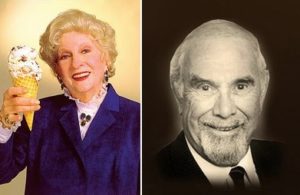
Rose and Reuben Mattus

Reuben Mattus (1912-1994) was born in Poland during World War I, which took his father’s life. He and his mother moved to New York when he was still a child. To make a living, the two worked at an ice cream parlour run by Mattus’ uncle, where ten-year old Reuben would squeeze lemons. By the time he finished high school, the family business was making chocolate ice cream bars and ice cream sandwiches, and sold them from a horse-drawn carriage. They opened up an ice cream factory in Brooklyn, where a young Rose Vesel (1916-2006) was hired to be a bookkeeper. Rose also immigrated with her Polish-Jewish family to New York as a five-year old. She first met Reuben on the streets of Brooklyn, and the two finally married in 1936. Two decades later, the couple decided to open up a new ice cream company. This ice cream would be richer and thicker, made with natural ingredients and butterfat as opposed to the artificial ingredients commonly used by other ice cream makers at the time. Since foreign-sounding names typically market better, Reuben came up with the Danish-sounding “Häagen-Dazs”, and put a map of Denmark on the logo. He did this as a tribute to Denmark, a country which strove to protect its Jews during the Holocaust. (The name “Häagen-Dazs” doesn’t actually mean anything in Danish!) While Reuben developed the recipes, Rose would sell the ice cream – initially by giving out free samples at supermarkets and universities, then catering to upscale restaurants. By 1973, Häagen-Dazs was the only ice cream being sold across the US, and opened its first official store just three years later. The Mattus’ sold the company for $70 million in 1983, but stayed on as consultants. Today, Häagen-Dazs is among the best-known ice cream brands in the world, and continues to operate ice cream shops all over the globe. (It still uses natural flavours and avoids using emulsifiers and artificial stabilizers like guar gum and carrageenan.) Reuben and Rose Mattus have been called the “Emperors of Ice Cream”, much like their fellow Jewish compatriots Baskin & Robbins and Ben & Jerry. Aside from ice cream, the Mattus’ were noted philanthropists, and strong supporters of Israel. They founded a school in Herzliya which still bears their name, and funded the construction of multiple settlements. They also financially supported the controversial Rabbi Meir Kahane, founder of the Jewish Defense League (JDL), as well as the Likud party. Rose Mattus sat on the board of the Zionist Organizations of America, and was reportedly a good friend of both Ariel Sharon and Benjamin Netanyahu. In 2004, she published a book detailing the incredible story of Häagen-Dazs.

Words of the Week

It is better to have an Israel that everyone hates, than an Auschwitz that everyone loves.
– Rabbi Meir Kahane