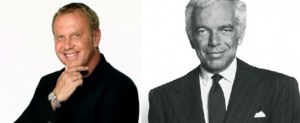
Michael Kors and Ralph Lauren
Listed by Forbes among the richest people in the world, Ralph Lauren (b. 1939) was born Ralph Lifshitz to Polish-Belorussian immigrants in the Bronx. He began selling ties to his classmates at the Marsha Stern Talmudical Academy. Lauren then studied at Baruch College, followed by several years in the US Army, after which he became a tie salesman. For a long time he would struggle to make a living, until he was finally able to open his own tie store in 1967, called Polo. As his success grew, Lauren released several men’s clothing lines. Today, Polo Ralph Lauren is a multi-billion dollar company. Interestingly, Lauren owns a rare car collection with over 70 unique vehicles – one of the greatest collections in the world. He is also a knight of the French legion.
A fellow New Yorker, Karl Anderson (b. 1959) was born to a Swedish father and Jewish mother. He changed his name to Michael Kors at age 5 when his mother remarried. Influenced by his mother’s modelling career, Kors began designing clothes as a teen and selling them out of his parents’ basement. He was discovered soon after while studying at New York’s Fashion Institute of Technology. After working for French fashion giant Celine for many years, Kors left to focus on his own label, which has quickly grown to huge popularity globally. Aside from the fashion world, Kors received the Oliver R. Grace Award for Distinguished Service in Advancing Cancer Research.
Words of the Week
You create your own universe as you go along.
– Winston Churchill

 Donna Ivy Faske (b. 1948) was born in Forest Hills, New York and grew up in the “Jewish Greenwich” of Five Towns, Long Island. She was raised by a single mother who worked as a fashion model. Karan began her fashion career drawing sketches for Liz Claiborne. Although she dropped out of designer school, her talent propelled her onward, working first with fellow Jew Anne Klein, and eventually starting her own company with husband Stephen Weiss. In 1985, the Donna Karan Co. line premiered for the first time – with the motto “modern clothes for modern people” – and was an instant hit. Along with her popular Essentials and Signature lines, in 1988, Karan launched a new line for youth that has since gained even greater fame: abridging ‘Donna Karan New York’ to DKNY. The brand became huge worldwide (and currently operates 70 stores around the globe), and is often seen as a symbol of New York City itself, likely due to the famous ad poster, which has been called a ‘New York landmark’. A winner of multiple awards, Karan has been nicknamed ‘The Queen of Seventh Street’.