
The Man Who Helped Save Countless Israeli Lives
 Shlomo Gerzovsky (1913-1997) was born in Uman, Ukraine. When the Communist Revolution began, the family fled to Romania, and eventually made its way to the Holy Land. Gerzovsky, now with the Hebraized last name “Gur”, started studying at the Mikveh Israel Agricultural School. In 1936, the Arab Revolt began, with Arab mobs attacking both British nationals and Jewish residents. In response, Gur was among the co-developers of the Homa u’Migdal (“Wall and Tower”) system, a method of building settlements with pre-fabricated protective walls and a watchtower—quickly assembled, sometimes overnight. Gur co-founded the first such settlement, Kibbutz Tel Amal, then helped to establish a whopping 56 others. All settlements were built legally according to existing Ottoman law, on land purchased by the JNF. They served as safe havens for Jews during the violent Arab pogroms, and ensured that Jewish life in the Holy Land would continue to flourish. In 1945, Gur travelled to the US to further his scientific studies. He returned in 1947 to fight alongside the Haganah, and was placed in charge of overseeing weaponry. Soon after, he established and directed Israel’s new Science Corps (heil hamadah), the focus of which was developing new weapons to protect the State of Israel. Together with Itzhak Bentov, they built Israel’s first rockets. The Science Corps later became RAFAEL, which developed the Iron Dome and David’s Sling, currently saving countless lives in Israel. In his later years, Gur moved to Tel Aviv and worked in the high-tech sector. He also oversaw the construction of several important building projects, including the Hadassah Medical Center, the Knesset, and Tel Aviv’s city hall.
Shavuot Begins Sunday Night – Chag Sameach!
Words of the Week
The power of resistance which has enabled the Jewish people to survive for thousands of years has been based to a large extent on traditions of mutual helpfulness. In these years of affliction our readiness to help one another is being put to an especially severe test. May we stand this test as well as did our fathers before us.

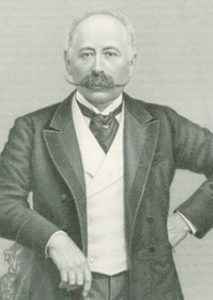
 Yonah Yosipovich Leibensohn Kremenezky (1850-1934) was born in Odessa, Ukraine to a Russian-Jewish family. He studied electrical engineering and worked on designing Russia’s first railways. In 1874, Kremenezky moved to Berlin to further his studies at the city’s Technical University. He then got a job working for Siemens, and was sent across Europe to build the continent’s first street lighting systems, starting in Paris and ending up in Vienna in 1878, where he settled permanently. Two years later, Kremenezky founded his own factory that produced lamps and batteries—the first of its kind in the Austro-Hungarian Empire. By 1883, he had become very well-known as a scientist-industrialist (a European Edison), and Crown Prince Rudolf personally asked him to help “electrify” his empire. Kremenezky did just that, laying electrical cables and setting up lighting systems, as well as building the empire’s first power plant. Meanwhile, his lamp factory designed all sorts of new lights, including ornamental bulbs and what we now know as “Christmas lights”. Kremenezky lights were a huge hit, exported around the world, even to the United States. For playing a key role in rebuilding and repowering Vienna after World War I, Kremenezky was awarded with the Ehrenbürgerrecht, the city’s highest decoration for citizens (a street in Vienna was named after him, too). Meanwhile, back in 1896, Kremenezky had met
  Moritz Tzvi von Hirsch auf Gereuth (1831-1896) was born in Munich to a wealthy German-Jewish family. His grandfather was a banker for the Bavarian king, and became the first Jew to be permitted to own land in Bavaria. His father also served as the court banker, and became a German baron. Hirsch studied in Brussels, then took a banking job himself at age 17. Years later, he branched off on his own, eventually making his fortune from sugar, copper, and railroads. One of his boldest projects was building a Vienna-to-Istanbul rail line. Hirsch settled in Paris where he lived for the remainder of his life, going by the French version of his name, Maurice de Hirsch. In 1860, the Alliance Israélite Universelle (Kol Israel Haverim) organization was founded in Paris to secure human rights and education for Jews around the world. Hirsch became their biggest supporter, essentially bankrolling their operation to the tune of several hundred thousand pounds a year. The organization was most famous for building Jewish schools, including the first schools in pre-State Israel. The Alliance schools were also the first to teach a Hebrew curriculum, playing a key role in the language’s revival. Hirsch also donated countless sums to schools and hospitals across Germany, France, and England. He paid for the renowned Pasteur Institute’s entire biochemistry building. In the last two decades of his life, Hirsch was devoted to easing the plight of Russian Jews. He founded the Jewish Colonization Association in 1891 with a starting budget of £2 million pounds. The money was used to resettle Eastern European Jews in the Americas (particularly in Canada and Argentina), as well as in Ottoman Palestine. Altogether, Hirsch donated £18 million to the organization, the equivalent of about $4 billion today! Needless to say, it played a massive role in getting the Zionist movement off the ground and re-establishing a Jewish state in Israel (though de Hirsch himself didn’t believe it would ever actually happen!) as well as saving countless lives from pogroms and oppression. Maurice de Hirsch is ranked among the most generous philanthropists of all time. His wife, Clara de Hirsch, is also on this list, in her own right. She came from a wealthy banking family, too, and donated another 200 million francs of her own funds. When the couple tragically lost their only son in 1887, Maurice de Hirsch declared: “My son I have lost, but not my heir; humanity is my heir.” For his efforts to launch a mass-exodus and liberation of Jews, he has been called the “Moses of the 19th Century”.