Tag Archives: Yeshiva

Jew of the Week: Barbra Streisand

Top Female Singer of All Time
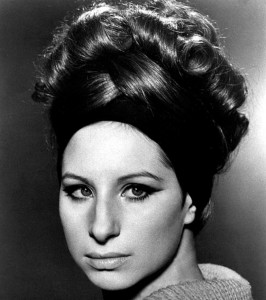
Barbra Streisand

Barbara Joan Streisand (b. 1942) was born in Brooklyn to parents whose families both immigrated from the former Russian Empire. Her father died soon after her birth, leaving her family in poverty. Streisand studied at the Jewish Orthodox Yeshiva of Brooklyn, where she developed her singing abilities and gave her first solo performances. Starting in her teens she sang at many nightclubs and also started to act in stage performances. Her first big break was on The Tonight Show in 1961, and in 1962 she acted in a small Broadway role. The following year, Streisand released her first music album. An instant hit, it brought her two Grammy Awards. Returning to Broadway in 1964, she made a splash with her performance in Funny Girl, which put her on the cover of TIME Magazine. Streisand would go on to release an incredible 50 studio albums. She is still the best-selling female artist of all time, and the only female in the Top 10. At one point, she only lagged Elvis Presley and The Beatles in terms of albums sold, and many of her songs still hold records. She owns a total of 8 Grammy Awards, in addition to 5 Emmy Awards, a Tony and 2 Oscars! This makes Streisand among the most decorated entertainers of all time, and also among the most diverse, achieving success in film, stage, and music. Barbra was the first woman to produce a movie that she also directed, wrote, and starred in. She is also a great philanthropist, having personally raised over $25 million for charities, and has donated millions more from her own pockets. She has been listed among the most charitable celebrities in the world. Adding to her fervent support of Israel, Streisand will be performing several sold-out shows in the Holy Land this summer.

Words of the Week

To be yourself in a world that is constantly trying to make you something else is the greatest accomplishment.
– Ralph Waldo Emerson

Jew of the Week: Rafael Halperin

Rafael “Mr. Israel” Halperin

Rafael Halperin (1924-2011) was born in Vienna, immigrating to Israel as a child along with his family who fled rising tensions in Europe. Despite living in Ultra-Orthodox Bnei Brak, and studying in yeshiva, Halperin was drawn to body-building and exercise. To everyone’s surprise, Halperin’s rabbi, the famous Chazon Ish – one of the greatest Jewish leaders of the last century – actually permitted Halperin to pursue his new passion! After learning the depths of the sport in the U.S., Halperin returned to Israel and opened The Samson Institute – Israel’s first chain of gyms and health clubs. He soon organized the first ever Mr. Israel contest, and drew the attention of a wrestling promoter. As a professional wrestler, Halperin earned the nickname ‘Samson the Second’. Among the most famous wrestlers at the time, he refused to throw matches or participate in match-fixing, which has always been the norm in wrestling. [Click here to see Halperin in action.] Amazingly, he was also the personal trainer for Ethiopia’s emperor Haile Selassie, the father of Rastafarianism. Halperin was adept in business, opening many restaurants and hotels across Israel, as well as the country’s first automated car wash. His greatest success was ‘Optica Halperin’, Israel’s largest chain of optical stores. To the last days of his life, Halperin was a businessman. A year before his passing, he opened ‘Zisalek’, Israel’s newest glatt-kosher ice cream parlour. Devoutly religious throughout his life, Halperin officially received his rabbinic ordination in the 1970s, and in his later years worked to develop a credit card that wouldn’t function on Shabbat. Oh, and he also started his own political party called Otzma, published several books including an encyclopedia, worked as a diamond cutter, was once Israel’s karate champion, and fought in the Yom Kippur War. What have you done lately?

Words of the Week

Everybody is a genius. But if you judge a fish by its ability to climb a tree it will live its whole life believing it is stupid.
– Albert Einstein

Jews of the Week: Zev Wolfson and Sir Isaac Wolfson

Zev Wolfson

Zev Wolfson (1928-2012) was born in Lithuania, deported to Siberia during World War II and finally made his way to New York. With no money he began working as a light-bulb salesman, but soon found his way into real estate where he quickly earned a large sum of wealth. Inspired by the sight of an Israeli flag, Wolfson began working tirelessly for Israel, lobbying the U.S. government to help the nascent state. He secured arms for Israel during the critical period of the Yom Kippur War, and built countless institutions across the country. Yitzchak Rabin said he didn’t know “one other Jew in the world who, as an individual, had done more for the State of Israel”. In spiritual matters, too, Wolfson was a giant, financing yeshivas worldwide, and paying for such programs as RAJE, Aish Fellowships, and Argentina’s Morasha, which bring thousands of young Jews to Israel every year at virtually no cost. Possibly every Jew in the world has somehow been touched by Wolfson’s outreach – he even established a Torah-learning program in Iran during the times of the Shah! Humble and dedicated to Torah, he made sure to donate more than 50% of his earnings, and was known to fly economy class despite his wealth. His family continues to contribute hundreds of millions of dollars to Jewish causes every year.

Sir Isaac Wolfson

Zev Wolfson is not to be confused with Sir Isaac Wolfson (1897-1991) of Scotland, another great Jewish philanthropist. Born to poor Polish immigrants, Isaac Wolfson couldn’t afford school so he became a salesperson. He worked his way up to become director of Great Universal Stores, once among the largest retailers in the UK, with over 50,000 employees. A devout Orthodox Jew, Sir Wolfson donated virtually all of his wealth, much of it to build the young State of Israel, saying “No man should have more than £100,000. The rest should go to charity.”

Words of the Week

People are accustomed to look at the heavens and wonder what happens there. It would be better if they would look within themselves to see what happens there.
– Menachem Mendel of Kotzk, “The Kotzker Rebbe”