
Tag Archives: World War II

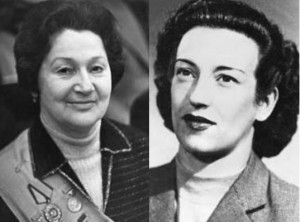
Jews of the Week: Keleti and Gorokhovskaya

Gorokhovskaya and Keleti

Agnes Keleti (b. 1921) was born in Budapest and was Hungary’s national gymnastics champion by age 16. Shortly after, World War II began, forcing Keleti to go into hiding. Much of her family, including her father, were killed in the Holocaust. Keleti survived by posing as a Christian villager. After the war, she began training once more, but had to overcome injuries that prevented her from competing. Determined to go on, she qualified for the 1952 Helsinki Olympics, and won 4 medals, including a gold. Keleti returned to the Olympics in 1956, winning 6 more medals, 3 of which were gold. Being 35 years old at the time made her the oldest-ever gold medal winner in her sport. Her ten total medals makes her among the most decorated female athletes of all time. She also won at the 1954 World Championship. After the Soviet Union’s invasion of Hungary in 1956, Keleti immigrated to Israel, where she still lives today.

A very similar story is that of Maria Gorokhovskaya. Like Keleti, she was born in 1921 (in Ukraine) and took up gymnastics at a young age. After surviving the war, she also competed at the 1952 Helsinki Games, winning 2 golds and 5 silvers. Her 7 medals in one Olympiad is still a world record. Like Keleti, Gorokhovskaya won at the 1954 World Championships, too. With the collapse of the Soviet Union, she made aliyah to Israel in 1990. Both Keleti and Gorokhovskaya have been inducted in the Jewish Sports Hall of Fame. In addition, Keleti has been inducted to the Hungarian and Gymnastics Halls of Fame.

Words of the Week

Everything that is for the sake of God should be of the best and most beautiful… When one feeds the hungry, one should feed them of the best and sweetest of one’s table. When one clothes the naked, one should clothe them with the finest of one’s clothes.
– Maimonides
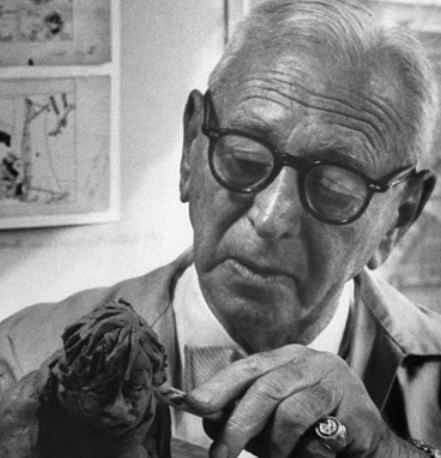
Jew of the Week: Rube Goldberg

Rube Goldberg Machine

Rube Goldberg

Reuben Garrett Lucius Goldberg (1883-1970) was born in San Francisco and began drawing at age 4. He was obsessed with the art, but discouraged by his parents who sent him to study engineering. After earning $100 per month designing sewer systems, Goldberg realized it wasn’t what he wanted to do in life, so he quit to pursue his dream. He earned $8 per week drawing for the San Francisco Chronicle, most of which was thrown out and never used. Mainly, his job was sweeping floors and filing morgue photos. But Goldberg persisted, and was soon discovered when editors found that issues with his drawings sold more copies. Shortly after, Goldberg became a household name with his nationally syndicated comics like Mike & Ike, Lala Palooza and Sideshow. He was now earning $100,000 per year! During World War II, Goldberg drew infamous and controversial political cartoons. Though such cartoons would later earn him the Pulitzer Prize, he was forced to change his children’s last names. Inspired by the tech boom, Goldberg started designing various contraptions and inventions. He realized that people always do things the hard way, and to spoof this, drew cartoons of incredibly complex machines performing the simplest tasks, “a symbol of man’s capacity for exerting maximum effort to achieve minimal results.” These beloved, world-famous contraptions would be known as ‘Rube Goldberg Machines’. Goldberg was also a sculptor, author and screenwriter, and the first cartoonist whose work was featured at the Smithsonian Institute. The international Reuben Award for best cartoonists is named after him.

Words of the Week

The price of apathy towards public affairs is to be ruled by evil men.
– Plato

Jew of the Week: Primo Levi

Chemist and World-Famous Author Primo Levi

Chemist and World-Famous Author Primo Levi

Primo Levi (1919-1987) was born in Turin, Italy. His brilliance was quickly noted even as a child, allowing him to start school a year early. After learning at both secular and religious schools in his youth, as an adult he decided to study chemistry. Despite the open anti-Semitism of the university system, Levi fought through it and graduated with honours. Being a Jew barred him from most jobs. However, a mining company that was aware of his intelligence and expertise offered him a position under a false name and false papers. He later found work for a Swiss company looking to extract anti-diabetic components from vegetables. As World War II worsened, Levi joined an Italian resistance movement. Untrained, he was quickly captured and arrested, sent to the Fossoli internment camp, and later to Auschwitz where he spent nearly a year until it was liberated by the Soviets. It didn’t get any easier at this point. To get back home to Turin he had to travel across Belarus, Hungary, Romania, Ukraine, Austria, and Germany (a story which has been adapted to film). After the war, Levi started a chemical company with a friend, synthesizing various industrial compounds like stannous chloride (for use in mirrors) and a variety of synthetic dyes. Meanwhile, he began writing about his roller coaster life experiences. He would go on to write two famous memoirs, one of which was voted the best science book ever written by London’s Royal Institution. Levi also penned many poems, essays and short stories – two of which have been adapted to film – and published two well-known novels. Often quoted, he once wrote: “The aims of life are the best defense against death.”

Words of the Week

If words are the pen of the heart, song is the pen of the soul.
– Rabbi Schneur Zalman of Liadi