Tag Archives: World War II

Jew of the Week: Morris Cohen

China’s “Uncrowned Jewish King”
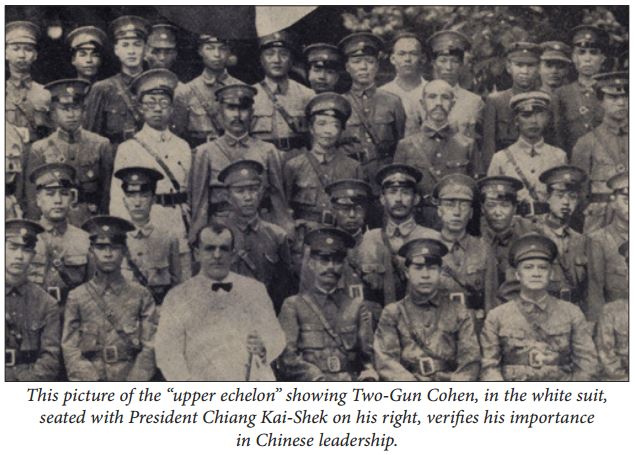
Morris Cohen sitting next to Chinese President Chiang Kai-Shek (Credit: Joe King)

(Credit: Joe King)

Moshe Morris Abraham Cohen (1887-1970) was born in Poland to a poor Orthodox Jewish family. While he was still an infant, his family fled the pogroms and settled in London, England. Growing up, Cohen often got in trouble so his parents sent him to work on a farm in Saskatchewan, Canada, hoping to mend his ways. There, he learned the value of hard work, in addition to playing cards and shooting guns. He became good friends with Chinese railroad workers, and even defended a Chinese man who was being robbed – a big deal at a time when white people rarely stood up for the Chinese in those days. Cohen’s friends invited him to join the revolutionary party of Dr. Sun Yat-sen, who would become modern China’s founding father and first president. Cohen agreed to train Chinese-Canadians in military combat and helped secure weapons for China’s revolutionary army. Meanwhile, he settled in Edmonton and became a successful real estate broker. Cohen was soon appointed as the province of Alberta’s Commissioner of Oaths. With the outbreak of World War I, he fought valiantly with the Canadian Railway Troops. Finding it hard to make a living in Canada after the war, he moved to China. Cohen was hired by Sun Yat-sen to train his forces, procure arms, and serve as his personal bodyguard. After once taking a bullet while protecting Sun Yat-sen in an assassination attempt, he started carrying two guns, and henceforth was known as “Two-Gun Cohen”, though the Chinese called him Ma Kun, “Clenched Fist”. Following Sun Yat-sen’s death, Cohen continued working for China as a military commander and head of their secret service. During World War II, it was Cohen that proved the Japanese were using poison gas against Chinese civilians. Cohen was captured in battle by Japanese soldiers. He was nearly beaten to death before being freed in a prisoner exchange. Cohen then returned to Canada, settled in Montreal, and finally married. He spent the rest of his life in relative quiet, working as a consultant in various capacities, and often traveling to China. (He had the distinction of being the only person allowed to travel freely between China and Taiwan – as he was friendly with leaders of both nations, despite their antagonism towards each other.) Perhaps his last great act was convincing the Taiwanese not to oppose the UN Partition Plan that gave birth to the State of Israel. Taiwan’s position on the UN Security Council made their vote critical, and they intended to oppose the plan until Cohen stepped in. He also helped to arm the nascent State of Israel in its War of Independence. Cohen’s life inspired two books, as well as the 1936 film The General Died at Dawn, and the 1984 film The Gunrunner, starring Kevin Costner. As a major general in China’s revolutionary army (to this day, the only Westerner to hold such a high rank in the Chinese military), one-time head of China’s secret service, and Sun Yat-sen’s personal aide, Cohen played an instrumental role in the founding of modern China. He was once described as China’s “uncrowned Jewish king”.

Yom Kippur Begins Tonight! Gmar Chatima Tova!

Words of the Week

All lovers of democracy cannot help but support… the movement to restore your wonderful and historic nation which has contributed so much to the civilization of the world and which rightly deserves an honourable place in the family of nations.
Dr. Sun Yat-sen, on his support for the Zionist movement

Jew of the Week: Tribich Lincoln

The Unbelievable Story of a Jew Who Almost Became the Dalai Lama

Lincoln as "Chao Kung"

Lincoln as “Chao Kung”

Trebitsch Ignácz (1879-1943) was born in the shtetl of Paks, in Hungary. The family moved to Budapest when he was a child, and after finishing school, he enrolled in an acting academy. By this point, Ignácz had left his Orthodox Jewish roots, and would often get in trouble with the police. At 18, he ventured to London and made friends with Christian missionaries. Ignácz converted two years later and was off to a seminary in Germany where he became a reverend. He was sent on missionary duty to Montreal, but didn’t last very long there, and returned to England. He changed his name to Ignatius Timothy Tribich Lincoln, or I.T.T. Lincoln, and got his British citizenship in 1909. He met the Archbishop of Canterbury (the head of the Church of England) who appointed Lincoln to be a parish priest in Kent. There, he met the millionaire politician Seebohm Rowntree, who made Lincoln his personal secretary. Somehow, Lincoln managed to get on a Liberal Party ticket and was elected to the British Parliament in 1910 in an upset victory over the favoured incumbent. However, MPs were not paid at the time, and Lincoln was soon bankrupt. He moved to Romania and started an oil business. When the business failed, he moved back to London and applied to become a British spy. The British rejected him, so he went to the Germans and was hired as a double agent. Lincoln traveled to the US, but then the Germans didn’t want him either, so he revealed his story to a magazine, and then had a book written about him. The book was popular enough that the British government was embarrassed by the whole thing, and had him extradited for fraud. Lincoln spent three years in prison. After this, he returned to Germany and rose through the ranks of various right-wing parties, at one point even meeting Hitler. Later on, he sold government secrets and was deported for treason. Lincoln now headed to China. After working for a number of Chinese warlords, Lincoln apparently had a revelation and converted to Buddhism. He became a monk and quickly rose to the high rank of abbot by 1931, at which point he founded his own Buddhist monastery under his new name, Chao Kung. In 1937, he became a spy for Japan, but at the same time seemed to assist Japan’s enemy, China. During World War II, Lincoln reconnected with the Nazis and offered to raise Buddhist support for them. When the 13th Dalai Lama passed away, Lincoln proclaimed himself the new Dalai Lama! Despite strong support from the Japanese, the Tibetans rejected his claim. Lincoln passed away in Shanghai not too long after. While some think he was a crazy adventurer who dangerously played both sides of every conflict to even the odds, others think he was a smooth-talking con artist who was simply exploring the limits of his acting abilities – and perhaps even surprised himself at how far he could go. It seems his only redeeming quality came at the end of his life: Lincoln protested the Holocaust and wrote a strongly-worded letter to Hitler to end the terror. Hitler requested that the Japanese have Lincoln poisoned, and this was likely the cause of his sudden death in 1943.

Words of the Week

People think of education as something they can finish.
– Isaac Asimov

Jews of the Week: Margaret and H.A. Rey

Curious George

Margaret and H.A. Rey

Margaret and H.A. Rey

Margarete Elisabethe Waldstein (1906-1996) was born in Hamburg, Germany, the daughter of a Jewish politician. She studied art and worked in advertising until 1935, when she fled Nazi Germany for Brazil. In Rio de Janeiro, she reconnected with an old family friend who had also moved to Brazil. Hans Augusto Reyersbach (1898-1977) was born in Hamburg, too, and now working as a salesman in Rio. The two got married that same year, and resettled in Paris. Reyersbach started drawing a series of animal cartoons and was soon commissioned to write a children’s book by a French publisher. Cecily G. and the Nine Monkeys, a story about a giraffe and her monkey friends, was published in 1939 under the pen name H.A. Rey. The story became popular very quickly. Particularly beloved was one of the monkey characters in the book, originally named Fifi, and commonly translated to other languages as George. The following year, Rey started working on a new manuscript featuring the curious monkey. By this point, World War II had started, and the Nazis were approaching Paris. Hans and Margaret fled the city on a pair of bicycles. The manuscript was one of the few things they took with them. The couple arrived in Spain, then Portugal, then headed back to Brazil, and finally settled in New York. Curious George was published in 1941, and like its predecessor, was very popular. Hans and Margaret went on to produce seven Curious George books together. Hans wrote and illustrated many more children’s books before passing away in 1977. Two years later, Margaret became a professor of creative writing at Brandeis University. Meanwhile, she worked on a second series of Curious George books, as well as a number of short TV films based on the stories. In 1989, she established the Curious George Foundation with two goals: to promote creative writing among children, and to prevent cruelty to animals. When she passed away in 1996, Margaret left major donations for the Boston Public Library, the Beth Israel Deaconess Medical Center, and donated the family’s entire literary estate. Curious George continues to be among the most popular children’s books all over the world. A third series of Curious George stories have been produced in recent years, as well as a TV series which airs on PBS. In 2006, an animated film starring Will Ferrell and Drew Barrymore was released. Two sequels and a video game have been produced since then. Today, there is an official children’s bookstore in Cambridge, Massachusetts called The World’s Only Curious George Store. There is also a Curious George Live national tour, and a popular Curious George-themed water park at Universal Studios in Florida.

Words of the Week

One should always see to it that tomorrow should be much better than today.
– Rabbi Yosef Yitzchak of Lubavitch